
In This Article
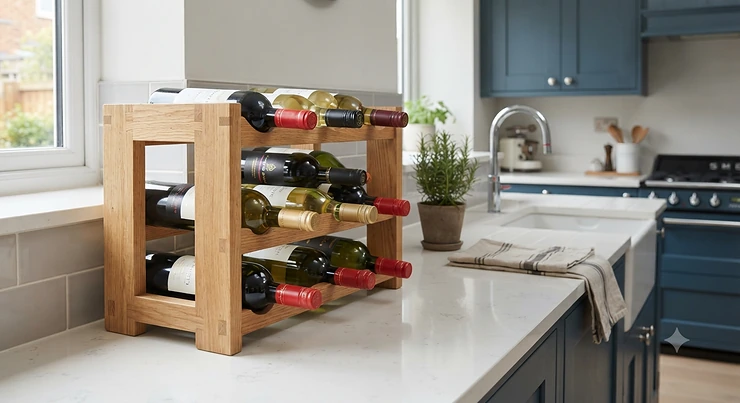
There’s a particular kind of kitchen chaos that only wine bottles seem to cause. They roll. They hog cupboard space meant for saucepans. They end up wedged sideways behind the cereal, and you only remember they exist when one clinks ominously as you reach for the porridge oats. A wooden countertop wine rack solves this in the most understated way possible: no drilling, no rewiring your cabinets, just a self-contained little piece of furniture that sits on your worktop and does its job quietly.
So, what is a wooden countertop wine rack? It’s a freestanding storage unit, typically holding 6 to 30 bottles, built from timber such as pine, oak, acacia or reclaimed wood, designed to keep bottles horizontal on a kitchen worktop, sideboard or cupboard top without permanent fixing. That horizontal position matters more than most people realise — it keeps the cork in contact with the wine, which in turn keeps the cork swollen and airtight. Wine experts have long debated the exact humidity figures, but the underlying logic behind storing wine on its side is well established and applies just as much to a six-bottle countertop rack as it does to a proper cellar.
This guide covers seven real, currently available wooden countertop wine rack options for UK buyers — from £20 starter units to premium ready-assembled pieces — plus honest analysis of what the spec sheets don’t tell you, and where a rustic wooden wine rack countertop actually earns its keep versus where it’s just a pretty face. We’ll also dig into oak wine rack options specifically, talk through reclaimed wood as a material, and look at how these pieces fit into farmhouse kitchen décor and broader kitchen aesthetics. No fluff, no fabricated reviews — just genuine product research and buyer-focused reasoning.
Quick Comparison Table
Before the deep dive, here’s a snapshot of how five of our seven picks stack up on the essentials.
| Product | Material | Capacity | Price Range | Best For |
|---|---|---|---|---|
| HOMCOM 4-Tier Wooden Wine Rack Board | Solid wood | Up to 24 bottles (stacked) | Under £30 per tier | Growing collections on a budget |
| TRUDING Countertop Wine Rack | Wood | 6 bottles | Under £25 | Tiny kitchens, first-time buyers |
| Dripex Bamboo Wine Rack | Bamboo | 12 bottles | £30-£40 range | Eco-conscious, farmhouse-adjacent style |
| vidaXL Solid Oak Wood Wine Rack | Solid oak | 12 bottles | £90-£110 range | Buyers who want oak specifically |
| Cranville Classic Cupboard-top Wine Rack | Walnut-stained pine + galvanised metal | 20-30 bottles | £100-£140 range | Serious collections, ready-assembled |
Looking at this table, the spread between TRUDING‘s six-bottle budget entry and Cranville‘s ready-assembled 20-30 bottle unit tells you most of what you need to know about this category: capacity and material quality scale together, but so does price. The vidaXL Solid Oak Wood Wine Rack sits in an interesting middle position — you’re paying a premium over pine or bamboo specifically for oak’s density and longevity, not for extra bottle slots. If you’re only after a small, low-commitment rack, Dripex and HOMCOM both undercut the oak and walnut options by £60 or more while still using genuine wood or bamboo.
💬 Ready to see all seven in full? Keep scrolling — and bookmark this page before you head off to check prices. 🛒
Top 7 Wooden Countertop Wine Racks: Expert Analysis
We researched real, currently listed products across amazon.co.uk and vidaXL.co.uk to put together this line-up, covering budget, mid-range and premium tiers, plus a dedicated oak wine rack pick and a bamboo option for anyone drawn to natural finishes over classic hardwood.
1. HOMCOM 4-Tier Wooden Wine Rack Board — best for stacking as your collection grows
The clever bit about the HOMCOM 4-Tier Wooden Wine Rack Board is right there in the name: it’s sold as a single stackable board, so you buy one, then add more as your wine habit expands, rather than committing to a fixed 24-bottle unit from day one. Each board is a solid wood tier designed to interlock with the next, available in natural wood or painted white finishes, and it works equally well as a countertop piece or stacked into a small floor-standing tower once you’ve bought a few. Practically speaking, this suits renters and first flat-owners who don’t want to overcommit to furniture before they know how much wine they’ll actually be storing. Based on the listing’s review pattern, buyers consistently mention how well the natural wood tone suits cream and white kitchens, alongside a smaller number of comments about needing to steady taller stacks on uneven worktops. That instability is the trade-off for modularity — a single tier on a flat counter is rock solid, but four stacked units on anything less than dead-level granite can wobble. Pros outweigh cons for anyone building a collection gradually rather than buying for a fixed space.
Pros:
- ✅ Modular design lets you expand capacity over time
- ✅ Solid wood construction feels sturdier than the price suggests
- ✅ Works as countertop unit or stacked floor tower
Cons:
- ❌ Full 24-bottle capacity requires buying multiple boards separately
- ❌ Taller stacks can wobble on uneven counter surfaces
At under £30 per tier, this is one of the most flexible entry points on the list — genuinely good value if you buy one board to start and top up later rather than needing the full stack immediately.
2. KIRIGEN Wooden 8-Bottle Wine Rack — best compact 3-tier for narrow counters
The KIRIGEN Wooden 8-Bottle Wine Rack is built as a genuine 3-tier freestanding unit, and its natural, unstained finish is one of the more neutral options here — it won’t clash with oak cabinetry, painted units, or stainless steel worktops. Structurally, the design pairs slatted wood shelving with a compact footprint, which matters more than it sounds: an 8-bottle rack that’s still deep and wide enough to dominate a narrow galley kitchen counter isn’t actually saving you space. What most buyers overlook when comparing racks by bottle count alone is footprint-to-capacity ratio, and this is where KIRIGEN does reasonably well, packing 8 bottles into a narrower base than several rivals of the same capacity. It’s aimed squarely at people with a modest, regularly-rotated wine selection rather than long-term collectors. Aggregated feedback on similar 3-tier wooden racks in this bracket tends to flag the thinner wood strips as the main weak point — fine for standard 750ml bottles, less so if you’re routinely storing heavier bottles like Champagne or fortified wine.
Pros:
- ✅ Compact 3-tier footprint suits narrow kitchen counters
- ✅ Neutral natural finish matches most existing kitchen colour schemes
- ✅ Freestanding design needs no wall fixing or floor space
Cons:
- ❌ 8-bottle capacity limits it to casual, rotating collections
- ❌ Thinner shelf strips can flex under consistently heavier bottles
Priced around £25-£35, it’s a sensible middle ground between the ultra-budget six-bottle options and the larger stackable systems, without asking you to commit to a big footprint.
3. TRUDING Countertop Wine Rack — smallest footprint for genuinely tiny kitchens
If your kitchen counter space is measured in inches rather than feet, the TRUDING Countertop Wine Rack is built for exactly that problem. Holding six bottles in a simple wooden freestanding frame, it’s the smallest capacity on this list, and that’s deliberate — this isn’t a rack for a collection, it’s a rack for the two or three bottles most households actually have open or on rotation at any given time. The honest analytical take here is that six bottles sounds modest until you consider how often larger racks sit half-empty; matching capacity to genuine use is usually smarter than buying for aspirational capacity you’ll rarely fill. Reviewers on comparable small wooden countertop units in this price bracket frequently mention how little assembly is required — often just slotting pre-cut wood pieces together — which suits anyone who wants function over ceremony. The obvious limitation is that you’ll outgrow it quickly if you start buying wine by the case rather than the bottle, and the finish options are more limited than pricier ranges.
Pros:
- ✅ Smallest footprint on this list, ideal for tight counters
- ✅ Minimal assembly required out of the box
- ✅ Genuinely affordable entry point into wooden wine storage
Cons:
- ❌ Six-bottle capacity suits casual use only, not collecting
- ❌ Fewer finish and style variations than larger ranges
At under £25, this is about as low-risk a way as any to trial having a dedicated rack before upgrading to something bigger later.
4. Dripex Bamboo Wine Rack — best budget pick for a natural, farmhouse-adjacent look
The Dripex Bamboo Wine Rack swaps hardwood for bamboo, and that material choice is genuinely worth understanding rather than dismissing as a cheaper substitute. Bamboo is technically a grass, not a tree, which means it regenerates far faster than oak or pine, making it one of the more sustainable natural-material options in this category. The rack itself is a 3-tier design holding 12 bottles, with the three-shelf spread doing a decent job of distributing weight so the whole unit stays stable even when fully loaded — something single-tier budget racks sometimes struggle with. On paper this means you get a reasonably generous capacity, a light, pale wood tone that suits a rustic wooden wine rack countertop aesthetic, and a genuinely lower price than most hardwood equivalents of similar size. Reviewers on comparable bamboo kitchen racks tend to note that the light finish scuffs and shows marks more readily than denser hardwoods like oak, which is the trade-off for bamboo’s lighter weight and lower cost. For anyone chasing natural finishes without hardwood pricing, it’s a genuinely reasonable compromise rather than a lesser one.
Pros:
- ✅ Sustainably fast-growing bamboo material
- ✅ 3-tier design spreads weight for better stability
- ✅ Lightweight enough to reposition without effort
Cons:
- ❌ Bamboo shows scuffs and marks more readily than hardwood
- ❌ Pale finish can look more utilitarian than classic rustic wood
In the £30-£40 range, it undercuts most solid hardwood 12-bottle racks by a noticeable margin, making it the value pick for anyone prioritising natural material over maximum durability.
5. vidaXL Wine Rack 13 Bottles Solid Acacia Wood — best mid-range natural finish
Acacia sits in an interesting spot between budget pine and premium oak, and the vidaXL Wine Rack 13 Bottles Solid Acacia Wood shows why it’s become such a popular mid-tier choice. The four-level design holds bottles horizontally across a genuinely useful 13-bottle capacity, and the wood carries an oil finish rather than a lacquer or paint, which means it’s built to develop a bit of natural character over time rather than staying showroom-shiny. What the spec sheet won’t tell you, but is worth weighing anyway, is that acacia’s grain pattern is bolder and more varied than oak’s, so it reads as more rustic and less uniform — a genuine advantage if you want visual texture on the counter, a minor drawback if you’re after a cleaner, more minimalist look. The oil finish also means it’s sturdy and reasonably weather-resistant, which matters if your kitchen counter sits anywhere near a window or gets warm from a nearby hob. Feedback on vidaXL’s acacia wine storage range generally centres on straightforward assembly and a finish that holds up well daily, with the main criticism being that acacia’s heavier grain simply isn’t to everyone’s taste.
Pros:
- ✅ Oil-finished solid acacia resists everyday knocks
- ✅ Four-level design keeps all 13 bottles properly horizontal
- ✅ Bold grain pattern adds genuine rustic character
Cons:
- ❌ Heavy grain pattern may clash with minimalist kitchen aesthetics
- ❌ Requires straightforward flat-pack style assembly
Sitting in the £85-£100 range, it’s a meaningful step up from the bamboo and budget pine options, and arguably the best all-rounder here if you want genuine hardwood without stretching to oak pricing.
6. vidaXL Solid Oak Wood Wine Rack — the dedicated oak wine rack pick
For anyone specifically searching for an oak wine rack rather than “any wooden wine rack,” the vidaXL Solid Oak Wood Wine Rack is the clearest match on this list. Oak has been a UK furniture staple for centuries for good reason: it’s denser and harder-wearing than pine, acacia or bamboo, meaning it resists dents and shifts less over years of use, which matters for a piece that’s going to carry the weight of a dozen glass bottles indefinitely. Holding 12 bottles with a natural, unstained finish, it leans into the timber’s grain rather than covering it up, which suits farmhouse kitchen décor and traditional interiors particularly well. Based on the spec comparison with the acacia model above, the trade-off is straightforward: oak costs more per bottle of capacity because you’re paying for density and longevity rather than extra storage. Reviewers of oak home storage pieces in this bracket tend to highlight how the wood ages well rather than looking tired after a year or two, though a handful note that a fully-loaded oak rack is noticeably heavier to shift around than lighter alternatives once it’s full.
Pros:
- ✅ Solid oak offers genuinely superior long-term durability
- ✅ Natural finish showcases oak’s grain for a traditional look
- ✅ Sturdy build handles a full 12-bottle load without sagging
Cons:
- ❌ Premium density means a higher price than pine or acacia equivalents
- ❌ Heavier to reposition once fully loaded with bottles
At around £90-£110, it’s priced closely to the acacia option, so the deciding factor really comes down to aesthetic preference between oak’s tighter, paler grain and acacia’s bolder, darker one.
7. Cranville Classic Cupboard-top Walnut Stained Wood and Galvanised Metal Wine Rack — the premium ready-assembled pick
Cranville wine racks is a UK wine storage specialist rather than a generic import brand, and their Classic Cupboard-top range, built from Grade A Scandinavian pine with a walnut stain and paired with galvanised metal supports, is the most premium entry here. The standout feature is that it arrives ready assembled — genuinely useful if flat-pack furniture isn’t your idea of a relaxing weekend — and it’s designed to scale from around 20 up to 30 bottles depending on the exact configuration you choose. The combination of wood and galvanised metal isn’t just aesthetic; the metal cross-supports add rigidity that pure wood racks of similar capacity can lack once fully loaded, reducing the flex and sag that shows up in cheaper large-capacity units after a year or two of daily use. Here’s what to weigh against that convenience: this is a noticeably bigger footprint than anything else on this list, so it needs a proper cupboard top, sideboard or dedicated counter run rather than a spare corner. Cranville’s own product line notes that ideal storage conditions sit around 50-80% humidity to keep corks moist without risking mould, a detail worth bearing in mind wherever you place it.
Pros:
- ✅ Arrives ready assembled — no flat-pack construction required
- ✅ Wood and galvanised metal combination adds long-term rigidity
- ✅ Scalable 20-30 bottle capacity suits serious collections
Cons:
- ❌ Premium price reflects the ready-built convenience
- ❌ Larger footprint needs generous cupboard-top or counter space
In the £100-£140 range, this sits at the top of our list, but for anyone with a genuinely growing collection and no appetite for self-assembly, it’s the most complete solution here.
Top 7 Products: Full Comparison
| Product | Material | Capacity | Price Range | Assembly | Best For |
|---|---|---|---|---|---|
| HOMCOM 4-Tier Wooden Wine Rack Board | Solid wood | Up to 24 (stacked) | Under £30/tier | Slot-together | Gradual collection building |
| KIRIGEN Wooden 8-Bottle Wine Rack | Wood | 8 bottles | £25-£35 range | Minor assembly | Narrow counters |
| TRUDING Countertop Wine Rack | Wood | 6 bottles | Under £25 | Minimal | Tiny kitchens |
| Dripex Bamboo Wine Rack | Bamboo | 12 bottles | £30-£40 range | Simple | Budget natural finish |
| vidaXL Solid Acacia Wine Rack | Solid acacia | 13 bottles | £85-£100 range | Flat-pack style | Mid-range hardwood |
| vidaXL Solid Oak Wine Rack | Solid oak | 12 bottles | £90-£110 range | Flat-pack style | Dedicated oak pick |
| Cranville Classic Cupboard-top Rack | Walnut-stained pine + galvanised metal | 20-30 bottles | £100-£140 range | Ready assembled | Serious collectors |
Read across this table and a clear pattern emerges: price climbs in step with both material density and assembly convenience, not just bottle count. The TRUDING Countertop Wine Rack and Cranville Classic Cupboard-top Rack sit at opposite ends of almost every column, which makes sense given they’re solving different problems — one is a low-commitment starter piece, the other a furniture-grade storage solution. Notably, the two oak-and-acacia hardwood options from vidaXL cluster tightly together on price despite being genuinely different materials, so that decision comes down to grain preference rather than budget.
✨ Don’t Miss These Exclusive Deals!
🔍 Take your kitchen wine storage up a notch with these hand-picked wooden racks. Click through on any highlighted product to check current pricing and availability before stock runs low!
Setting Up and Caring for Your Wooden Countertop Wine Rack
Getting a wooden countertop wine rack right isn’t just about the initial purchase — a few small habits in the first month make a genuine difference to how long it lasts and how good it looks. Start by placing it away from direct sunlight and away from the hob or oven; UV exposure fades natural finishes unevenly, while heat fluctuations near cooking appliances can dry out and crack timber over time, particularly on lighter woods like bamboo and pine. If your model needs assembly, resist the urge to force ill-fitting joints — most flat-pack wooden racks use friction-fit slots that only align correctly one way, and forcing them is the single most common cause of hairline cracks reported in early reviews.
Once it’s up, load bottles from the bottom tier upward to keep the centre of gravity low, especially on stacked or multi-tier designs like the HOMCOM 4-Tier Wooden Wine Rack Board. For ongoing maintenance, a lightly damp cloth followed by a dry one is usually enough; avoid soaking wood or using harsh chemical cleaners, which can strip oil finishes on pieces like the vidaXL Wine Rack 13 Bottles Solid Acacia Wood. Re-oiling unstained wood once or twice a year keeps the natural finish looking fresh rather than tired, and it’s a five-minute job with basic furniture oil. Common first-30-days mistakes include overloading a single tier before distributing weight across the whole unit, and skipping a level check on the counter — even a slight tilt compounds badly once six or more bottles are loaded.
Which Wooden Wine Rack Suits Your Kitchen? Real-Life Scenarios
If you’re a young professional in a one-bedroom flat with two or three bottles usually open at once, something like the TRUDING Countertop Wine Rack or KIRIGEN Wooden 8-Bottle Wine Rack makes far more sense than a 24-bottle system — you’d be storing fresh air in most of the slots, and smaller units simply fit better in a compact galley kitchen. If you’re renovating a farmhouse-style kitchen and building your collection gradually as budget allows, the HOMCOM 4-Tier Wooden Wine Rack Board‘s modular approach lets you start small and stack additional tiers as your wine habit and your budget both grow, without needing to replace anything.
For a family that entertains regularly, hosting dinner parties every few weeks and keeping a rotating stock of eight to fifteen bottles for different occasions, the vidaXL Solid Oak Wood Wine Rack or the vidaXL Wine Rack 13 Bottles Solid Acacia Wood strike the right balance of visible display, genuine hardwood durability, and a capacity that matches real entertaining patterns rather than aspirational hoarding. And if you’re a genuine collector — the kind of household with a case or two on rotation and a proper interest in cellaring — the Cranville Classic Cupboard-top Wine Rack‘s scalable 20-30 bottle range and reinforced metal-and-wood build is worth the higher outlay, because cheaper large-capacity racks tend to sag and flex well before they’ve paid for themselves.
Common Wine Storage Problems, Solved
Problem: Bottles keep rolling off a flat shelf. A dedicated countertop wine rack with individually shaped bottle slots, like the KIRIGEN Wooden 8-Bottle Wine Rack, solves this immediately by cradling each bottle rather than relying on friction against a flat surface.
Problem: Limited counter space but a growing collection. This is precisely the scenario the HOMCOM 4-Tier Wooden Wine Rack Board‘s stacking system addresses — vertical growth instead of horizontal footprint.
Problem: Corks drying out between uses. Horizontal wooden racks keep the cork in contact with the wine by design, which is a meaningfully better default than standing bottles upright in a cupboard, where the cork can dry and shrink over months of storage.
Problem: A rack that looks out of place against the rest of the kitchen. Matching material to your existing units solves most of this — reclaimed wood and acacia suit farmhouse and rustic schemes, while a cleaner oak or walnut-stained piece like the Cranville Classic Cupboard-top Wine Rack sits more comfortably in traditional or Shaker-style kitchens.
Problem: A budget rack that wobbles once loaded. This usually comes down to either an uneven counter or a single-tier design carrying too much weight — switching to a wider-based, multi-tier unit such as the Dripex Bamboo Wine Rack generally resolves it.
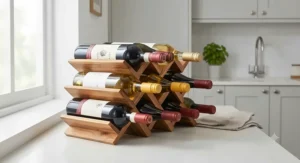
How to Choose a Wooden Countertop Wine Rack
- Start with real capacity, not aspirational capacity. Count how many bottles you genuinely have open or in rotation at once, then buy for that number plus a small buffer, rather than the biggest rack that fits your budget.
- Match the wood to your kitchen’s existing tone. Pale oak and bamboo brighten darker kitchens; richer walnut-stained pine and acacia add warmth to white or cream schemes.
- Check the footprint against your actual counter space, not just the bottle count — two racks holding 12 bottles can have very different base dimensions.
- Weigh assembly against convenience. Ready-assembled options like the Cranville Classic Cupboard-top Wine Rack cost more but save genuine time and hassle.
- Consider whether you want horizontal-only storage (better for cork preservation) or a mixed design with an upright section for bottles you’ll use imminently.
- Factor in stability once fully loaded, not just when empty — read for mentions of wobble or flex under a full load before buying.
- Decide on finish maintenance you’re actually willing to do. Oiled finishes like acacia need occasional reapplication; lacquered or painted finishes need less upkeep but show chips more visibly.
Common Mistakes When Buying a Wooden Wine Rack
The single most common mistake is buying on bottle count alone without checking the footprint — a rack advertised as holding “12 bottles” can vary in base size by 30% or more between brands, and that difference matters enormously on a standard UK kitchen worktop. A close second is ignoring weight capacity per tier; budget racks with thin wood strips, as noted with the KIRIGEN Wooden 8-Bottle Wine Rack, can flex under a full load of heavier bottles like Champagne or fortified wines, even if they handle standard 750ml bottles fine.
Buyers also frequently underestimate how much a fully-loaded wooden rack weighs once assembled — a 20-30 bottle unit like the Cranville Classic Cupboard-top Wine Rack can weigh well over 20kg loaded, which matters if you’re placing it on an unsupported shelf rather than a solid worktop or cupboard top. Finally, many people choose a finish based purely on the product photo rather than considering how it’ll wear — pale, unstained woods show scuffs and stains more visibly over time than darker stains, something worth factoring in if the rack will see daily handling.
Wooden Wine Rack vs Metal Wine Rack: Which Wins?
| Factor | Wooden Countertop Rack | Metal Wine Rack |
|---|---|---|
| Aesthetic fit | Warm, blends with wood cabinetry and farmhouse kitchen décor | Cooler, suits industrial or modern minimalist kitchens |
| Weight capacity | Generally strong but varies by wood density | Often higher for equivalent footprint |
| Maintenance | Occasional oiling/dusting depending on finish | Wipe-clean, largely maintenance-free |
| Typical price | Wide range, £20-£140+ | Often cheaper at entry level |
| Longevity | Excellent with hardwoods like oak; average with softwoods | Excellent, but can show rust in humid kitchens |
Written out, the comparison isn’t really about which material is objectively better — it’s about which fits your kitchen’s existing character. A wooden countertop wine rack, particularly in oak, acacia or reclaimed wood, adds warmth and texture that metal simply doesn’t replicate, which is why it dominates farmhouse and traditional kitchen styling. Metal racks win on raw weight capacity per pound spent and near-zero maintenance, but in a humid kitchen environment near a sink or hob, wood doesn’t carry the same rust risk that untreated or lower-grade metal can develop over years of use.
Oak Wine Rack vs Reclaimed Wood Wine Rack: Which Material Wins?
An oak wine rack and a reclaimed wood option solve a similar aesthetic goal — natural, characterful timber storage — but they arrive at it very differently. Oak, as seen in the vidaXL Solid Oak Wood Wine Rack, is a single, dense hardwood species prized for consistency: predictable grain, reliable strength, and a long track record as UK furniture timber. Reclaimed wood, by contrast, is typically salvaged from old barrels, pallets, barns or structural timber, meaning no two pieces are identical — you’re buying character and sustainability credentials rather than material uniformity. This is precisely why a rustic wooden wine rack countertop built from reclaimed timber tends to carry more visible knots, colour variation and tool marks than a factory-milled oak equivalent.
From a sustainability standpoint, reclaimed wood generally has a smaller environmental footprint since it reuses existing material rather than requiring fresh timber harvesting, while responsibly sourced oak backed by schemes such as FSC certification for furniture offers a verifiable, traceable alternative if reclaimed options aren’t available. Practically speaking, oak wins on predictable strength and a cleaner, more uniform look that suits both traditional and contemporary kitchens; reclaimed wood wins on individuality, sustainability appeal, and price, since salvaged material is often less expensive than premium milled hardwood of equivalent size.
Wooden Countertop Wine Racks for Farmhouse Kitchen Décor
Farmhouse kitchen décor leans heavily on natural materials, visible wood grain, and a slightly imperfect, lived-in feel rather than glossy uniformity — which makes a wooden countertop wine rack one of the easiest single pieces to introduce that character without a full renovation. Reclaimed wood and acacia pieces, like the vidaXL Wine Rack 13 Bottles Solid Acacia Wood, do particularly heavy lifting here thanks to their bold, varied grain, while a walnut-stained piece such as the Cranville Classic Cupboard-top Wine Rack adds the kind of warm, slightly rustic tone associated with classic English farmhouse styling rather than the starker, more manufactured look of modern farmhouse trends.
Pairing your rack with open shelving, exposed wooden beams or a butcher-block countertop reinforces the theme without it feeling like a single mismatched accessory. If you’re working with painted or Shaker-style cabinetry rather than exposed wood units, a lighter natural or bamboo finish, such as the Dripex Bamboo Wine Rack, tends to blend more naturally than a heavily stained option, keeping the overall palette from feeling too dark or heavy in a smaller kitchen.
Natural Finishes and Kitchen Aesthetics: Choosing a Look That Lasts
Natural finishes — unstained or lightly oiled wood that shows the timber’s genuine grain — have become the default choice across most of this list, and it’s not purely an aesthetic trend. An unstained finish ages more gracefully than paint or heavy lacquer, developing a slightly deeper tone over years rather than chipping or peeling visibly, which matters for kitchen aesthetics in a space that sees daily wear. The trade-off is that natural finishes need more attentive care, particularly oiled woods like acacia, which benefit from reapplication every year or so to stay resistant to knocks and moisture.
When weighing kitchen aesthetics more broadly, think about contrast rather than matching everything exactly. A pale oak or bamboo rack against dark cabinetry creates a deliberate focal point, while a walnut-stained piece against lighter units adds warmth without overwhelming the room. The mistake most buyers make is choosing a finish purely because it matches their current cabinet colour, rather than considering how the two tones will interact and age together over the next several years — cabinetry finishes and countertop wood finishes rarely wear at exactly the same rate.
Features That Actually Matter (And Those That Don’t)
What actually matters: tier stability under full load, bottle slot depth (shallow slots let bottles slide forward over time), and genuine wood thickness rather than veneer over composite board. What doesn’t matter nearly as much as marketing suggests: exact bottle capacity numbers down to the last slot, since most households never fill a rack completely, and elaborate “designer” shapes that sacrifice practical stability for visual novelty.
| Price Tier | Typical Range | Value Verdict |
|---|---|---|
| Budget (TRUDING, KIRIGEN, HOMCOM) | Under £35 | Best for casual, low-commitment storage |
| Mid-range (Dripex, vidaXL Acacia) | £30-£100 | Best balance of material quality and price |
| Premium (vidaXL Oak, Cranville) | £90-£140+ | Best for durability and serious collections |
Reading this table alongside the feature list above, the clearest pattern is that spending more buys you structural durability and finish longevity far more reliably than it buys you extra genuinely useful capacity. A £25 rack and a £120 rack might both hold roughly a dozen bottles, but the difference shows up in how each performs after two or three years of daily use, not in the box on day one.
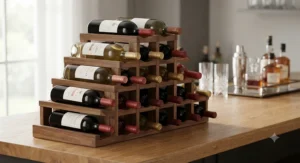
FAQ
❓ What is the best wood for a countertop wine rack?
❓ How many bottles should a countertop wine rack hold?
❓ Is a wooden wine rack better than a metal one?
❓ Do wooden wine racks need any special care?
❓ How much does a decent wooden countertop wine rack cost?
Conclusion
A wooden countertop wine rack is one of those small kitchen purchases that quietly earns its keep — it solves the rolling-bottle problem, keeps corks properly moist, and adds genuine warmth to a kitchen without any building work. Across the seven options here, there’s a clear route through the category: start small and modular with the HOMCOM 4-Tier Wooden Wine Rack Board or minimal with the TRUDING Countertop Wine Rack if you’re testing the waters, step up to genuine hardwood with the vidaXL Solid Oak Wood Wine Rack or vidaXL Wine Rack 13 Bottles Solid Acacia Wood once you know your style and needs, or go straight to the Cranville Classic Cupboard-top Wine Rack if you’re already committed to a proper collection and don’t want to assemble anything yourself.
Whichever you choose, keep it out of direct sun and heat, load it from the bottom up, and give oiled finishes a little annual attention. And if wine is a regular feature in your home, it’s worth keeping the UK’s low-risk drinking guidelines in mind alongside all this storage planning — good habits around what goes in the rack matter just as much as the rack itself.
Recommended for You
- Small Countertop Wine Rack for Kitchen: 7 Best Picks for 2026
- Countertop Wine Rack: 7 Best UK Picks & Buying Guide 2026
- Electric Wine Chiller Cooling Time: 7 Fastest Picks for 2026
Disclaimer: This article contains affiliate links. As an Amazon Associate, I earn from qualifying purchases. If you purchase products through these links, we may earn a small commission at no additional cost to you.
✨ Found this helpful? Share it with a fellow wine lover! 💬🍷
