
In This Article
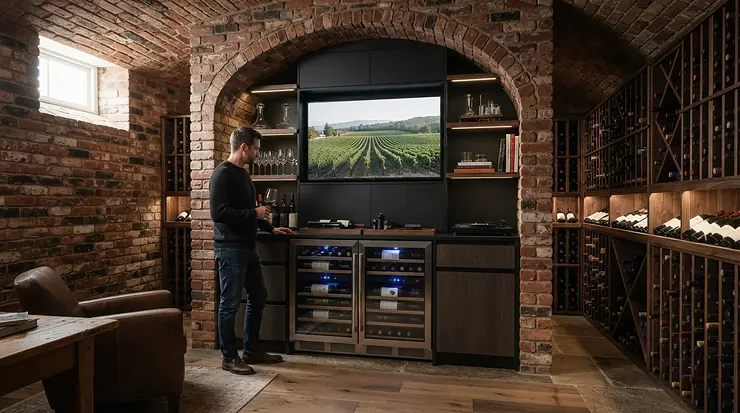
A split system wine cellar cooling unit is a two-piece refrigeration setup that separates the noisy, heat-generating condenser from the quiet evaporator inside your cellar, connected by refrigerant lines so the racket happens somewhere you’ll never hear it. That’s the whole trick, really — and it’s why serious collectors, and increasingly ordinary homeowners converting a cupboard under the stairs into something grander, keep circling back to this format rather than the humbler through-the-wall box.
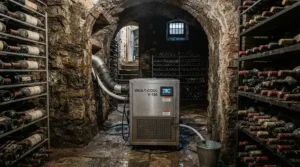
Here’s the thing nobody tells you at the start: buying one of these units is less like buying a fridge and more like specifying a small piece of industrial plant. There’s heat-load maths involved. There’s a refrigerant line-set with a maximum practical run length. There’s a genuine, non-negotiable requirement for a qualified engineer to touch the pipework, because these units use F-gas refrigerants and UK law is unambiguous about who’s allowed near them. None of that is meant to put you off — it’s meant to save you from the classic mistake of buying on room-area alone and ending up with a compressor that short-cycles itself into an early grave.
We’ve dug through real manufacturer spec sheets, aggregated genuine buyer and installer feedback from the trade, and cross-checked wine storage science against established reference sources and Decanter’s own advice columns, so what follows is grounded in real numbers rather than marketing gloss. Whether you’re chasing whisper-quiet running for a glass-walled display cellar, wrestling with a naturally humid basement, or planning a genuinely large cellar build that needs proper ducting, there’s a configuration below that fits. Let’s get into it.
Further background on cellar fundamentals is available on the Wikipedia entry for wine cellars, which is a useful primer before comparing hardware.
Quick Comparison Table
| Unit | Best For | Rated Capacity | Approx. Equipment Price |
|---|---|---|---|
| WhisperKOOL Platinum Split 4000 | Quietest wall-mounted option | Up to 1,000 cu. ft. | £5,500–£6,200 |
| CellarPro 4000S-EC | Best all-round value split | Up to 1,000 cu. ft. | £3,800–£4,300 |
| Breezaire WKSL 4000 | Budget entry point | Up to 1,000 cu. ft. | £2,900–£3,600 |
| Wine Guardian DS050 | Large or awkward-shaped cellars | 650–3,000 cu. ft. | £5,500–£9,000 |
| CellarCool WM Split 2500 | Compact cellars and wine closets | Up to 500 cu. ft. | £2,200–£2,900 |
| Friax Chill’loop H2OX | Humid climates & bespoke UK installs | Cellar-specific | £6,000–£12,000 installed |
| Panasonic-based bespoke split (Wine Racks UK) | Fully installed turnkey UK route | Cellar-specific | around £4,300–£4,800 installed |
A quick read of that table tells its own story: capacity and price track together roughly as you’d expect, but installation route matters just as much as the hardware. The two UK-sourced options at the bottom already fold in contractor labour and VAT, while the American brands above them are equipment-only figures from specialist suppliers, meaning freight, import handling and a qualified installer’s day rate still need adding on top. If you’re chasing the lowest all-in cost for a modest cellar, the Breezaire or CellarPro route wins; if you want one phone call and a finished job, the UK-installed options are worth the premium.
💬 Found a split system that fits your cellar? Bookmark this comparison and share it with anyone else planning a build!
Top 7 Split System Wine Cellar Cooling Units: Expert Analysis
1. WhisperKOOL Platinum Split 4000 — quietest wall-mounted split on the market
The Platinum Split 4000 is WhisperKOOL’s flagship wall-mounted unit, and the standout feature is genuinely how little you hear it. Specs first: it delivers roughly 3,650 BTU/h with 90°F air entering the condenser coil, covers up to 1,000 cubic feet of properly insulated cellar, and the evaporator runs at around 54 decibels — condenser side at 65 decibels, safely banished outdoors or into a plant room.
In practice, that BTU figure translates to a cellar that holds a rock-steady 55°F even through a warm English summer, provided your insulation and vapour barrier are up to scratch (a poorly sealed glass-fronted display cellar will chew through that capacity fast). This is the pick for collectors who’ve invested heavily in a glass-walled or feature cellar and simply cannot tolerate compressor hum bleeding into an adjoining dining room.
Aggregated feedback from wine-storage forums and trade reviewers consistently flags the low operating noise and the up-to-100-foot condenser placement flexibility as the two biggest wins, while the most common gripe is the price tag relative to CellarPro’s near-identical output. If you’re building a cellar that doubles as a showpiece, this is one of the few units where the extra spend is justified purely by acoustics.
Pros:
- ✅ Among the quietest evaporators in its BTU class
- ✅ Condenser can sit up to 100 ft from the cellar
- ✅ Well-documented reliability across long-term installs
Cons:
- ❌ Noticeably pricier than similarly rated CellarPro units
- ❌ Requires a dedicated 220V circuit for the H.E. condenser
Equipment cost typically runs around £5,500–£6,200 before installation; check current price and stock with a specialist supplier, as figures shift with exchange rates and shipping.
2. CellarPro 4000S-EC — best all-round value split system
CellarPro’s 4000S-EC earns its standout tag through the EC (electronically commutated) fan on the evaporator, which is the detail most buyers skim past and shouldn’t. Real numbers: 3,938 sensible BTU/h at 55°F, rated for cellars up to 1,000 cubic feet, with three fan speeds ranging from 51 dBA on low to 63 dBA on high.
What that EC fan actually buys you is meaningfully lower running noise at low speed than the older AC-fan CellarPro models, plus a documented energy saving — CellarPro’s own figures suggest roughly £70-£80 a year in reduced electricity costs versus the AC-fan equivalent, assuming typical UK duty cycles. This is the split system for the buyer who wants WhisperKOOL-adjacent performance without WhisperKOOL pricing, and it suits mid-sized residential cellars — the classic 800-1,200 bottle build — better than almost anything else on this list.
Reviewers and installers alike tend to describe it as the “safe default” recommendation, the unit trade suppliers reach for first when a client hasn’t specified a preference, which says something about its consistency even if it lacks a flashy headline feature. On the downside, the evaporator can only be located inside the cellar or ducted with CellarPro’s own hood — you don’t get quite the same free-form flexibility as the Wine Guardian range further down this list.
Pros:
- ✅ EC fan technology cuts running costs and noise
- ✅ Five-year compressor warranty as standard
- ✅ Widely stocked with fast trade availability
Cons:
- ❌ Evaporator location options are more limited than rivals
- ❌ Fresh-air intake for the condenser cannot come from the cellar
Expect an equipment price in the £3,800–£4,300 range at the time of research; always check current price before ordering, since CellarPro periodically updates model numbers.
3. Breezaire WKSL 4000 — best budget entry point into split cooling
The Breezaire WKSL 4000 is the unit for someone who wants the quiet-cellar benefits of a split system without committing CellarPro or WhisperKOOL money on day one. It’s rated to cool up to 1,000 cubic feet at 4,000 BTU, with the air handler mounted inside the cellar and the exhaust unit placed up to 50 feet away — a shorter maximum run than the premium brands, but perfectly adequate for a typical UK loft, garage, or utility-room condenser placement.
Breezaire’s design philosophy leans on producing “cool, not cold” air even during the initial pull-down, specifically to avoid shocking a wine collection with a sudden temperature swing, which is a genuinely thoughtful engineering choice rather than marketing fluff. Aggregated buyer sentiment across cellar-building forums tends to describe Breezaire units as dependable workhorses rather than exciting kit — nobody raves about them, but very few people report early failures either, and the five-year parts warranty on Breezaire’s broader range backs that reputation up.
Where it best for practically: first-time cellar builders converting an under-stairs space or a modest 400-700 bottle room who want split-system quiet without split-system premium pricing.
Pros:
- ✅ Lowest entry price among genuine split systems here
- ✅ Produces gentle “cool not cold” air to protect wine
- ✅ Five-year parts warranty across the range
Cons:
- ❌ Shorter maximum condenser run (50 ft) than premium rivals
- ❌ Controls are more basic than WhisperKOOL or CellarPro digital panels
Typical equipment pricing sits around £2,900–£3,600; prices may vary by retailer, so check current listings before committing.
4. Wine Guardian DS050 — most flexible unit for large or awkward cellar builds
The DS050 is a ducted split system, and that single word — ducted — is what separates it from most of this list. Rather than the evaporator sitting exposed inside the cellar, the DS050’s fan-coil can be tucked into a plant room or roof void and ducted into the wine space, with a rated capacity spanning 2,700 to 6,458 BTU/h and a working volume range of 650 to 3,000 cubic feet depending on configuration.
That range alone makes it the natural pick for large cellar builds — think a converted basement running to several thousand bottles, or a commercial cellar for a restaurant or hotel — where a wall-mounted evaporator would simply look wrong or eat valuable racking space. The system operates across a wide ambient range (0°F to 118°F), is built from corrosion-resistant, commercial-grade components, and carries ETL certification to UL and CSA safety standards, which matters more than it sounds if your insurer ever asks.
Feedback aggregated from commercial wine-storage operators highlights the flexibility of duct routing as the standout practical benefit — you can solve genuinely awkward mechanical-room layouts that would defeat a standard wall-mount split — while the trade-off is a meaningfully higher installation complexity and cost, since ducting design isn’t something a general handyman should attempt.
Pros:
- ✅ Ducted design solves awkward or space-constrained plant rooms
- ✅ Wide capacity range suits large, multi-thousand-bottle cellars
- ✅ ETL-certified to UL and CSA safety standards
Cons:
- ❌ Ducting design adds real installation complexity and cost
- ❌ Overkill (and overpriced) for a modest domestic cellar
Equipment pricing typically spans £5,500–£9,000 depending on configuration and options; get a tailored quote rather than assuming a fixed figure, as duct-kit extras add up quickly.
5. CellarCool WM Split 2500 — best compact split for small cellars and wine closets
Not every wine collection needs a 1,000-cubic-foot behemoth, and the CellarCool WM Split 2500 is built for exactly that reality. Rated around 2,078-2,492 BTU/h and sized for roughly 500 cubic feet, it’s aimed squarely at wine closets, small under-stairs conversions, and single-room cellars where a full-sized CellarPro or WhisperKOOL unit would be comical overkill.
The evaporator and condenser stay connected via a line-set that can run up to 100 feet, which is generous for a unit this size, and CellarCool offers an optional UV-C lighting accessory aimed at reducing mould and bacterial growth inside the cellar cavity — a genuinely useful add-on for anyone nervous about a naturally damp UK cellar space.
Reviewers who’ve fitted these in smaller conversions consistently describe the footprint as the main selling point: both evaporator and condenser are noticeably smaller than anything else on this list, which matters when you’re trying to squeeze cooling equipment into a space that was never designed to house it. The obvious limitation is capacity — push it beyond its rated volume, particularly in a glass-fronted closet, and it will run constantly without ever quite catching up.
Pros:
- ✅ Smallest footprint of any split system on this list
- ✅ Optional UV-C accessory helps manage mould risk
- ✅ Generous 100 ft line-set run for its size class
Cons:
- ❌ Not suitable for cellars beyond roughly 500 cu. ft.
- ❌ Specification sheets are less detailed than bigger-name rivals
Expect equipment pricing in the £2,200–£2,900 bracket at the time of research; confirm current availability, as smaller specialist brands can have longer lead times.
6. Friax Chill’loop H2OX — best for humid UK climates and bespoke professional installs
The Friax Chill’loop range takes a genuinely different engineering approach, and it’s worth explaining because it directly answers the “what about humid climates” question that trips up so many UK cellar owners. Rather than a conventional refrigerant-to-air split, the H2OX uses chilled-water-loop technology: a wall-mounted terminal unit that draws cooling from a central chilled-water source rather than running its own outdoor condenser, which sidesteps a lot of the condensation and humidity-management headaches that plague conventional split units in already-damp basement environments.
According to UK supplier Wine Storage Solutions, residential installs are typically fitted with the “BNS” quiet-condenser option specifically to minimise noise, and the range includes a remote monitoring feature — branded the Wine Supervisor — that lets owners check temperature and humidity from outside the cellar itself, useful when the cellar in question is somewhere you don’t visit daily.
This is squarely a professional cellar cooling system rather than a DIY-adjacent purchase: supply-only lead times run around three weeks (longer over the August holiday period), and Wine Storage Solutions explicitly positions it for full-service supply-and-install projects handled by their own engineers. If your cellar sits in a naturally damp UK basement or converted cellar where ordinary split systems fight a losing battle against ambient moisture, this chilled-water approach is worth the higher outlay and longer lead time.
Pros:
- ✅ Chilled-water design handles humid basements more gracefully
- ✅ Remote monitoring of temperature and humidity built in
- ✅ BNS quiet-condenser option specifically engineered for residential noise
Cons:
- ❌ Longer lead times (roughly three weeks, more in August)
- ❌ Pricing is bespoke and generally higher than off-the-shelf splits
Installed costs for a bespoke UK project of this type commonly land in the £6,000–£12,000 range; treat this as a starting point and request a firm quote, since pricing depends heavily on cellar size and access.
7. Panasonic-based bespoke split system (Wine Racks UK) — best fully installed turnkey UK route
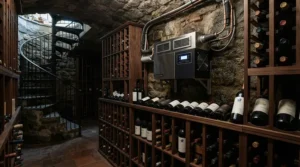
The seventh option on this list isn’t a single branded model so much as a route to market, and it deserves its place because it answers a question a lot of British buyers actually have: “who do I call, and roughly what will the whole job cost?” UK specialist Wine Racks UK fits bespoke split air-conditioning systems built around Panasonic components, with the indoor evaporator commonly concealed behind a removable wine-rack front so the equipment simply disappears from view — a neat solution for anyone who wants a working climate-control system without staring at grilles and ductwork every time they go to fetch a bottle.
Published guide pricing from the company puts a typical installed system at around £4,300–£4,800 including VAT and fitting, though the final figure depends on cellar size and how far the condenser needs to travel to an external wall — a genuinely useful real-world data point in an industry that mostly hides behind “request a quote” forms.
This is the pick for buyers who want a single point of contact managing hardware, F-gas-certified installation, and commissioning together, rather than sourcing equipment from a US specialist and then separately hunting for a UK engineer willing to install imported kit. The trade-off is less brand flexibility — you’re buying into their specified hardware and their installer’s schedule — but for many first-time cellar owners, that simplicity is worth the premium over piecing it together yourself.
Pros:
- ✅ Single quoted price covers hardware, VAT, and fitting
- ✅ Evaporator concealed behind a wine-rack front for aesthetics
- ✅ One UK point of contact for install and aftercare
Cons:
- ❌ Less flexibility over specific brand or model choice
- ❌ Final price scales with distance to the outdoor condenser
Published guide pricing sits around £4,300–£4,800 installed; always request a site-specific quotation, as this figure is illustrative rather than fixed.
Practical Usage Guide: Installing and Living With Your Split System
Buying the unit is genuinely the easy part. Getting it running well, and keeping it running well, is where most of the actual value lives — and where most first-time buyers trip up. Start with the heat-load calculation before you buy anything: room volume alone is a rough guide at best, because glass walls, recessed lighting, and poorly insulated ceilings can all pile heat into a cellar that a simple square-footage formula never accounts for. Most manufacturers, including CellarPro and WhisperKOOL, publish free online calculators for exactly this reason, and it’s worth running your numbers through more than one before committing to a specific BTU rating.
Once installed, the first 30 days matter more than people expect. Resist the urge to load the cellar to capacity on day one; let the unit stabilise the space over a week or two, monitoring temperature swings with a simple remote thermometer rather than trusting the built-in display alone. Common early mistakes include sealing the room too tightly without addressing the fresh-air intake the condenser needs (starving it of ventilation shortens compressor life dramatically), and setting the thermostat too aggressively low in the mistaken belief that colder is automatically better — most reds and whites are perfectly happy at a stable 12-14°C rather than fridge-cold temperatures.
For ongoing maintenance, build a simple seasonal routine: check and clean the evaporator’s air filter every one to three months depending on dust levels, inspect the condenser’s outdoor housing twice a year for debris or vegetation blocking airflow, and have a qualified engineer service the refrigerant circuit annually — not optional under UK F-gas rules for anything beyond the smallest charge sizes, and genuinely sensible even where it isn’t strictly mandated.

Real-World Scenarios: Matching a Split System to Your Cellar
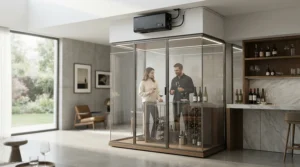
Numbers on a spec sheet only tell half the story, so here are three genuinely common buyer profiles and how they map onto the units above. First, picture a couple converting a 300-bottle under-stairs cupboard in a Victorian terrace with no easy external wall nearby — the compact footprint and 100-foot line-set of the CellarCool WM Split 2500 solves the access problem neatly, letting the condenser sit in a garage or loft space well away from the cellar itself. Second, consider a serious collector building a glass-fronted 1,500-bottle display cellar as a genuine architectural feature in an open-plan kitchen-diner — here, the acoustic performance of the WhisperKOOL Platinum Split 4000 earns its premium price, because any compressor hum in that setting would undermine the entire point of the room.
Third, imagine a family converting an entire basement into a 4,000-bottle commercial-adjacent cellar with a tasting room attached — a project of that scale genuinely needs the ducted flexibility of the Wine Guardian DS050, since a single wall-mounted evaporator simply cannot serve a space that large evenly, and the ability to route ductwork through an existing plant room becomes essential rather than a nice-to-have. In each case, the “right” answer isn’t the most expensive or most powerful unit on this list — it’s the one whose installation constraints actually match the building you’re working with, which is precisely why a proper site survey by an HVAC contractor beats guessing from a spec sheet every time.
How to Choose a Split System Wine Cellar Cooling Unit
Cutting through the marketing, choosing the right unit really comes down to seven practical checks, worked through in order:
- Calculate your actual heat load — use a manufacturer’s free BTU calculator with real figures for insulation, glass area, and ceiling height, not room volume alone.
- Decide your condenser location first — a unit’s maximum line-set length (often 50-100 feet) should shape which model you shortlist, not the other way round.
- Match capacity with a safety margin — sizing a unit at exactly your calculated load leaves no buffer for a heatwave summer; aim slightly above, not below.
- Check ducting requirements against your plant room — if there’s no dedicated outdoor-facing space, a ducted model like the Wine Guardian range solves problems a wall-mount can’t.
- Weigh noise ratings against the cellar’s use — a working storage room can tolerate more dBA than a glass-fronted showpiece cellar adjoining a living space.
- Confirm humidity handling for your specific building — naturally damp basements benefit from chilled-water or humidity-controlled designs over basic refrigerant splits.
- Book a qualified HVAC contractor before you buy, not after — get a site survey and installation quote alongside the equipment quote, since the two numbers together determine your real budget.
Split System Wine Cellar Cooling Units for Humid Climates
British weather has a habit of making itself felt in basements and cellars whether you invite it or not, and a naturally humid cellar space genuinely changes which split system makes sense. The core issue is straightforward: standard air-conditioning-style refrigeration actively removes moisture from the air as a side effect of cooling it, which is fine for a living room but actively harmful for wine storage if it drags humidity below the 50-70% range that keeps corks properly sealed. Decanter’s own advice column puts the ideal range for fine wine even tighter, at 65-70% relative humidity, precisely because drier air lets more oxygen creep past the cork and prematurely ages the bottle.
For a genuinely humid UK basement — the kind with a slightly musty smell even before any wine goes in — a conventional split system on its own often isn’t enough, because it will happily over-dry the air while chasing a low temperature. This is exactly where chilled-water designs like the Friax Chill’loop H2OX earn their keep, since they don’t dehumidify as aggressively as a standard refrigerant loop and typically pair with dedicated humidification accessories rather than fighting against the room’s natural moisture. Common problem-solving steps worth pairing with any split system in a damp space include: sealing the room properly with a vapour barrier before installation (cooling equipment can’t fix a leaky room), adding a wall-mounted hygrometer independent of the unit’s own sensor to cross-check readings, and specifying a humidity-control accessory — CellarPro, Breezaire and Wine Guardian all offer optional humidifier add-ons — rather than assuming the cooling unit alone will hold the line.
Buyer’s Decision Framework: Choosing the Right Split System
If you’d rather skip straight to a decision, here’s a simple priority checklist. If your cellar is under 500 cubic feet and access to an external wall is tight, choose a compact model like the CellarCool WM Split 2500 because footprint and line-set flexibility matter more than raw capacity. If noise is your absolute priority — a glass-fronted or open-plan cellar — choose the WhisperKOOL Platinum Split 4000, because its acoustic performance is the entire reason to pay its premium. If you want the safest, most widely recommended default for a standard 800-1,200 bottle residential cellar, choose the CellarPro 4000S-EC, because trade familiarity and EC-fan efficiency reduce both risk and running costs. If your cellar exceeds 2,000 cubic feet or has an awkward plant-room layout, choose the Wine Guardian DS050, because ducted flexibility genuinely can’t be substituted with a wall-mount at that scale. And if you’d simply rather one UK company handled hardware, F-gas-certified installation and aftercare as a single package, choose the Panasonic-based bespoke route through a specialist like Wine Racks UK, because the simplicity is worth the reduced brand choice for most first-time buyers.
✨ Ready to compare specific models? Click through to check current availability and pricing on your shortlisted units!
Professional Cellar Cooling Systems vs DIY Cooling Kits
There’s a real fork in the road when planning a cellar: a professional cellar cooling system specified and fitted by a qualified engineer, versus a smaller self-contained or through-the-wall unit a confident DIYer can fit themselves. The self-contained route — a single-box unit with both evaporator and condenser in one housing — genuinely works for smaller cellars and needs no refrigerant pipework at all, since it’s a sealed system from the factory, making it legally fittable by a competent homeowner. A split system, by contrast, has its refrigerant circuit broken and rejoined on-site, which under UK F-gas law requires a certified engineer regardless of how confident you feel with a spanner.
The trade-off is worth being honest about. A self-contained unit is cheaper up front and needs no contractor booking, but it dumps both heat and noise directly into or immediately outside the cellar space, and it can’t be located remotely at all. A split system costs more in total — equipment plus a qualified installer’s time — but buys genuine acoustic separation, remote condenser placement, and, in ducted configurations, the ability to serve awkward or large spaces a self-contained box simply cannot reach. For a small wine cabinet or under-100-bottle collection, the DIY-friendly self-contained route is entirely reasonable. For anything larger, anything glass-fronted, or anything where the cellar sits near living space, the professional split-system route pays for itself in years of quieter, more stable storage.
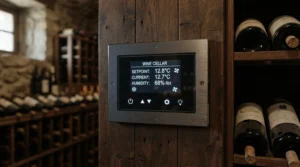
Split Systems for Large Cellar Builds
Large cellar builds — anything running into several thousand bottles, commercial cellars for restaurants and hotels, or ambitious residential basement conversions — change the calculus considerably. At that scale, a single wall-mounted split evaporator, however well-rated, tends to create uneven cooling: bottles nearest the unit sit noticeably cooler than those in a far corner, which defeats the entire point of stable, consistent storage. This is precisely the scenario ducted systems like the Wine Guardian DS050 are engineered for, since ducting can distribute conditioned air evenly across a large or irregularly shaped floor plan rather than relying on natural air movement from a single point.
Large builds also change the maths on redundancy. A single-point failure on a 4,000-bottle cellar is a far bigger financial risk than the same failure on a 200-bottle cabinet, so serious large-cellar projects increasingly specify twin or backup cooling circuits — sometimes two Wine Guardian units running in a lead-lag configuration, so one can take over if the other needs servicing without the whole cellar drifting out of range. Ducting design at this scale genuinely isn’t a DIY project; it needs proper airflow calculations from an HVAC contractor experienced specifically in wine-cellar work, since general commercial air-conditioning ducting principles don’t automatically translate to a room with wine’s much tighter humidity tolerances.
Why HVAC Contractors Matter: Installation, F-Gas & Safety Compliance
It’s worth stating plainly: installing a split system wine cellar cooling unit yourself, beyond the most trivial pre-charged plug-and-play models, is against UK law. Any work that involves breaking into a refrigerant circuit containing F-gas — connecting line-sets, commissioning a compressor, recovering refrigerant during a service — legally requires a qualified, certified engineer. The relevant guidance, published by the UK government, sets out exactly which qualifications are needed and who can issue them; you can check the current F-gas qualification requirements directly on GOV.UK before booking anyone.
Beyond the legal requirement, there’s a genuinely practical reason to use HVAC contractors experienced specifically with wine cellars rather than a general air-conditioning fitter: wine storage has tighter, more unusual tolerances than a normal room-cooling job. A contractor used to fitting office air-con will size for comfort cooling around 21°C, not the 12-14°C wine actually needs, and may not think twice about the aggressive dehumidification that damages corks. When vetting a contractor, ask specifically about their F-gas certification body (Refcom and the F-Gas Register are the two most common in the UK), request examples of previous wine-cellar-specific installs rather than general air-conditioning work, and confirm in writing who’s responsible for the heat-load calculation — a good contractor will insist on doing this themselves rather than simply fitting whatever unit you’ve already bought.
Common Mistakes When Buying a Split System Wine Cellar Cooling Unit
The single most common mistake, echoed across nearly every wine-cellar specialist we researched, is sizing a unit off room square footage alone rather than a proper heat-load calculation — it’s the single biggest cause of both undersized units that never quite hold temperature and oversized units that short-cycle themselves into premature failure. A close second is ignoring the condenser’s ventilation needs: air-cooled condensers must draw fresh air from outside the cellar, never from within it, yet it’s a strikingly common installation error, particularly when a condenser gets tucked into a cupboard for tidiness without anyone checking airflow clearance.
Buyers also frequently underestimate humidity as a separate problem from temperature, assuming that if the unit holds 12-14°C, the job is done — it isn’t, and a unit that over-dries the air can do as much cork damage as one that runs too warm. Another recurring error is skipping the installer conversation until after the equipment has already arrived, which can leave buyers stuck with a unit that doesn’t suit their actual plant-room layout or line-set distance. Finally, plenty of first-time buyers assume the cheapest unit that technically meets their BTU number is the smart choice, without factoring in noise tolerance for the room’s actual use — a bargain unit humming away next to a home cinema is a false economy the moment the film starts.
Long-Term Cost & Maintenance of Split System Wine Cooling
The purchase price is only the opening chapter of the cost story. Ongoing electricity consumption for a typical residential split system, running intermittently to hold a stable 12-14°C, generally lands in a modest range for most UK households — EC-fan models like the CellarPro 4000S-EC measurably undercut older AC-fan designs here, which compounds over a decade of near-constant operation. Annual servicing by a certified engineer, covering refrigerant level checks, filter cleaning, and a leak test as required under F-gas rules, typically costs a modest sum per visit but is genuinely cheap insurance against a compressor failure that could otherwise ruin an expensive wine collection with no warning.
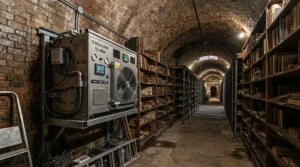
Warranty terms are worth reading closely rather than skimming, because they vary meaningfully between brands: CellarPro’s compressor warranty commonly runs to five years with two years on labour and parts, while Breezaire similarly backs its range with a five-year parts warranty. Beyond warranty, budget for a compressor’s realistic working life of roughly 10-15 years under normal residential duty, and factor humidity accessories — humidifier cartridges, UV-C bulbs where fitted — into a simple annual maintenance checklist so nothing gets forgotten between services. Set against the alternative cost of a spoiled collection, these are genuinely modest numbers, and the total cost of ownership over a decade of stable, temperature-correct storage almost always looks better than the sticker price alone suggests. Anyone managing a genuinely valuable collection should also read NICE’s broader guidance on indoor damp and air-quality standards, since the same humidity principles protecting your health in a home apply directly to protecting corks and labels in a cellar next door.
Frequently Asked Questions
❓ What is the difference between a split system and a self-contained wine cooling unit?
❓ How far can a split system's condenser be from the wine cellar?
❓ Do I need a professional to install a split system wine cellar cooling unit?
❓ What size split system do I need for my wine cellar?
❓ Can a split system wine cooling unit control humidity as well as temperature?
Conclusion
Choosing a split system wine cellar cooling unit isn’t really about finding the single “best” model — it’s about matching a specific set of engineering constraints (cellar size, condenser placement, humidity, noise tolerance) to the unit built to handle them. The CellarPro 4000S-EC remains the sensible default for a standard residential cellar, the WhisperKOOL Platinum Split 4000 earns its premium where acoustics genuinely matter, and the Wine Guardian DS050 is worth the extra installation complexity the moment your build scales past a few hundred bottles. For anyone facing a naturally humid UK basement, the Friax Chill’loop H2OX solves a problem conventional splits struggle with, while the Panasonic-based bespoke route through Wine Racks UK offers a genuinely simple, fully quoted path for buyers who’d rather not assemble a project from separate suppliers.
Whatever you land on, the two steps that matter more than brand choice are a proper heat-load calculation before you buy, and a certified HVAC contractor booked in alongside the equipment rather than as an afterthought. Get those two things right and any of the seven units above will do exactly what it says on the spec sheet — keep your wine collection climate control quietly, reliably, and out of sight, for years rather than months.
✨ Don’t miss out on the right split system for your cellar — check current prices and availability today, and give your collection the storage conditions it deserves! 🍷
Recommended for You
- Wine Cellar Door Seal for Temperature Control: 7 Proven Picks (2026)
- Wine Cellar Lighting Kit: 7 Best Picks for UK Homes (2026)
- Wine Cellar Hygrometer: 7 Best Picks for UK Cellars (2026)
Disclaimer: This article contains affiliate links. As an Amazon Associate, I earn from qualifying purchases. If you purchase products through these links, we may earn a small commission at no additional cost to you.
✨ Found this helpful? Share it with your friends! 💬🤗
