
In This Article
There’s a moment that every wine enthusiast in Britain knows well. You’re standing in the kitchen, bottle in hand, staring at the warm shelf where your Sauvignon Blanc has been quietly suffering for three days. That’s when the penny drops: it’s time for a proper wine fridge.
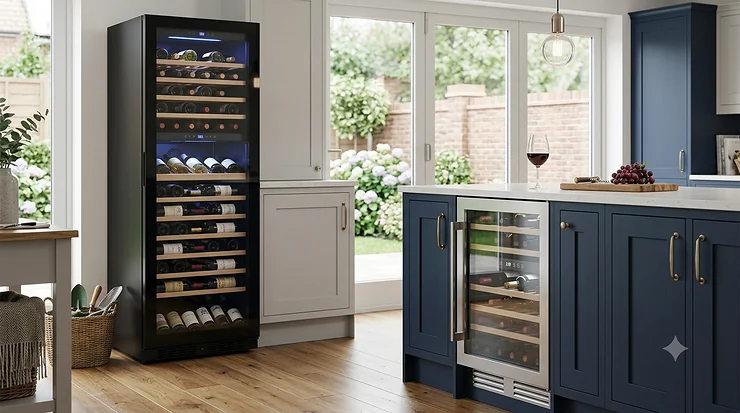
But then comes the next dilemma — and it’s a surprisingly consequential one. Should you go for a freestanding vs built in wine fridge? On the surface, it sounds like a trivial question. In practice, it shapes your kitchen layout, your installation budget, your flexibility for future moves, and ultimately how well your wine is stored for years to come.
A freestanding vs built in wine fridge debate isn’t just about aesthetics. It touches on ventilation requirements, cabinetry dimensions, rental property restrictions, and the kind of commitment you’re willing to make to your kitchen. And that’s before you even consider the science of what good wine storage actually requires — temperature stability, humidity control, vibration dampening, and UV protection are the four conditions that genuinely determine whether a wine develops well or deteriorates prematurely. If you’re in a terraced house in Leeds, a new-build flat in Bristol, or a Georgian semi in Edinburgh, the right choice will be different — and this guide will help you navigate it properly.
In short: a freestanding wine fridge is a standalone unit that you can plug in almost anywhere and move when you need to. A built-in wine fridge, also called an integrated wine fridge, is designed to sit flush within your kitchen cabinetry, venting through the front so it doesn’t require side clearance. Each has real advantages and genuine drawbacks, and neither is universally superior.
Over the next few thousand words, I’ll walk you through seven of the best models currently available on Amazon.co.uk — a carefully curated mix of freestanding and built-in options across budget, mid-range, and premium price points. I’ll also cover what the spec sheet won’t tell you: real-world performance, British kitchen considerations, and the questions worth asking before you buy.
Quick Comparison: Freestanding vs Built In Wine Fridge at a Glance
| Feature | Freestanding | Built-In / Integrated |
|---|---|---|
| Ventilation | Side/rear (needs clearance) | Front-venting (fits under counter) |
| Installation | Plug and go | Cabinetry fitting required |
| Flexibility | High — move anytime | Low — fixed in position |
| Aesthetics | Standalone look | Seamless kitchen finish |
| Cost (unit) | Lower (budget from ~£80) | Higher (typically £200+) |
| Installation cost | None | £100–£300+ (joiner/fitter) |
| Ideal for | Renters, flexibility seekers | Homeowners, kitchen renovations |
| Noise | Varies | Generally quieter |
| UK kitchen fit | Good in alcoves or utility rooms | Excellent in modern fitted kitchens |
What this table makes clear is that the decision isn’t purely about the appliance — it’s about your situation. A freestanding model wins hands-down on flexibility and upfront cost, which matters enormously if you’re renting or likely to move in the next few years. A built-in unit, however, earns its premium price through kitchen integration and long-term aesthetics, particularly in open-plan living spaces where a standalone fridge can look oddly out of place. The “right” answer almost always comes down to tenure, budget, and whether your landlord would actually let you start cutting cabinetry.
✨ Don’t Miss These Exclusive Deals!
🔍 Take your wine storage to the next level with these carefully selected products. Click on any highlighted item to check current pricing and availability on Amazon.co.uk. These picks will help you find exactly what you need!
Top 7 Wine Fridges on Amazon.co.uk: Expert Analysis
1. Cookology CWC300SS — Best Budget Freestanding Wine Fridge
Type: Freestanding | Capacity: 20 bottles / 60 litres | Width: 30cm | Temperature: 5–18°C (single zone) | Price range: under £150
The Cookology CWC300SS is the sensible starting point for anyone dipping their toes into proper wine storage without committing to a significant outlay. At just 30cm wide, it slides neatly into a worktop gap that most people wouldn’t know what to do with — a genuinely useful dimension in British kitchens where every centimetre counts.
The single-zone temperature control manages a range of 5–18°C, which covers both chilled whites and slightly warmer reds. It won’t satisfy a serious collector who needs separate zones for different varietals, but for a household that mostly drinks one type at a time — a very reasonable description of most British homes — it does the job without fuss. The five sliding shelves accommodate a mix of Bordeaux and Burgundy-style bottles, and the stainless steel finish looks considerably more expensive than the price tag suggests.
What most buyers overlook about this model is the reversible door — a small but meaningful feature when you’re working with a tight kitchen layout and need the hinge on a specific side. UK reviewers consistently highlight how quiet the unit runs, which matters if it’s sitting near your dining area or in an open-plan kitchen-diner.
This is the wine fridge for the pragmatic British buyer: someone who wants reliable temperature control, a sensible footprint, and a price that doesn’t require a serious conversation with their bank.
Pros:
- ✅ Excellent value for money in the sub-£150 bracket
- ✅ 30cm width fits neatly into standard UK kitchen gaps
- ✅ Reversible door adds real flexibility for tight layouts
Cons:
- ❌ Single zone only — not suitable for serious mixed collections
- ❌ 20-bottle capacity will feel restrictive if your collection grows
Price range: under £150 — strong value; check current pricing on Amazon.co.uk.
2. Subcold Viva24 LED — Best Mid-Range Freestanding for Everyday Use
Type: Freestanding | Capacity: 24 bottles | Temperature: 3–18°C (single zone) | Features: LED lighting, lock and key | Price range: £150–£220
The Subcold Viva24 LED is a British brand that tends to fly under the radar next to the bigger European names, which is rather a shame because it consistently delivers solid performance at a fair price. Subcold is based in the UK and their products are designed with British kitchen conditions in mind — not an insignificant distinction when you consider that some European-market fridges assume ambient temperatures that rarely apply in a draughty British utility room.
The 3–18°C range is notably wide for this price bracket, meaning you can serve sparkling wine properly chilled at the lower end without compromising the unit’s ability to maintain cellar-like temperatures for reds. The LED lighting inside is a small but genuinely useful touch — it means you can spot your bottle without flooding the room with light at 10pm. The lock and key is a thoughtful addition if you have younger members of the household with curious habits.
At 24 bottles, this sits in a sweet spot: enough for a rotating collection, but not so large that it dominates a kitchen or utility room. UK customers frequently comment on its quiet operation and the quality of the glass door, which keeps UV light from degrading the wine — something more important than many people realise, particularly for bottles you’re keeping for more than a few weeks.
This is the one I’d recommend to someone hosting regularly: good-looking enough to sit on show, practical enough for everyday rotation.
Pros:
- ✅ Wide temperature range (3–18°C) suits both sparkling and reds
- ✅ British brand with UK-focused design philosophy
- ✅ LED and lock — useful features without premium pricing
Cons:
- ❌ Single zone limits versatility for mixed collections
- ❌ Not built-in compatible — needs side clearance
Price range: £150–£220 — well-positioned for what it delivers; check availability on Amazon.co.uk.
3. Hisense RW12D4NWG0 — Best Freestanding for Larger Collections
Type: Freestanding undercounter | Capacity: 30 bottles / 93 litres | Temperature: Digital touch control | Energy class: Listed on UK market | Price range: £200–£280
The Hisense RW12D4NWG0 occupies an interesting position in the market: it’s large enough to be genuinely useful for a growing wine collection but compact enough to slide under a worktop. At 93 litres and 30-bottle capacity, it comfortably handles a household that buys in quantity — a case or two at a time — without taking over your kitchen.
Hisense has been making steady inroads into the UK appliance market, and their wine fridge range shows the same design maturity as their white goods line. The digital touch control interface is intuitive and clean, and the temperature stability on this model is notably good — it holds its set point consistently rather than swinging a few degrees either way, which is the hidden issue that separates adequate wine fridges from genuinely capable ones. Temperature fluctuation is one of the primary causes of premature wine ageing, and it’s rarely mentioned on a spec sheet.
In a British context, this unit performs reliably in both warm summer kitchens and cooler utility rooms — a relevant consideration given how dramatically UK ambient temperatures can shift between July and January. UK reviewers note the unit settles quickly after the door is opened, which is encouraging for anyone opening it frequently throughout the evening.
This is the sensible choice for the wine enthusiast who’s moved beyond casual drinking and wants proper storage without the premium price of a built-in unit.
Pros:
- ✅ 30-bottle capacity covers a serious rotating collection
- ✅ Strong temperature stability — important for ageing wines
- ✅ Clean digital interface and undercounter dimensions
Cons:
- ❌ Freestanding only — needs side ventilation clearance
- ❌ Some UK reviewers note the interior light is less impressive than competitors
Price range: £200–£280 — strong performance per pound; check Amazon.co.uk for current pricing.
4. Hoover H-WINE 500 HOWC034K — Best Mid-Premium Freestanding with Smart Features
Type: Freestanding | Capacity: 34 bottles | Temperature: Single zone, anti-UV glass | Smart features: hOn App compatible | Energy class: G | Price range: £250–£350
The Hoover H-WINE 500 HOWC034K is where things start to get interesting. Hoover — an old British household name now owned by Candy/Haier but still widely trusted in the UK — has brought smart connectivity into its wine fridge range, and the result is more useful than you might expect.
The hOn App compatibility means you can monitor and adjust temperature remotely from your phone — helpful if you’re entertaining and want to pre-chill without being in the kitchen, or if you’re away for a weekend and want to check the unit is behaving itself. The spec sheet won’t tell you how reassuring it is, on a warm British July evening, to glance at your phone and confirm the fridge is holding temperature while you’re out in the garden.
At 34 bottles, this sits nicely for households with an active wine habit: enough storage to maintain a proper rotation of red, white, and rosé simultaneously. The anti-UV glass is genuinely important here — standard glass transmits the ultraviolet wavelengths that break down organic compounds in wine, and this is one of the mechanisms by which decent bottles spoil faster than they should on a bright south-facing kitchen. In a British context, where south-facing kitchens are prized (and genuinely sunny for about three weeks a year), it’s still worth having.
This is the wine fridge for the organised enthusiast who wants a little more control and doesn’t mind paying a modest premium for it.
Pros:
- ✅ hOn App connectivity — genuinely useful for remote monitoring
- ✅ Anti-UV glass protects bottles from light degradation
- ✅ 34-bottle capacity suits serious everyday collections
Cons:
- ❌ G energy rating — not the most efficient on this list
- ❌ Smart features require the Hoover hOn App, which has mixed UK reviews
Price range: £250–£350 — fair for the features on offer; check Amazon.co.uk for current pricing.
5. Haier Wine Bank 50 Series 5 HWS49GA — Best Premium Freestanding
Type: Freestanding | Capacity: 49 bottles | Temperature: Single zone, anti-UV glass | Smart features: hOn App | Energy class: F | Dimensions: 49.7 x 58.5 x 82 cm | Price range: £400–£550
The Haier Wine Bank 50 Series 5 HWS49GA is the premium freestanding option in this roundup, and it earns that status through a combination of capacity, build quality, and thoughtful design. Haier has invested seriously in their wine storage range, and this model reflects that — it has the feel of a product designed by people who actually collect wine, not just marketers who needed a new SKU.
The 49-bottle capacity at 82cm height means this unit stands at a comfortable working height while holding enough wine for a household that takes their collection seriously. The low-vibration design deserves particular mention: vibration is the enemy of wine ageing, disrupting the slow chemical processes that develop complexity over time. Many entry-level fridges create enough internal vibration to be genuinely detrimental to bottles kept for more than a month or two. The Haier’s quiet, stable operation is demonstrably better in this respect.
The hOn App connectivity allows temperature monitoring and adjustment via smartphone — the same Hoover-family ecosystem mentioned above, since both brands now share the Candy/Haier technology platform. The F energy rating is one step better than the Hoover above, and for a unit of this size, it represents respectable efficiency.
UK reviewers highlight the build quality of the shelves and the quality of the door seal — two details that separate a genuinely capable wine fridge from a drinks fridge with aspirations. This is the one to consider if you’re buying once and buying well.
Pros:
- ✅ 49-bottle capacity with low-vibration design for ageing
- ✅ Strong build quality — shelves and door seal above class average
- ✅ hOn App connectivity; F energy rating for its size
Cons:
- ❌ Price reflects premium positioning — not a casual purchase
- ❌ Freestanding design means it needs side/rear ventilation clearance
Price range: £400–£550 — a serious investment for a serious collection; check Amazon.co.uk for current pricing.
6. Hoover H-WINE 300 HWCB 45 UKBM/1 — Best Mid-Range Built-In Wine Fridge
Type: Built-in / integrated | Capacity: 24 bottles | Temperature: Single zone | Smart features: Wi-Fi / hOn App | Energy class: F | Dimensions: H45.5 x W59 x D60.7 cm | Price range: £280–£380
Here’s where we cross into built-in territory, and the Hoover H-WINE 300 HWCB 45 UKBM/1 makes a compelling case for why you’d bother. At 45.5cm tall, it slots beneath a standard 90cm worktop with room to spare, front-venting so it doesn’t need side clearance — the defining characteristic of a true built-in wine fridge, and the feature that makes integration into fitted cabinetry genuinely practical.
The Wi-Fi connectivity via the hOn App is a level above what you’d expect at this price point. Being able to monitor your wine fridge remotely from your phone sounds like a luxury feature, but for a built-in unit that’s neatly tucked under a worktop and thus harder to glance at casually, it’s genuinely practical. You know the temperature is holding without having to crouch down and peer at the display.
For UK kitchens undergoing renovation — a booming sector given the number of homeowners choosing to upgrade rather than upsize in the current market — this model is worth serious consideration. At 59cm wide, it fits a standard UK kitchen unit gap, and at 24 bottles, it’s sized appropriately for a household that drinks regularly but isn’t operating a cellar.
What distinguishes this from the freestanding models isn’t just the form factor. It’s the finish — the unit is designed to be seen as part of a kitchen, and it looks the part. UK buyers in the £300-range for a built-in unit are essentially paying for kitchen integration and the aesthetics that come with it.
Pros:
- ✅ True front-venting — fits flush under standard UK worktops
- ✅ Wi-Fi/hOn App connectivity for remote temperature monitoring
- ✅ F energy rating; 59cm width suits standard kitchen unit gaps
Cons:
- ❌ Professional installation recommended — adds to total cost
- ❌ Single zone; no flexibility for mixed red and white ageing
Price range: £280–£380 for the unit — add £100–£250 for professional fitting; check Amazon.co.uk for current pricing.
7. AEG 5000 Series AWUS052B5B — Best Premium Built-In Wine Fridge
Type: Built-in / integrated | Capacity: 52 bottles / 145 litres | Height: 82cm | Shelves: Extendable wooden shelves on telescopic runners | Features: LED display, cellaring fundamentals | Price range: £600–£800
The AEG 5000 Series AWUS052B5B is the premium built-in option in this roundup, and it represents a genuinely different class of appliance from everything else on this list. AEG’s wine fridge range is designed around what the company calls “Cellaring Fundamentals” — humidity control, vibration dampening, temperature precision, and UV protection — and the 5000 Series delivers on all four.
The 52-bottle capacity at 82cm tall means this integrates into a tall housing unit rather than under a worktop, which opens it up to a different kitchen renovation context: a dedicated wine column alongside other integrated appliances, rather than a simple undercounter slot. The extendable wooden shelves on telescopic runners are a notable differentiator — they allow you to pull the shelf fully out to reach bottles at the back without disturbing those at the front, a small ergonomic improvement that becomes significant when you’re doing it daily. For those building a more serious collection, it’s worth noting that wine experts generally recommend long-term cellaring at a constant 10–15°C — a target the AEG’s ±0.5°C precision puts well within reach.
The temperature precision on this unit is measurably better than the mid-range options — AEG quotes ±0.5°C stability, which is the kind of performance that matters if you’re storing anything worth more than £30 a bottle. For UK buyers who are investing in quality wine and want it stored properly, this precision is the justification for the premium price.
UK reviewers who have fitted this unit consistently note the installation quality — it sits flush, the door aligns correctly with cabinetry, and the overall result looks and feels architectural rather than appliance-like. This is wine storage for people who take both their wine and their kitchen seriously.
Pros:
- ✅ 52-bottle capacity with ±0.5°C temperature precision
- ✅ Extendable telescopic wooden shelves — excellent ergonomics
- ✅ UV-protective glass, humidity control, vibration dampening
Cons:
- ❌ Premium price point — this is a committed investment
- ❌ Requires tall housing unit installation; not a simple undercounter fit
Price range: £600–£800 — the premium built-in choice for serious collections; check Amazon.co.uk for current pricing.
How to Choose Between Freestanding and Built In Wine Fridge: A Practical UK Framework
This is the question that deserves a direct answer before you spend a penny. Here’s how to think through it clearly.
1. Are you renting? If you’re in a rental property, a freestanding wine fridge is almost certainly your only viable option. Modifying cabinetry or cutting kitchen units without landlord consent violates most tenancy agreements in England, Scotland, and Wales. A freestanding unit plugs in, stands wherever you have space, and moves with you when you leave. This is non-negotiable for most UK renters.
2. Are you renovating? If you’re in the middle of a kitchen renovation — and the number of UK homeowners choosing to upgrade rather than move has grown significantly in recent years — this is the ideal moment to integrate a built-in wine fridge. The cabinetry is already being configured, the cost of building in a wine fridge housing is marginal compared to the overall project, and you get a seamless finish that freestanding units simply cannot match.
3. What’s your budget (total cost, not just unit cost)? A freestanding fridge at £200 costs £200 installed. A built-in fridge at £300 costs £300 plus £100–£300 for a joiner or fitter plus any cabinetry modifications. Be honest about the total cost of ownership, not just the sticker price.
4. How many bottles do you realistically need? Be sceptical of your own optimism here. Most households overestimate how many bottles they need to store. A 20–30 bottle capacity suits the majority of regular wine drinkers. A 50+ bottle unit only makes sense if you’re actively building a cellar.
5. Is aesthetics a genuine priority, or a vague aspiration? Built-in units look better in fitted kitchens — genuinely and significantly better. But if your kitchen is already a mix of freestanding appliances, a wine fridge that matches the general character of the room is perfectly acceptable.
6. Do you have the right space? Freestanding fridges need 5–10cm of side clearance for ventilation; built-in fridges vent through the front and need none. Measure before you buy — this mistake is more common than it should be and entirely avoidable.
7. Will you want to move it? If there’s any chance you’ll want to relocate the fridge — to a utility room, garage (if properly insulated), or new home — freestanding wins by a significant margin.
Freestanding Wine Fridge Pros and Cons: What You Actually Need to Know
The internet is full of freestanding wine fridge pros and cons lists that tell you the same five things. This section goes a little further.
The genuine advantages
Flexibility is the headline benefit — and it genuinely is. A freestanding wine fridge can sit in your kitchen, utility room, home office, dining room, or even a well-insulated garage. You can move it between rooms as your needs evolve, and you can take it with you when you move house. In a country where the average UK homeowner moves approximately every 10–15 years, that flexibility has real monetary value.
Lower upfront commitment is the other major advantage. Entry-level freestanding models on Amazon.co.uk start under £100, and competent mid-range options sit in the £150–£300 range. You can test whether a wine fridge suits your lifestyle before committing to a built-in installation.
No installation costs is the obvious corollary. You plug it in and it works. There’s no joiner to book, no cabinetry to modify, and no waiting for an installation slot.
The genuine limitations
Ventilation requirements are the practical constraint that catches buyers by surprise. Most freestanding wine fridges vent from the sides and rear, meaning they need clearance — typically 5–10cm on each side and 10–15cm at the back. In a narrow kitchen gap, this can mean a 30cm-wide wine fridge effectively requires 50cm of actual space. Read the installation manual before you buy.
Aesthetics in fitted kitchens is the honest limitation. A freestanding wine fridge alongside fitted kitchen cabinetry looks like an afterthought, because it is. If your kitchen is open-plan or guest-facing, this matters.
Ambient temperature sensitivity is a lesser-known issue: freestanding fridges placed in cold British garages or utility rooms in winter may not function correctly. Most wine fridges are designed to operate in ambient temperatures of 10–38°C — below 10°C, the compressor may not cycle correctly. Worth checking the spec sheet if you’re planning garage placement.
Real-World Scenarios: Which Wine Fridge Suits Your Situation?
Sometimes the best way to cut through the decision fatigue is to recognise yourself in someone else’s situation.
The London flat renter: Emma lives in a two-bedroom flat in Clapham, renting with a partner. The kitchen is galley-style with a 30cm gap at the end of the worktop that currently holds a toaster they rarely use. She can’t modify the cabinetry, her landlord is friendly but firm, and she wants something that moves when she eventually buys. The Cookology CWC300SS fits her gap, her budget, and her situation precisely. She should not be considering a built-in unit.
The family in a Birmingham semi: David and his wife are having their kitchen renovated — new units, new worktops, the lot. They entertain regularly and have a growing interest in wine. The joiner is already on-site; adding a built-in wine fridge housing to the plan costs relatively little in the context of the project. The Hoover H-WINE 300 HWCB 45 UKBM/1 fits a standard 60cm unit gap, front-vents neatly, and will look like it was always part of the kitchen. A sensible choice.
The wine enthusiast in Edinburgh: Margaret has owned her tenement flat for 15 years and has no plans to move. She has a collection of around 40 bottles at any given time, including some bottles she’s keeping for five or more years. She has a utility room behind the kitchen. She wants a freestanding unit with proper vibration control and temperature stability. The Haier Wine Bank 50 Series 5 HWS49GA gives her the capacity, the low-vibration design, and the build quality for long-term ageing — without the complication of built-in installation.
The kitchen renovation enthusiast in Surrey: Mark is completing a full open-plan kitchen extension and wants a wine fridge that genuinely integrates into the design. He has a specialist wine column housing in the plans. Budget isn’t the primary concern; quality is. The AEG 5000 Series AWUS052B5B is built for exactly this situation — precision temperature control, cellaring-grade specification, and an aesthetic finish that complements a quality kitchen.
Common Mistakes When Buying a Wine Fridge in the UK
These are the errors that UK buyers make repeatedly — and that are entirely avoidable with a little foreknowledge.
Buying a freestanding unit and putting it in a too-tight space. This is the single most common mistake. The buyer measures the gap, confirms the fridge width fits, orders it — and then discovers the ventilation clearance requirements mean it either doesn’t fit or runs hot. Always check the installation instructions for clearance requirements before ordering.
Assuming a built-in fridge is just a freestanding fridge that fits under the worktop. They’re not the same thing. A freestanding unit placed under a worktop without adequate ventilation will run inefficiently, potentially overheat, and shorten its own lifespan. Built-in fridges are specifically engineered to front-vent; freestanding ones aren’t. Check the designation carefully.
Underestimating the total cost of a built-in installation. The unit price is only the beginning. Cabinetry modification, a qualified fitter, and potentially an electrician for a dedicated circuit (recommended for large units) can add £200–£400 to the total cost. Factor this in from the start.
Buying US or EU-market products that aren’t UK-compatible. This is more of a risk on non-Amazon platforms, but it’s worth mentioning. UK electrical supply is 230V/50Hz with a Type G plug. Products designed for 110V US markets or 220V EU markets with a Europlug should not be used without a proper transformer — not an adapter. All products on this list are confirmed UK-market compatible.
Forgetting your cancellation rights when buying online. Under the Consumer Contracts Regulations 2013, as explained by Which?, UK online shoppers have 14 days from delivery to cancel an order and a further 14 days to return the goods — even if the item is perfectly functional and you’ve simply changed your mind. This is particularly relevant for wine fridges, which can look different in person than in product photos. Keep your delivery note and don’t discard packaging until you’re certain.
Choosing based on bottle capacity alone. The stated capacity is usually based on Bordeaux-style bottles in an upright or slightly angled position. Burgundy bottles are fatter; Champagne bottles are taller. If your collection includes these, real-world capacity may be 15–20% lower than the stated figure.
Ignoring the should I get freestanding or built in wine fridge question until after renovation is complete. This is the most expensive mistake: completing a kitchen renovation and then realising you want a built-in wine fridge means retrofitting cabinetry, which costs considerably more than planning it from the start.
Freestanding Wine Fridge Kitchen Placement: Getting It Right
Freestanding wine fridge kitchen placement is one of those topics that sounds obvious until you get it wrong. Here’s what actually matters.
Temperature stability of the location. Wine fridges work best in environments with consistent ambient temperatures. An alcove near a south-facing window that bakes in summer and chills in winter will cause your fridge to work harder and maintain temperature less consistently. A utility room or north-facing kitchen wall is often a better location than it might appear aesthetically.
Distance from heat sources. Placing a wine fridge directly next to a hob, oven, or dishwasher forces the compressor to work against significantly higher ambient temperatures. Maintain at least 30cm of separation from major heat sources where possible.
Flooring and levelling. Wine fridges need to be level to operate correctly — an unlevel unit can cause the door to swing open unintentionally and reduces the effectiveness of the door seal. Use the adjustable feet (standard on most units) and a spirit level before loading it with wine.
Access to a dedicated socket. Ideally, a wine fridge should be on its own circuit, or at least not sharing a socket with high-draw appliances. This is particularly important for larger compressor-based units in the 50+ bottle range.
Ventilation clearance. As discussed above — always check the installation guide. For freestanding models, ensure the stated side and rear clearances are actually achievable in your chosen location before ordering.
Garage placement caution. A British garage in January can drop well below 10°C, which is outside the operating range of many wine fridges. If you’re considering garage placement, look for models with a stated ambient operating range that includes lower temperatures, or consider a purpose-built garage wine fridge.
Installation Cost: What to Budget for a Built-In Wine Fridge in the UK
The installation cost question is one of the most-searched aspects of the freestanding vs built in wine fridge debate, and it’s rarely answered with any precision. Let’s fix that.
For a standard undercounter built-in wine fridge (such as the Hoover HWCB 45 UKBM/1):
- If the cabinetry space already exists: a local kitchen fitter or handyman typically charges £60–£120 for the fitting itself, depending on your location (London rates are meaningfully higher).
- If cabinetry modification is needed: add £150–£300 for a joiner to modify an existing unit or create a new housing.
- Electrical work: if a dedicated circuit is needed, a Part P-certified electrician will typically charge £100–£200 for the work and certification.
- Total realistic budget: £150–£450 over and above the unit cost.
For a tall column built-in unit (such as the AEG 5000 Series AWUS052B5B):
- This requires a dedicated tall housing, which typically costs £200–£500 for the carcass and fitting, depending on whether you’re using a flat-pack solution or a bespoke unit.
- Professional kitchen fitting: £150–£300.
- Total realistic budget: £350–£800 over and above the unit cost.
The practical implication: a mid-range built-in unit at £300 can easily cost £500–£700 all-in once installation is accounted for. This doesn’t make it a poor choice — it makes it a different category of decision. The aesthetics and long-term integration value are real. But the budget comparison should always be total cost of ownership, not just unit price.
For UK homeowners with a kitchen renovation underway, these costs are substantially reduced — the joinery work is already priced in, and adding a wine fridge housing at that point is often £50–£100 of additional work rather than a standalone job.

FAQ: Freestanding vs Built In Wine Fridge (UK)
❓ Can I use a freestanding wine fridge as a built-in?
❓ What is the best freestanding wine fridge kitchen placement in a small UK flat?
❓ Does a built-in wine fridge add value to a UK home?
❓ Should I get freestanding or built in wine fridge for a rental property?
❓ Are wine fridges expensive to run in the UK?
Conclusion: Making the Right Call for Your Kitchen
The freestanding vs built in wine fridge question doesn’t have a universal answer — and anyone who tells you it does is selling something. What it has is a clear framework, and you now have it.
If you’re renting, move house regularly, have a limited budget, or simply want the flexibility to put a wine fridge where it’s convenient rather than where the cabinetry dictates, a freestanding model is the right choice. The Cookology CWC300SS starts the range sensibly, the Subcold Viva24 LED represents excellent mid-range value, and the Haier Wine Bank 50 Series 5 HWS49GA is the premium freestanding option for anyone who takes their collection seriously.
If you’re renovating, own your home, have a fitted kitchen you’re proud of, and want wine storage that looks like it was always part of the design, a built-in unit is worth the additional investment. The Hoover H-WINE 300 HWCB 45 UKBM/1 is the practical mid-range choice; the AEG 5000 Series AWUS052B5B is the premium option for those who won’t compromise.
Whatever you choose, the most important advice is this: measure your space carefully, check the ventilation requirements, and calculate total cost (unit plus installation, if applicable) before committing. Wine fridges are appliances that can last a decade or more when well-chosen and properly placed. It’s worth taking the time to get it right.
✨ Ready to Upgrade Your Wine Storage?
🔍 Browse all seven of our recommended wine fridges on Amazon.co.uk. Click any highlighted product to check current pricing, Prime delivery eligibility, and customer reviews. Great wine deserves great storage — check current prices on Amazon.co.uk today.
Recommended for You
- Best Freestanding Wine Fridge UK 2026: 7 Expert Picks
- Under Counter Wine Fridge Installation: 7 Best UK Picks (2026 Guide)
- Best Under Counter Wine Fridge UK 2026: 7 Expert Picks Reviewed
Disclaimer: This article contains affiliate links. As an Amazon Associate, I earn from qualifying purchases. If you purchase products through these links, we may earn a small commission at no additional cost to you.
✨ Found this helpful? Share it with your mates! 💬🤗
