
In This Article
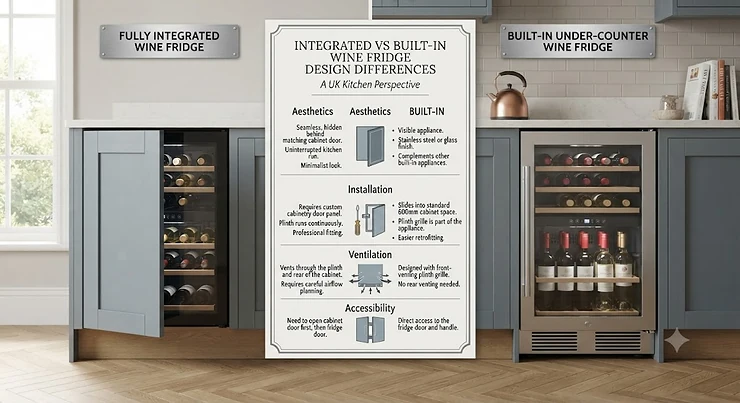
So you’ve decided your kitchen needs a wine fridge, and now you’ve hit the wall every renovator eventually hits: integrated or built in? The terms get thrown around almost interchangeably by kitchen showrooms, which is exactly why so many people end up with the wrong unit wedged into the wrong gap. An integrated wine fridge is designed to disappear entirely behind a matching furniture door panel, so it reads as just another cupboard. A built in wine fridge, by contrast, has its own visible fascia and sits flush with your worktop or cabinetry, proudly on show rather than hidden away. Neither is objectively “better” — they solve different design problems, and the wrong choice can mean a wonky door, a fridge that overheats, or a hole in the kitchen where the wine should be.
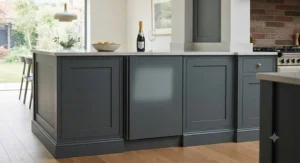
This guide breaks down what is the difference between integrated and built in wine fridge units in plain English, walks through what fully integrated wine fridge meaning actually implies for your cabinetmaker, and reviews seven real models available through amazon.co.uk, spanning honest budget buys through to serious kitchen centrepieces. Which?’s own wine cooler testing covers models spanning a wide price spread, so there’s a genuine range to navigate whatever your budget looks like. We’ll cover installation reality, running costs, common buying mistakes, and the specific cabinetry details — furniture door panel, overlay door, plinth grilles — that decide whether your new appliance looks bespoke or looks bodged.
Quick Comparison Table: Integrated vs Built In vs Freestanding
| Style | Door | Ventilation | Typical Install Cost | Best For |
|---|---|---|---|---|
| Fully Integrated | Hidden behind furniture door panel | Rear + top/bottom via plinth grille | Higher (bespoke joinery) | Seamless, handle-less kitchens |
| Built In / Built Under | Own visible fascia, flush fit | Front vent, grille beneath door | Moderate | Showing off a collection under the counter |
| Freestanding | Own visible fascia, any finish | Rear and side clearance needed | Lowest (plug and go) | Renters, flexible layouts, home bars |
Reading across that table, the jump from freestanding to built in is mostly about ventilation discipline rather than price — you’re paying for a front-venting system that lets the unit sit flush without cooking itself. The bigger cost jump comes with full integration, because a furniture door panel has to be sized, hung, and ventilated correctly, typically via a plinth grille or a self-venting fan system built into the housing, and that’s carpentry, not just plumbing in a plug. If your kitchen is already fitted and you simply have a gap to fill, built in is nearly always the pragmatic choice; if you’re designing from scratch and want zero visual interruption, integration is worth the extra planning.
💬 Found a style that fits your kitchen already? Scroll down to compare our top 7 picks and see current availability!😊
Top 7 Integrated & Built In Wine Fridges: Expert Analysis
Below are seven genuine, currently available models spanning budget under-counter units through to premium bespoke cabinets. Each one has been chosen to represent a different price bracket and a different installation style, so whichever gap you’re filling, there should be a sensible match. Where I mention customer feedback, it’s aggregated review sentiment drawn from retailer and marketplace listings, never invented star ratings or fabricated quotes.
1. Cookology CWC600SS — best budget under-counter option
The Cookology CWC600SS is the entry point into proper under-counter wine storage without the bespoke joinery bill. Rated for 54 bottles across a 135-litre cabinet, it’s built to slot into a standard 60cm run of units and run as a built-under appliance from day one. The digital temperature control and reversible door aren’t flashy, but they cover the two things a beginner collection actually needs: consistency and the flexibility to hang the door whichever way your kitchen layout demands. Based on the spec comparison with pricier rivals, what you’re sacrificing here is dual-zone cooling and premium vibration damping, not core reliability. This is the sensible pick for someone building their first proper collection — students becoming hosts, young couples furnishing a first kitchen, or anyone who wants wine stored correctly without remortgaging the extension. Reviewers consistently note that the sliding shelves make loading and unloading noticeably easier than fixed racking, though a recurring theme in aggregated feedback is that the compressor is audible in a quiet kitchen at night, so it’s not the choice for an open-plan space where noise really matters.
Pros:
- ✅ Genuine 54-bottle capacity at a budget price point
- ✅ Reversible door suits either side of a run
- ✅ Sliding shelves make loading easier than fixed racks
Cons:
- ❌ Single temperature zone only, no red/white split
- ❌ Audible compressor noise reported in quiet rooms
Expect this model to sit in the under-£400 range, and at that price it represents solid value for a first wine fridge, provided you’re not chasing whisper-quiet running or dual-zone flexibility.
2. Dellonda Baridi DH31 — best built-in for tight budgets
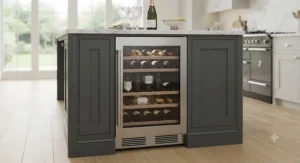
The Baridi DH31 is a stainless steel, 85-litre under-counter cooler with a built-in thermostat and a lockable door — genuinely useful if there are children or thirsty house guests around. What most buyers overlook about this model is the security lock; it’s a small feature that turns an appliance into a proper wine store rather than a glorified drinks fridge anyone can raid. The digital thermostat covers a workable single-zone range suitable for everyday drinking wine rather than serious long-term ageing, and the stainless finish is designed to sit flush under a worktop as a built-in unit. Aggregated customer feedback on this Baridi range tends to praise the straightforward controls and the tidy stainless fascia, while a recurring complaint concerns the door seal needing occasional adjustment after a year or two of daily use — not unusual at this price tier, but worth noting before you commit. For anyone converting an existing gap left by an old dishwasher or under-counter fridge, this is one of the more straightforward built-in retrofits going, since it doesn’t demand a bespoke furniture door panel.
Pros:
- ✅ Lockable door protects the collection from curious hands
- ✅ Stainless finish suits a built-in retrofit without new joinery
- ✅ Simple digital thermostat, minimal learning curve
Cons:
- ❌ Single zone limits serious red and white separation
- ❌ Door seal reportedly needs attention after extended use
Price sits in the under-£300 range at the time of research, making it one of the most accessible genuinely built-in options on this list.
3. Hoover HWCB 60D UK/N — best mid-range dual-zone integrated
The Hoover HWCB 60D UK/N is a proper 60cm integrated wine cooler, holding 38 bottles across two independently controlled zones running roughly 5–18°C. Here’s what to weigh: dual-zone cooling means you can hold a Sauvignon Blanc and a Rioja at their correct serving temperatures simultaneously, which single-zone units simply can’t do, and that’s the single biggest practical upgrade most households actually notice day to day. The wooden shelving reduces vibration transfer compared with metal racking, and the charcoal filter tackles the musty smell that can otherwise creep into a sealed cabinet over time. What most buyers overlook is the hOn app integration with Vivino label scanning, which turns an ordinary fridge into a basic cellar-management tool. Reviewers consistently note the dual-zone accuracy as the standout feature, while a common complaint in user reviews concerns the interior LED being a touch bright for a darkened kitchen at night. As an integrated 60cm unit it requires a furniture door panel to disappear into cabinetry, or it can be run with its own black fascia visible as a built-in unit — genuinely flexible either way.
Pros:
- ✅ True dual-zone control for reds and whites together
- ✅ Wooden shelving reduces vibration versus metal racks
- ✅ Works as integrated behind a panel or visible built-in
Cons:
- ❌ Interior LED brightness criticised in some user reviews
- ❌ App features add little value without a smartphone habit
Expect a price in the mid-to-high £400s, which places it firmly as the mid-range benchmark against which cheaper and pricier units should be judged.
4. Amica AWC600SS — best value stainless finish for open-plan kitchens
Amica’s AWC600SS is a 60cm stainless steel wine cooler built around dual temperature zones and a total capacity in the mid-40s for standard Bordeaux bottles. The spec sheet won’t tell you this, but user reports suggest the stainless fascia handles fingerprints better than glossy black finishes, which matters if the unit is going somewhere highly visible in an open-plan kitchen-diner. Electronic temperature control and an over-temperature alarm cover the practical basics, while height-adjustable feet make it more forgiving than most units when your floor isn’t perfectly level — a detail that matters more than people expect until they’re the one shimming a wine fridge with beer mats. This is a strong match for households who entertain regularly but don’t have a serious ageing collection to protect; it’s built for storage and serving rather than decade-long cellaring. Aggregated review sentiment tends to flag the electronic display as clear and easy to read even from across a kitchen island, with occasional comments about the compressor cycling audibly during the warmest summer weeks.
Pros:
- ✅ Dual-zone cooling for mixed red and white collections
- ✅ Height-adjustable feet forgive an uneven kitchen floor
- ✅ Stainless finish resists visible fingerprint marks
Cons:
- ❌ Compressor noise more noticeable in hot weather
- ❌ Energy rating trails newer integrated rivals
Price typically falls in the £400-£500 range, positioning it as a direct rival to the Hoover above with a slightly more premium visual finish.
5. AEG 5000 Series AWS4052B5B — best mid-premium integrated under-counter
AEG’s 5000 Series wine fridge is an 82cm integrated under-counter unit built around what the brand calls its “3 Fundamentals of Cellaring” — stable temperature, protection from light, and freedom from vibration. Based on the spec comparison with entry-level rivals, the extendable wooden shelves on telescopic runners are the genuine upgrade here: you can pull a shelf fully clear of the cabinet to inspect labels or select a bottle without disturbing the rest of the rack, something budget models with fixed shelving simply can’t offer. Top LED illumination lights the collection without introducing heat into the cabinet interior, a subtle but real advantage over cheaper side-lit designs. Reviewers consistently note the telescopic shelving as the feature that sells them, describing the day-to-day usability as noticeably better than their previous cooler, while a fair number mention that the taller 82cm housing needs careful measuring against tall cabinet runs before ordering. As an integrated model, it’s designed to disappear behind a furniture door panel matched to your kitchen cabinetry, making it a strong pick for anyone renovating a kitchen from scratch.
Pros:
- ✅ Telescopic wooden shelves fully extend for easy access
- ✅ Top LED lighting avoids adding heat to the cabinet
- ✅ 52-bottle capacity suits a genuinely growing collection
Cons:
- ❌ Taller 82cm housing needs careful cabinet measuring
- ❌ Requires a properly ventilated furniture door panel to integrate
Expect a price in the £700-£900 range, which puts it squarely in mid-premium territory for households serious about their collection but not yet chasing luxury cellaring.
6. Caple Wi6161 — best premium in-column integrated cooler
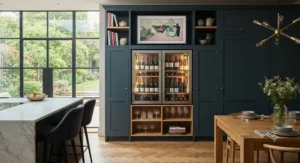
The Caple Wi6161 is a dual-zone, 60cm integrated undercounter wine cooler from a British-founded appliance brand with a strong reputation in bespoke kitchen design. It’s a premium wine cooler designed to sit behind a furniture door matched to your kitchen cabinet so it blends in seamlessly, which is precisely the point — this is a unit designed from the outset for a designer kitchen where nothing is meant to look like an appliance. What most buyers overlook about Caple’s integrated range is the ventilation engineering: most models need a plinth grille for airflow, though some units in the range use a self-ventilating fan that draws cool air from beneath the door and expels warm air above it, removing the need for extra cabinetry vents altogether. Dual independently controlled zones mean serious collectors can hold ageing reds separately from ready-to-drink whites. Aggregated feedback on Caple’s integrated range tends to highlight the two-year guarantee and quiet running as strong points, with the main hesitation being the extra planning required around the matching door panel before installation day. This is squarely aimed at kitchen renovators working with a designer or joiner rather than a straightforward drop-in replacement.
Pros:
- ✅ Genuine dual-zone control for mixed collections
- ✅ Self-ventilating options remove the need for extra cabinet vents
- ✅ Backed by a two-year guarantee from a UK-established brand
Cons:
- ❌ Requires a bespoke furniture door panel to integrate properly
- ❌ Premium price relative to non-integrated dual-zone rivals
Expect this unit in the £900-£1,200 range, reflecting both the brand positioning and the engineering behind fully hidden installation.
7. Liebherr UWKes 1752 GrandCru — best luxury built-under wine cabinet
The Liebherr UWKes 1752 GrandCru sits at the top of this list for good reason: Liebherr’s reputation among serious collectors rests on genuinely precise, stable single-zone cooling rather than flashy extras. This built-under cabinet holds 46 standard Bordeaux bottles with a flush-mounted door assembly designed to sit level with surrounding units. What the spec sheet won’t tell you, but wine enthusiasts consistently mention, is that Liebherr’s compressor engineering keeps temperature swings unusually tight compared with cheaper compressors that cycle more aggressively — exactly the stability serious ageing wines need over years, not weeks. The digital display gives a precise readout rather than a vague dial, and the German engineering pedigree means this unit is built to run for well over a decade with proper care. Aggregated reviewer sentiment across retailers is strongly positive on quietness and long-term reliability, with the main honest criticism being that a single temperature zone limits flexibility for households who want reds and whites split — if that’s a priority, Liebherr’s dual-zone Vinidor range is the alternative to look at instead. This is the pick for someone who has already decided they’re serious about wine, not dabbling.
Pros:
- ✅ Renowned temperature stability for long-term ageing
- ✅ Flush-mounted door assembly fits precisely into cabinetry
- ✅ German engineering with a strong long-term reliability reputation
Cons:
- ❌ Single temperature zone only on this model
- ❌ Premium price reflects the brand and build quality
Expect a price above £1,200, often well beyond it depending on finish — this is a considered long-term investment rather than an impulse kitchen upgrade.
Top 7 Products at a Glance
| # | Model | Capacity | Zones | Style | Price Range |
|---|---|---|---|---|---|
| 1 | Cookology CWC600SS | 54 bottles | Single | Built-under | Under £400 |
| 2 | Dellonda Baridi DH31 | ~85L | Single | Built-in | Under £300 |
| 3 | Hoover HWCB 60D UK/N | 38 bottles | Dual | Integrated/Built-in | Mid-£400s |
| 4 | Amica AWC600SS | ~46 bottles | Dual | Built-in | £400-£500 |
| 5 | AEG AWS4052B5B | 52 bottles | Dual | Integrated | £700-£900 |
| 6 | Caple Wi6161 | Undercounter | Dual | Fully Integrated | £900-£1,200 |
| 7 | Liebherr UWKes 1752 | 46 bottles | Single | Built-under | £1,200+ |
Laid out side by side like this, the pattern is obvious: capacity doesn’t rise in a straight line with price, but temperature precision, shelving engineering, and integration flexibility do. The Cookology and Hoover both punch above their price point on bottle count, while the Caple and Liebherr justify their premium through build quality and how invisibly they integrate, not through headline bottle numbers. Budget buyers chasing raw capacity should look at the top of the table; anyone renovating a kitchen from scratch should focus on the bottom two rows instead.
✨ Don’t Miss These Exclusive Deals!
🔍 Take your kitchen wine storage to the next level with these carefully selected coolers. Click on any highlighted model to check current pricing and availability on amazon.co.uk. The right fit will keep every bottle at its best for years of proper entertaining!
Practical Usage Guide: Installing & Living With Your Wine Fridge
Getting a wine fridge working well isn’t just about plugging it in. In the first 30 days, the most common mistake is loading the cabinet to capacity immediately — resist that urge, because a partially filled unit actually reaches stable temperature faster than one crammed full on day one. Before switching on, let the appliance stand upright for a few hours if it’s been transported on its side, since compressor oil needs time to settle back into place; skipping this step is a leading cause of early compressor failure claims. For built-in and integrated models specifically, check the plinth grille or front vent isn’t obstructed by a kickboard or trailing cable before you slide the unit fully home, because restricted airflow is the single biggest cause of coolers running warmer than their setting suggests.
Ongoing maintenance is refreshingly low-effort: wipe down door seals every few months to stop dust building up and compromising the seal, and vacuum any rear or plinth-mounted vents twice a year to keep dust from clogging the condenser. It’s worth setting your zones with a genuine target in mind rather than guessing — the Wine & Spirit Education Trust’s guidance on storage and serving temperatures is a solid reference point if you’re unsure where to set a dual-zone unit for reds versus whites. If you notice the unit working harder than usual or the internal temperature drifting, check nothing has been pushed against the rear ventilation gap — a common issue after a kitchen deep-clean when items get shuffled back into place slightly too close to the cabinet. Optimisation tricks worth knowing: keep the unit away from ovens, hobs, and direct sunlight through a window, since ambient heat forces the compressor to work harder and shortens its working life, and always leave at least the manufacturer’s specified clearance even on a built-in unit with its own venting system.
Real-World Scenarios: Which Style Actually Suits You?
Picture three households. First, a young professional couple in a one-bedroom flat with an open galley kitchen and a growing collection of 20-30 bottles bought on weekend trips to the supermarket wine aisle — for them, a budget built-under unit like the Cookology or Baridi makes complete sense, since there’s no design commitment to a bespoke furniture door and the appliance can simply slot into an existing gap. Second, a family renovating a forever-home kitchen with a dedicated drinks station and a designer’s involvement from day one — here, full integration behind a matching furniture door panel, using something like the Caple Wi6161 or AEG 5000 Series, is worth the extra planning because the visual payoff over a 15-20 year kitchen lifespan easily justifies it. Third, a genuine collector with fifty-plus bottles they’re actively ageing for years rather than weeks, entertaining often and caring about precise temperature control above all else — the Liebherr GrandCru earns its premium here, because for this household the wine itself is the investment being protected, not just the kitchen’s aesthetic.
None of these scenarios is more “correct” than another; they simply reflect different budgets, different collection sizes, and different levels of design commitment. If you recognise yourself in the first scenario but keep eyeing the third, that’s a signal to buy for your current collection size with an eye on upgrading later, rather than overspending now on capacity you don’t yet need.
How to Choose Between an Integrated and Built In Wine Fridge
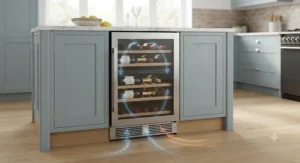
What is the difference between integrated and built in wine fridge models? In short: a fully integrated wine fridge hides completely behind a matching furniture door panel so it looks like ordinary cabinetry, while a built in wine fridge has its own visible fascia that sits flush with surrounding units. Both are fitted into cabinet space, unlike freestanding units which need clearance on every side.
Here’s a practical, step-by-step way to decide which is right for your kitchen:
- Measure your gap precisely first. Built in units are typically a standard 59.5-60cm width designed to replace a kitchen module directly, while fully integrated models often run slightly narrower, with the door itself extending to cover the cabinet frame.
- Decide if you want the appliance visible or hidden. If you want to show off labels and glass fronts, choose built in; if you want an unbroken run of cabinetry, fully integrated is the only option that delivers that.
- Check your budget for joinery, not just the appliance. Fully integrated units need a bespoke furniture door panel matched to your cabinetry, which is a separate cost most people forget to budget for.
- Confirm the ventilation method. Front-venting built in units are simpler to retrofit into an existing kitchen, while integrated models typically need a plinth grille or a self-venting fan system built into the housing.
- Match zones to your drinking habits. A single household mostly drinking one type of wine rarely needs dual zones, while mixed red-and-white households benefit noticeably from independent temperature control.
- Think about resale and longevity. A fully integrated appliance tied to bespoke cabinetry is harder to swap out later than a built in unit with its own standard-sized housing.
- Get a professional to check clearances before you order. Both styles have manufacturer-specified airflow gaps that, if ignored, void warranties and shorten compressor life.
Integrated vs Built In Wine Fridge: The Kitchen Design Difference
Fully Integrated Wine Fridge Meaning
Fully integrated wine fridge meaning, in kitchen design terms, is specific: the appliance’s own door is replaced or overlaid entirely by a decorative furniture door panel that matches the surrounding cabinet doors, complete with matching handles or a handle-less push-to-open mechanism. The compressor, shelving, and cooling mechanism are identical to a standalone unit — what changes is purely the visible face, engineered so nobody glancing across the kitchen can tell an appliance is even there. This is different from “built in,” where the appliance keeps its own factory fascia and is simply slotted into a cabinet-height or under-counter opening.
Furniture Door Panel and Overlay Door Explained
A furniture door panel is a bespoke door, usually made by your kitchen joiner or cabinet supplier, sized to the appliance manufacturer’s exact specification and fixed to brackets on the front of the wine fridge itself. Getting the weight and thickness right matters enormously — too heavy, and the hinges the manufacturer supplies will sag over time; too light, and the door won’t sit flush with neighbouring cabinetry. An overlay door, sometimes used interchangeably with “furniture door panel” but technically slightly different, refers to a door that sits proud over the cabinet frame rather than being inset within it, which is the dominant style in most modern UK kitchens and generally the easier option for matching an integrated appliance seamlessly.
Fitting Into Your Kitchen Cabinetry
Whichever route you choose, your kitchen cabinetry needs to be planned around the appliance early, not squeezed in as an afterthought. Cabinetmakers need the exact aperture height, width, and depth from the manufacturer’s technical sheet before a single panel is cut, and ventilation routes — whether a plinth grille beneath the unit or a top vent above the door line — need to be built into the carcass design from the start. Skipping this step is the single most common reason integrated wine fridges end up running warm or triggering premature compressor wear within the first couple of years.
Common Mistakes When Buying an Integrated or Built In Wine Fridge
The most frequent mistake is buying on bottle count alone without checking the aperture height against existing cabinetry — a 52-bottle unit that’s 5cm too tall for your run is a 52-bottle problem, not a 52-bottle solution. A close second is assuming any appliance can go “integrated” simply by adding a door; units not designed for this typically lack the bracket fittings and ventilation allowances that fully integrated models are engineered with from the factory. Buyers also frequently underestimate ongoing noise: a unit that sounds fine in a showroom can be noticeably more audible once it’s boxed into a quiet, enclosed cabinet run at home, since the surrounding carcass can actually resonate and amplify compressor vibration rather than dampen it. Finally, many people forget to plan the furniture door panel cost and lead time separately from the appliance itself, only to discover the appliance is sitting uninstalled for weeks while a joiner finishes the matching door.
Long-Term Cost & Maintenance
Running costs matter more than the sticker price over a wine fridge’s typical 10-15 year lifespan, and energy rating is the clearest signal available. Energy labelling for household appliances sold in the UK is a legal requirement, and it’s worth checking a model’s rating before assuming a cheaper unit is actually the cheaper option once electricity costs are factored in over a decade. The Energy Saving Trust’s appliance guidance makes the same point for any appliance running around the clock: look at the efficiency label and buy the size you actually need, since running a larger cabinet than your collection requires simply wastes electricity for no practical benefit. Maintenance costs are modest by comparison: expect an occasional door seal replacement, and budget for a professional call-out if the compressor ever needs attention, since these are sealed refrigeration systems that aren’t designed for DIY repair. Total cost of ownership, then, isn’t just the £300 versus £1,200 difference between our budget and premium picks — it’s that difference plus a decade of running costs, which narrows the gap between cheap-but-inefficient and pricier-but-frugal models more than most buyers expect.
Features That Actually Matter (And Those That Don’t)
Dual-zone cooling matters if you genuinely drink both reds and whites regularly; it’s wasted complexity if you only ever buy one type of wine. UV-protected glass matters for any unit positioned near a window or under direct kitchen lighting, since light exposure genuinely does degrade wine over time. Wooden shelving on telescopic runners matters more than it sounds, because it directly reduces the vibration that can disturb sediment in ageing reds. On the other hand, smartphone app connectivity and label-scanning features are pleasant extras rather than genuine buying criteria — nice if included, not worth paying a premium for on their own. Similarly, flashy interior lighting schemes look good in a showroom but contribute nothing to wine quality and, if anything, should be used sparingly since heat and light both work against long-term storage.
Safety, Ventilation & Regulations Guide
Proper ventilation isn’t just about performance — it’s about appliance safety and warranty compliance too. Built-in units rely on front venting through a grille beneath the door, while integrated models generally need airflow from a plinth grille or a top vent, since the compressor expels genuinely warm air that has to escape the cabinet housing rather than recirculate. Overloading a socket circuit is a common but avoidable risk in kitchens where a wine fridge is added alongside an existing dishwasher and washing machine on the same ring; always confirm your kitchen’s electrical circuit has capacity before adding another compressor-driven appliance. On the labelling side, UK regulations require the retailer selling you the appliance to clearly display a current energy efficiency label, and it’s an offence to provide misleading energy information, so a genuine retailer should always be able to show you the rating rather than a vague estimate. When the unit eventually reaches the end of its working life, most retailers offer old appliance collection, or you can take it to a local recycling point rather than leaving a compressor-based appliance for general waste collection.
Problem → Solution: Fixing Common Wine Fridge Issues
Problem: the fridge runs warmer than its display suggests. This is almost always a ventilation issue — check the plinth grille or rear gap isn’t blocked, and give the unit a full day to stabilise after any door has been left open for restocking. Problem: condensation building up inside the cabinet. This usually points to a door seal that’s no longer sitting flush, often from years of daily use; a replacement seal from the manufacturer is a cheap, straightforward fix. Problem: unexpected noise once the unit is boxed into cabinetry. As mentioned earlier, enclosed carcasses can resonate compressor vibration; adding a thin foam strip between the appliance chassis and the surrounding cabinet frame often solves this without any professional call-out. Problem: the furniture door panel doesn’t sit quite flush. This is nearly always a hinge or bracket adjustment issue rather than a faulty appliance — most integrated models include adjustable brackets specifically for this reason, so check the manufacturer’s fitting instructions before assuming something’s broken.

Frequently Asked Questions
❓ What is the difference between integrated and built in wine fridge models?
❓ What does fully integrated wine fridge meaning actually cover?
❓ Can any wine cooler become an integrated wine fridge kitchen design feature?
❓ Do I need a furniture door panel or will an overlay door work instead?
❓ Is a built in wine fridge cheaper than a fully integrated one?
Conclusion
Choosing between an integrated and a built in wine fridge really comes down to how much your kitchen design should hide, and how much you’re happy to plan around bespoke joinery. If you want an appliance that vanishes entirely into a run of cabinetry, budget for a furniture door panel and pick a model genuinely designed for full integration, like the Caple Wi6161 or AEG 5000 Series. If you’d rather keep things simpler and let the fridge show its own fascia, a built in unit like the Hoover HWCB 60D UK/N or Amica AWC600SS gets you flush-fitted storage without the extra carpentry. And if your collection is still growing, there’s no shame in starting with a genuinely affordable built-under option like the Cookology or Baridi and upgrading once your habits — and your bottle count — are clearer. Whatever you choose, get the aperture measurements right, plan the ventilation properly, and check the energy rating before you commit, because a wine fridge is one kitchen appliance that runs 24 hours a day for well over a decade.
✨ Ready to Choose Your Perfect Wine Fridge?
🍷 Compare our top 7 picks above, check current prices and availability on amazon.co.uk, and give your collection the home it deserves!
Recommended for You
- Integrated Wine Fridge UK: 7 Best Built-In Picks for 2026
- 7 Best Built In Wine Fridge Kitchen Units 2026 | Expert UK Fitting Guide
- Best Built In Wine Fridge UK 2026: 7 Top Picks Reviewed
Disclaimer: This article contains affiliate links. As an Amazon Associate, I earn from qualifying purchases. If you purchase products through these links, we may earn a small commission at no additional cost to you.
✨ Found this helpful? Share it with your friends! 💬🤗
