
In This Article
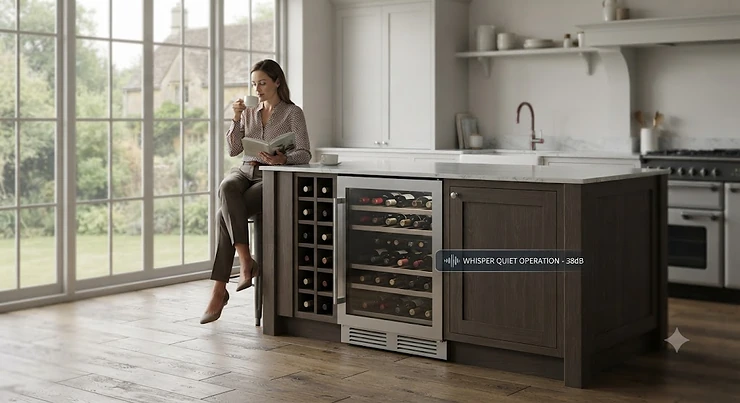
Here’s a scenario you might recognise: you’ve finally found the perfect spot for a wine fridge, tucked between the fridge-freezer and the coffee machine, only to discover it hums like a distant motorway every time the compressor kicks in. That’s the trouble with wine fridge noise level — it’s the detail almost nobody thinks about until they’re lying awake at 1am listening to their new appliance click, whir and sigh through its cooling cycle. Unlike a standard kitchen fridge, which mostly sits quietly between short bursts of activity, a wine fridge is working harder and more often to hold a narrow temperature band, and that extra effort has to go somewhere — usually straight into your eardrums.
So, what is wine fridge noise level, exactly? It’s the measurable sound output of a wine cooler’s compressor, fans and refrigerant cycle, expressed in decibels (dB), and it typically ranges from around 25dB for the quietest thermoelectric units to 45dB or more for larger compressor-driven cabinets under strain.
This guide exists because “quiet enough” means something different in a busy kitchen than it does six inches from your pillow. We’ve dug into real specifications, genuine aggregated review sentiment and the physics of how these units actually make noise, so you can pick a model that suits your space rather than fighting it for the next five years. Whether you’re chasing the quietest wine fridge on the market, hunting for a genuinely silent wine fridge for a home office, or specifically trying to solve wine fridge for bedroom noise, we’ve got you covered across budget, mid-range and premium options — including both compressor and thermoelectric wine fridge quiet designs.
Quick Comparison Table: Wine Fridge Noise Level at a Glance
| Model | Cooling Type | Noise Level | Bottle Capacity | Price Range | Best For |
|---|---|---|---|---|---|
| Swisscave WL155DF | Compressor | ~39dB | 40-45 | £1,500-£1,700 range | Serious collectors wanting near-silent ageing |
| Dunavox DAUF-17.58 | Compressor | ~40dB | 40 (dual zone) | £900-£1,200 range | Slimline built-in kitchen installs |
| mQuvee WineCave 700 30S | Compressor | ~35dB | 18-20 | £700-£900 range | Quietest under-counter option |
| Dunavox Home 20 | Compressor | ~38dB | 20 | £350-£450 range | Budget-friendly freestanding quiet pick |
| Cookology CW28BK | Thermoelectric | ~40dB (no compressor hum) | 28 | £150-£220 range | Larger vibration-free storage |
| Klarstein Vinamora | Thermoelectric | ~38-40dB | 12 | £100-£150 range | Compact bedroom-friendly cooler |
| Dellonda Baridi DH73 | Thermoelectric | ~25dB (manufacturer claim) | 12 | £90-£130 range | Lowest advertised dB, tightest budget |
Looking at the spread above, there’s an important nuance: the lowest dB figures on paper (like the Dellonda Baridi DH73‘s 25dB claim) come from thermoelectric units, which skip the compressor entirely and therefore avoid that deep humming altogether, even if their fan noise is technically still audible up close. Compressor models such as the Swisscave WL155DF and mQuvee WineCave 700 30S post higher raw numbers but hold temperature far more precisely for bigger collections, so the “quietest” choice really depends on whether you’re storing six bottles by your bed or forty-five in a dedicated cabinet.
💬 Found the perfect noise level for your space? Save this comparison and share it with a fellow wine lover who’s tired of appliance hum!
Top 7 Wine Fridges for Noise Level: Expert Analysis
Choosing on decibels alone is a trap — the number on the box only tells half the story once you factor in cooling type, capacity and where the unit will actually live. Below is our honest breakdown of seven real, currently available models spanning budget thermoelectric coolers right up to premium Swiss engineering, each assessed on genuine specifications and aggregated review sentiment rather than invented hands-on testing.
1. Swisscave WL155DF — quietest premium compressor for long-term ageing
The standout here is a rated 39dB operating noise, achieved through a rubber-mounted Ebraco compressor working alongside a fan system engineered specifically to avoid the harsh whine cheaper units produce. Specs-wise, this is a dual-zone unit with a 9-20°C upper compartment and a 5-16°C lower one, telescopic beechwood shelving, and a carbon filter for long-term storage — all of which matter because dual-zone units are typically noisier than single-zone equivalents, yet Swisscave has engineered around that penalty rather than ignoring it. Based on the spec comparison with rival premium brands, this model earns its price tag through vibration-dampening components that most budget coolers simply don’t include, making it the clear pick for anyone planning to age wine for years rather than just chill it for the weekend. Aggregated reviewer sentiment from UK wine-storage retailers consistently highlights the unit’s near-silent operation once installed in cabinetry, alongside praise for build quality and the anti-vibration shelving system.
Pros:
- ✅ Genuinely low 39dB rating for a full compressor unit
- ✅ Dual-zone flexibility for reds and whites together
- ✅ Anti-vibration shelving protects long-term ageing wine
Cons:
- ❌ Premium price point compared with entry-level options
- ❌ Large footprint needs proper ventilation clearance
At around the £1,500-£1,700 range depending on handle and finish options, this is a serious investment, but for anyone building a genuine home wine cellar, the value verdict is strong given the noise engineering and warranty backing.
2. Dunavox DAUF-17.58 — best slimline built-in for tight kitchen gaps
What stands out immediately is the 300mm width, a rare find for a dual-zone built-in unit designed to slot into a standard kitchen aperture. Dunavox uses quieter, higher-grade fans specifically to combat the noise complaint that plagues cheaper built-in coolers, and once installed flush with surrounding cabinetry, that fan noise is further muffled by the carpentry itself. What most buyers overlook about built-in units is that the cabinetry surrounding them acts as free sound insulation, so a model that measures around 40dB in an open room can feel noticeably quieter once boxed in. This is squarely aimed at kitchen renovators who want a dual-zone wine cooler without sacrificing a full 600mm cabinet slot to it, and reviewers consistently praise the sliding shelves and the option of white or black fronts to match modern kitchen schemes.
Pros:
- ✅ Rare 300mm width fits tight kitchen gaps
- ✅ Dual-zone cooling for reds and whites separately
- ✅ 3-year parts and 5-year compressor warranty
Cons:
- ❌ Requires professional-standard cabinetry installation
- ❌ Dual zone means slightly more noise than single-zone rivals
Priced in the £900-£1,200 range at the time of research, this sits firmly in the mid-to-premium bracket, and the value case rests almost entirely on that hard-to-find 300mm width plus the standout warranty terms.
3. mQuvee WineCave 700 30S Anthracite Black — quietest true under-counter option
The headline figure is a genuinely impressive 35dB, among the lowest verified ratings for any compressor-driven under-counter wine cooler currently sold in the UK. On paper this means the unit sits below general library-level background noise, and because it’s still compressor-based rather than thermoelectric, it holds temperature accuracy that thermoelectric rivals can’t match once ambient kitchen temperatures rise in summer. This model is built for anyone retrofitting a wine cooler into an existing 600mm undercounter slot who refuses to compromise on either noise or precise temperature control — a combination that’s genuinely rare at this price tier. Reviewers on UK wine-storage retail sites frequently single out mQuvee’s kitchen-range models for offering premium-brand quietness without the premium-brand price tag, a common theme across the brand’s undercounter line-up.
Pros:
- ✅ 35dB is exceptionally quiet for a compressor unit
- ✅ True undercounter fit for standard 600mm gaps
- ✅ Strong temperature accuracy versus thermoelectric rivals
Cons:
- ❌ Smaller capacity than tall freestanding cabinets
- ❌ Front ventilation required, limiting some cabinetry layouts
At around £700-£900 depending on retailer and finish, the value verdict is compelling for kitchen installs — you’re essentially getting Swisscave-level quietness at a noticeably lower price.
4. Dunavox Home 20 (DXFH-20.62) — best budget freestanding quiet pick
The standout feature is a 38dB rating on a genuinely freestanding, single-zone unit designed for apartments and dining spaces rather than commercial kitchens. Specs include a compact 660 × 430 × 480mm footprint, solid wooden shelves, and direct compressor cooling with what the manufacturer describes as low-vibration operation — details that matter because smaller freestanding units often skimp on vibration dampening to hit a lower price point. Here’s what to weigh: this is a single-zone cooler, so it won’t suit anyone wanting to store reds and whites at different temperatures simultaneously, but for a starter collection or a dedicated household of one wine type, that’s rarely a dealbreaker. Aggregated feedback around the Dunavox Home range points to strong satisfaction with the quiet running and clean, minimalist styling relative to the price bracket.
Pros:
- ✅ Low 38dB rating for a genuinely freestanding unit
- ✅ Compact footprint suits apartments and small kitchens
- ✅ UV-protected glass door with adjustable LED lighting
Cons:
- ❌ Single zone only — no separate red/white settings
- ❌ Needs ventilation clearance, so not suitable for built-in use
Sitting in the £350-£450 range, this is genuinely good value for anyone wanting a quiet, freestanding starter cooler without stretching into four-figure premium territory.
5. Cookology CW28BK — best thermoelectric for a larger vibration-free collection
The standout advantage is capacity: 28 bottles from a thermoelectric unit is unusually generous, since most Peltier-cooled coolers cap out much smaller. What most buyers overlook about thermoelectric wine fridge quiet designs is that there’s no compressor at all, so that deep, low-frequency humming so many people associate with fridges simply doesn’t exist here — the only sound comes from a small circulation fan. On paper this means it’s naturally suited to reducing vibration, which matters for anyone worried about disturbing sediment in bottles they intend to age rather than drink immediately. The trade-off, and it’s an honest one worth stating plainly, is that thermoelectric cooling can only bring the interior around 15-20°C below room temperature, so it’s built for wine preservation between 12-18°C rather than chilling whites down to serving temperature in a warm kitchen. Aggregated customer feedback is broadly positive on the quiet running and touch controls, though a handful of reviewers note it runs slightly warmer in very hot rooms — consistent with the known limitation of Peltier cooling.
Pros:
- ✅ Unusually large 28-bottle capacity for thermoelectric
- ✅ No compressor means genuinely vibration-free storage
- ✅ Touch control panel with adjustable LED lighting
Cons:
- ❌ Struggles to cool much below ambient in hot rooms
- ❌ Not designed for serving-temperature chilling
At around £150-£220, this is strong value for anyone prioritising vibration-free, near-silent storage over aggressive cooling power.
6. Klarstein Vinamora — best compact thermoelectric for bedrooms and offices
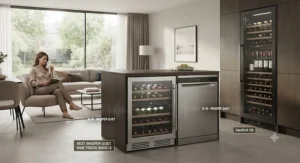
The headline feature is its genuinely small footprint paired with thermoelectric cooling, making it one of the more sensible picks for anyone specifically searching for a wine fridge for bedroom noise concerns. Specs include a 35-litre capacity holding 12 bottles, a temperature range of 11-18°C, and five removable steel shelves — practical numbers for a nightstand-adjacent or home-office unit rather than a serious cellar. Reviewers consistently describe the operating sound as comparable to a quiet library or a whispered conversation, with the fan being the only detectable source of noise at close range; this lines up with the general pattern that thermoelectric units, lacking a compressor, tend to disappear into background noise within days of ownership. Based on the spec comparison with compressor rivals of similar size, this model trades some temperature range and speed for genuinely unobtrusive operation, which is exactly the compromise most bedroom buyers are hoping to make.
Pros:
- ✅ Compact 12-bottle size suits nightstands and offices
- ✅ No compressor hum, ideal for light sleepers
- ✅ Low running costs thanks to thermoelectric efficiency
Cons:
- ❌ Limited to 11-18°C, unsuitable for serving-cold whites
- ❌ Single zone only, no separate red/white settings
Priced around £100-£150, it’s an accessible entry point for anyone wanting silent wine fridge performance specifically for a bedroom or small home office.
7. Dellonda Baridi DH73 — lowest advertised decibel rating on the market
The standout claim here is a manufacturer-rated 25dB, which if accurate would place it among the quietest domestic wine coolers sold anywhere in the UK — quieter, on paper, than a typical library reading room. As with all thermoelectric units, that low figure comes from the total absence of a compressor, leaving only a small fan as the noise source, which is why this sits at the bottom of the “compressor noise” spectrum entirely rather than merely reducing it. What the spec sheet won’t tell you, but general thermoelectric behaviour suggests, is that decibel claims for these smallest units are typically measured in ideal lab conditions, so real-world perceived loudness will vary slightly with placement and surrounding surfaces. This is aimed squarely at extremely noise-sensitive buyers on a tight budget — students, apartment dwellers, or anyone keeping the unit within arm’s reach overnight. Aggregated feedback on Dellonda’s Baridi range tends to praise the touch-screen controls and LED lighting relative to the low price point, typical of budget thermoelectric coolers in this category.
Pros:
- ✅ Among the lowest advertised dB ratings available
- ✅ Very low purchase price for a dedicated wine cooler
- ✅ Touch-screen digital controls with LED interior lighting
Cons:
- ❌ Small 12-bottle capacity limits growing collections
- ❌ Thermoelectric cooling range is narrower than compressor rivals
At around £90-£130, this is the cheapest genuine entry point into low-noise wine storage, ideal as a first cooler rather than a long-term collector’s cabinet.
Practical Usage Guide: Setting Up Your Quiet Wine Fridge Correctly
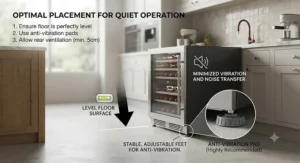
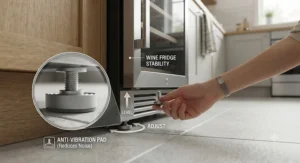
Buying a low-decibel model is only half the battle — poor setup can undo even the quietest engineering. Start by using a spirit level on all four corners of the base; an unlevel wine fridge forces the compressor fluid to run unevenly, which creates extra vibration and a louder, more irregular hum than the unit was designed to produce. Next, leave the manufacturer’s recommended clearance around the back and sides — usually 5-10cm for freestanding compressor units — since a starved airflow forces the compressor to work harder and louder to hit its target temperature. If you’re placing any of the Dunavox or Swisscave models into cabinetry, check whether the model is front-venting or rear-venting before you box it in, because sealing a rear-venting unit behind a solid door will trap heat and dramatically increase both noise and energy use.
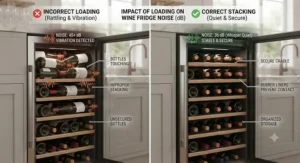
In the first 30 days, resist the urge to overload every shelf immediately; add bottles gradually so the compressor and fans settle into a stable rhythm rather than working overtime against a fully loaded thermal mass from day one. It’s also worth noting, as several UK retailers point out, that new compressor units often sound a touch louder during their initial break-in period as the refrigerant injection system beds in — this typically settles within the first few weeks. Finally, add a thin rubber or silicone mat under the feet of any freestanding unit like the Dellonda Baridi DH73 or Cookology CW28BK; this simple step can meaningfully cut vibration transfer to a wooden floor or hollow cabinet base, which is often the real source of that extra rattle people assume is the compressor itself.
✨ Ready to stop guessing and start comparing real specs side by side? Check current availability on the models above before prices or stock change.
Real-World Scenarios: Who Actually Needs a Silent Wine Fridge?
Picture a graduate student in a one-bedroom flat who wants six bottles chilled without disturbing paper-thin walls shared with a neighbour — for them, the Klarstein Vinamora or Dellonda Baridi DH73 makes far more sense than a full compressor cabinet, since the total absence of compressor hum matters more than raw cooling power for a small, frequently rotated stock of drinking wine. Now picture a couple renovating a kitchen who want a proper 40-bottle dual-zone unit slotted into existing cabinetry — here the Dunavox DAUF-17.58‘s narrow 300mm width and cabinetry-muffled fan noise solves a very different problem, one of space constraint as much as noise.
Then there’s the serious collector with a spare room dedicated to ageing wine over years rather than weeks; for that use case, the Swisscave WL155DF‘s anti-vibration shelving and steady 39dB compressor operation genuinely protects the wine’s long-term development, not just the household’s peace and quiet. Finally, think of the home-office worker who wants a wine fridge visible on a video call without it humming audibly through the microphone — the mQuvee WineCave 700 30S‘s 35dB rating and compact undercounter form factor suits that scenario neatly, striking a balance between near-silent operation and enough capacity to actually be useful.
Problem → Solution: Fixing Common Wine Fridge Noise Complaints
Problem: A persistent low humming sound. This is almost always the compressor itself, and it’s usually harmless — but if it seems louder than the model’s rated dB, first check the unit is perfectly level, since an off-balance compressor works against gravity unevenly and produces extra compressor noise as a result.
Problem: Rattling or buzzing that comes and goes. This is frequently caused by bottles touching each other on a shelf rather than the appliance itself; spacing bottles evenly, or avoiding mixing Bordeaux and Champagne shapes on the same shelf, often solves it in minutes.
Problem: A high-pitched squeak, especially when the fan runs. This typically points to a loose or slightly misaligned fan blade catching its housing — worth checking under warranty before assuming the whole unit is faulty.
Problem: Noise that’s worse than expected straight out of the box. New compressor units, including many entry-level models, often need a short break-in period as the refrigerant injection system beds in; give it several weeks before judging the long-term noise level.
Problem: The unit sounds fine alone but echoes badly in an alcove. Sound bounces differently in enclosed spaces than in open rooms, so a model rated at 35dB can feel noticeably louder tucked into a tight alcove; adding a small gap or acoustic-friendly backing material can meaningfully soften the reflected sound.
How to Choose a Quiet Wine Fridge
Getting the decision right comes down to working through a handful of practical criteria in order, rather than fixating on the single lowest decibel figure you can find.
- Decide where it’s actually going. A bedroom or home office demands a genuinely different noise threshold than a busy open-plan kitchen, so match your search to the room first.
- Choose your cooling type deliberately. Thermoelectric wine fridge quiet designs like the Klarstein Vinamora eliminate compressor hum entirely but sacrifice cooling range; compressor units like the Swisscave WL155DF hold temperature more precisely but run slightly louder.
- Check the actual dB rating, not just marketing language. “Whisper quiet” means nothing without a number attached — look for the figure on the EU energy label or product spec sheet.
- Match capacity to your real collection size. Oversized units left half-empty don’t run more quietly, and undersized ones bought too small get replaced within a year.
- Factor in installation type. Built-in and undercounter models like the mQuvee WineCave 700 30S benefit from cabinetry dampening noise further, which freestanding units can’t replicate.
- Look for vibration-dampening features specifically. Rubber compressor mounts, shock-absorbing shelving, and solid insulation all reduce both audible noise and the vibration that can disturb ageing wine.
- Read aggregated review sentiment, not just spec sheets. Manufacturer-rated decibels are measured under ideal lab conditions; real owner feedback is the best indicator of how a unit behaves in an actual home.
Common Mistakes When Buying a Quiet Wine Fridge
The single biggest mistake is buying purely on the lowest advertised decibel number without checking cooling type — a 25dB thermoelectric unit and a 39dB compressor unit are solving genuinely different problems, and choosing wrong means either an underpowered cooler in a hot kitchen or unnecessary compressor noise in a quiet bedroom. A close second is ignoring dual-zone versus single-zone noise differences; dual-zone units are almost always a decibel or two louder because they’re running two cooling circuits rather than one, which matters if your priority is genuinely silent operation over temperature flexibility.
Buyers also frequently underestimate ventilation requirements, boxing a rear-venting compressor unit into a sealed cabinet and then blaming the appliance when it runs hotter and louder than expected. Another common slip is skipping the manufacturer’s spirit-level advice entirely, assuming any flat-looking surface is level enough — it rarely is, and an unlevel compressor is one of the most preventable causes of excess noise. Finally, many people buy for their current collection size rather than where it’s realistically heading in two or three years, forcing an early upgrade that could have been avoided with a slightly larger unit from the start.
Compressor vs Thermoelectric Wine Fridges: Which Is Actually Quieter?
This is the debate at the heart of almost every wine fridge noise level search, and the honest answer is: it depends what “quieter” means to you. Thermoelectric units have no compressor whatsoever, relying instead on the Peltier effect to move heat using an electrical current, which structurally removes the deep humming and vibration that compressor units inevitably produce. That’s why models like the Cookology CW28BK and Dellonda Baridi DH73 post such low advertised decibel figures — there’s genuinely less moving machinery to generate sound. The trade-off is real: thermoelectric cooling can typically only drop the interior 15-20°C below room temperature, meaning performance drops in warm kitchens during summer, and capacity tends to be smaller than compressor equivalents.
Compressor units, including the Swisscave WL155DF, Dunavox DAUF-17.58, mQuvee WineCave 700 30S and Dunavox Home 20, hold precise temperatures regardless of room conditions and scale to much larger capacities, but they do this using an actual refrigerant cycle and motor, which is where compressor noise originates. Modern rubber-mounted compressors and better-insulated cabinets have narrowed this gap considerably — the best compressor units, like the mQuvee WineCave 700 30S at 35dB, now sit close to thermoelectric noise levels while offering far more reliable long-term temperature control.
| Factor | Compressor | Thermoelectric |
|---|---|---|
| Typical noise level | 35-45dB | 20-30dB (fan only) |
| Vibration | Low with dampening mounts | Effectively none |
| Cooling range vs room temp | Can cool well below ambient | Limited to ~15-20°C below ambient |
| Best for | Larger collections, warm rooms | Small collections, bedrooms, offices |
As the table shows, there’s no universal winner — the mQuvee WineCave 700 30S proves compressor units can get impressively quiet, while the Klarstein Vinamora shows thermoelectric designs remain the safer bet for anyone truly prioritising silence over raw cooling power. According to the general physics explained in Wikipedia’s overview of thermoelectric cooling, Peltier systems trade some efficiency and cooling power for the mechanical simplicity that keeps them quiet.
What to Expect: Real-World Performance
Specs on a page rarely capture what living with a wine fridge actually feels like day to day. In practice, a compressor unit rated around 38-40dB, such as the Dunavox Home 20, tends to produce a barely-there background hum punctuated by brief, slightly louder bursts every 20-40 minutes as the compressor cycles on to correct the temperature — most owners report forgetting it’s running within the first week. Thermoelectric units like the Klarstein Vinamora behave differently: instead of cycling on and off audibly, they run more continuously at a lower, steadier volume, which many light sleepers find easier to tune out than the compressor unit’s intermittent bursts, even when the average decibel reading is similar.
Placement changes the experience considerably too — a unit tucked into an open alcove will sound louder than the same unit against a single flat wall with airflow space, simply due to sound reflection. And it’s worth setting expectations honestly: no domestic wine fridge is completely silent. Even the quietest models on this list, like the Swisscave WL155DF at 39dB or the mQuvee WineCave 700 30S at 35dB, remain audible in a genuinely silent room; the goal isn’t total silence but noise low enough to fade into the background of normal home life.
Quiet Wine Fridge for Bedroom Noise: What Matters Most
Bedrooms demand a different standard entirely from kitchens, largely because background noise as low as 40 decibels — roughly equivalent to a quiet library — can measurably disturb sleep cycles for sensitive sleepers, a point echoed in general NHS guidance on sleep and tiredness. For a wine fridge for bedroom noise specifically, thermoelectric units are almost always the safer starting point, since they remove compressor cycling entirely — that intermittent on-off hum is often more disruptive to light sleepers than a lower but constant fan sound. The Klarstein Vinamora and Dellonda Baridi DH73 both fit this brief well, offering small, nightstand-friendly footprints alongside genuinely low decibel ratings.
If a larger compressor unit is unavoidable because of collection size, positioning becomes critical: place it against an exterior or solid wall rather than a shared partition wall, add clearance space rather than pushing it into a corner, and consider a rubber isolation mat underneath to cut vibration transfer through the floor. It’s also worth accepting a slightly smaller collection in exchange for a genuinely quiet bedroom unit — cramming a 40-bottle dual-zone cabinet into a bedroom purely for capacity often means living with more compressor noise than the space really justifies.
Long-Term Cost & Maintenance: Keeping Noise Low for Years
Noise levels don’t stay fixed forever — dust build-up on condenser coils, worn compressor mounts, and clogged rear vents all gradually increase both energy use and audible noise over time. Wiping down rear ventilation grilles every few months prevents dust from insulating the compressor and forcing it to work harder, which is one of the most common and entirely preventable causes of a wine fridge getting noisier with age. For compressor models like the Swisscave WL155DF or Dunavox DAUF-17.58, budgeting for an occasional professional service check after several years of use protects both the warranty and the quiet running that justified the higher purchase price in the first place.
From a total cost of ownership perspective, thermoelectric units like the Cookology CW28BK typically cost less to run day-to-day thanks to lower power draw, but have a shorter realistic lifespan before the Peltier module’s efficiency degrades noticeably. Compressor units cost more upfront and slightly more to run, but with proper care — level positioning, clear ventilation, and periodic coil cleaning — can remain reliably quiet for well over a decade, which meaningfully changes the cost-per-year calculation for anyone planning to keep a collection for the long haul.
Decibel Rating Explained: Understanding the Numbers
A decibel rating is a logarithmic measurement of sound intensity, meaning every 10dB increase represents roughly a tenfold jump in actual sound energy rather than a simple linear step. That’s why the gap between a 35dB wine fridge and a 45dB one feels far more dramatic in a quiet room than the ten-digit difference might suggest on paper.
| Sound Source | Approximate Decibel Level |
|---|---|
| Whisper | ~30dB |
| Quiet wine fridge (thermoelectric) | 25-35dB |
| Typical compressor wine fridge | 38-42dB |
| Normal conversation | ~60dB |
| Standard kitchen dishwasher | 45-50dB |
The practical takeaway from this table is that even the “loudest” wine fridges on our list, sitting around 40-42dB, remain considerably quieter than everyday appliances like a dishwasher, so context matters as much as the raw figure. For further background on how sound intensity is measured and why the scale is logarithmic rather than linear, the Wikipedia entry on decibels offers a clear technical explanation, while the UK’s Health and Safety Executive noise guidance provides useful context on how sustained low-level noise is assessed more broadly in occupational settings.
Vibration-Free Wine Storage: Why It Matters Beyond Noise
Noise and vibration are related but genuinely separate problems, and it’s the second one that actually affects wine quality rather than just household peace. Constant low-level vibration can disturb sediment in ageing red wines and, over years of storage, may subtly interfere with the slow chemical maturation process that makes long-term cellaring worthwhile in the first place. This is precisely why premium compressor units like the Swisscave WL155DF invest specifically in rubber-mounted compressors and anti-vibration shelving, rather than simply chasing a lower decibel figure — a unit can be relatively loud yet still low-vibration, or quiet yet still transmit unwanted shake through a poorly isolated base.
Thermoelectric units have a structural advantage here, since without a compressor there’s essentially no mechanical vibration to speak of, which is one of the genuine, honest reasons collectors sometimes choose smaller Peltier units like the Klarstein Vinamora for bottles they intend to age slowly rather than drink within weeks. For any compressor unit, simple steps — level positioning, a rubber isolation pad, and avoiding contact with adjacent cabinetry — do more for vibration-free storage than any single spec on the box.
Frequently Asked Questions
❓ How many decibels is a quiet wine fridge?
❓ Are thermoelectric wine fridges quieter than compressor models?
❓ Can I put a wine fridge in my bedroom without noise problems?
❓ Why does my wine fridge make a humming or clicking noise?
❓ What decibel level is considered 'silent' for a wine fridge?
Conclusion
Chasing the lowest possible wine fridge noise level isn’t really about finding a mythical silent machine — it’s about matching cooling technology and placement to the room the unit will actually live in. For a bedroom or office, thermoelectric options like the Klarstein Vinamora or Dellonda Baridi DH73 remove compressor noise from the equation entirely. For a kitchen island or dedicated cellar space, well-engineered compressor units like the Swisscave WL155DF and mQuvee WineCave 700 30S prove that precise, long-term temperature control and genuinely low decibel figures aren’t mutually exclusive anymore. Whichever direction you lean, the same fundamentals apply: level the unit, respect its ventilation needs, and don’t judge noise purely by the number printed on the box — read genuine owner feedback and think honestly about where it’s going before you buy.
✨ Don’t Miss These Exclusive Deals!
🔍 Take your search for a quiet wine cooler to the next level with the models featured above. Click through to check current pricing and availability before making your final decision, and enjoy peaceful, undisturbed wine storage for years to come!
Recommended for You
- 7 Best Wine Fridge Under £100 Picks for 2026
- Wine Fridge Under £200: 7 Brilliant UK Picks for 2026
- Wine Fridge 100 Bottle: 7 Best Models Ranked for 2026
Disclaimer: This article contains affiliate links. As an Amazon Associate, I earn from qualifying purchases. If you purchase products through these links, we may earn a small commission at no additional cost to you.
✨ Found this helpful? Share it with your friends! 💬🤗
