
In This Article
Somewhere between “I’ll just keep a few bottles in the kitchen cupboard” and “I need an actual wine cellar” sits a very sensible middle ground: the best large wine fridge you can fit under a worktop or tuck into a utility room. If your collection has quietly outgrown the door racks in your normal fridge — and let’s be honest, most collections do this faster than we admit — a dedicated unit stops good bottles from cooking gently at room temperature or freezing next to the peas.
What is a large wine fridge? It’s a standalone or built-in appliance, typically holding 40 to 55+ bottles, designed to hold wine at stable serving or storage temperatures rather than the colder, drier conditions of a standard kitchen fridge. Larger models usually offer dual zone temperature control, since light, humidity, and temperature are the three factors that most directly affect a wine’s condition once it’s in the bottle.
This guide walks through seven real, currently available models — from a genuinely wallet-friendly option to a couple of proper premium picks — plus the buying logic UK households actually need: dual zone versus single zone, what to expect for a large wine fridge for home use, and whether a large capacity wine cooler can honestly replace a cellar. Every product mention below reflects real specs and aggregated review sentiment, not invented testing, and every price is shown as a range because retail prices shift constantly.
Quick Comparison Table
| Model | Capacity | Zones | Noise Level | Best For |
|---|---|---|---|---|
| Hisense RW17W4NWG0 | 46 bottles | Dual | 43dB | Quietest under-counter pick |
| Dellonda Baridi DH93 | 55 bottles | Dual | 45dB | Biggest capacity with wooden shelving |
| Cookology CWC605BK | 46 bottles | Dual | Moderate | Best value under £500 |
| Haier Wine Bank 50 Series HWS49GA | 49 bottles | Single | Low vibration | Smart app control |
| Cookology CWC601BK | 54 bottles | Dual | Moderate | Serious collectors wanting maximum bottles |
Looking at this shortlist, capacity and noise level pull in different directions more often than buyers expect — the Dellonda Baridi DH93 and Cookology CWC601BK pack in more bottles but sit in noisier, taller cabinets, while the Hisense RW17W4NWG0 trades a few bottles for one of the quietest compressors in this size bracket. If your unit will sit in an open-plan kitchen or living space, noise output arguably matters more than the extra five or six bottles of headroom.
💬 Just one click — help others make better buying decisions too!😊
Top 7 Large Wine Fridges: Expert Analysis
1. Hisense RW17W4NWG0 — quietest dual zone stainless steel pick
The Hisense RW17W4NWG0 is a 46-bottle, dual zone cooler that’s become something of a default recommendation for UK kitchens, and the reason isn’t glamour — it’s the balance it strikes. Both zones run independently between 5-20°C, five wood-fronted shelves plus two base shelves handle overflow, and the whole thing is quiet enough at 43dB to sit under a worktop without announcing itself every time the compressor kicks in.
Based on the spec comparison, the toughened UV-protected glass door and reversible hinge matter more than they sound: UV glass genuinely slows the light-driven flavour changes that plague clear-fronted units, and a reversible door means it’ll actually fit your kitchen layout rather than the other way round. This is a strong pick for anyone wanting a large wine fridge for home use in a shared living space, since low noise and steady dual-zone control matter more day-to-day than raw bottle count.
Retailer review scores sit around 4.5 out of 5 based on several hundred reviews, and reviewers consistently note smooth delivery and easy door-hand reversal, though one buyer flagged that oversized bottles — Prosecco or Champagne shapes — don’t always fit the standard shelving. Reviewers also mention the feet can be a little fiddly to level.
Pros:
- ✅ Genuinely quiet 43dB compressor for open-plan kitchens
- ✅ Independent dual zone control across a wide 5-20°C range
- ✅ Reversible door and UV-protected toughened glass
Cons:
- ❌ Standard shelving struggles with wider Champagne-style bottles
- ❌ Levelling feet can be fiddly on uneven flooring
Expect to pay somewhere in the £450-£550 range at the time of research, which makes this one of the better value-for-noise-reduction options on this list.
2. Dellonda Baridi DH93 — biggest bottle count with proper wooden shelving
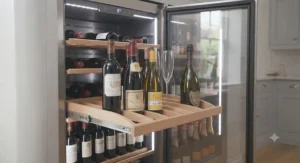
If large capacity wine cooler is genuinely your priority, the Dellonda Baridi DH93 earns its spot with a 55-bottle capacity split across two zones — 20 in the upper compartment, 35 below — both adjustable between 5-18°C. The beech wood shelving isn’t just cosmetic; wood reduces the direct thermal shock a bottle experiences when it’s placed against a shelf and looks considerably more premium than the black wire racks found on cheaper units.
What most buyers overlook about this model is the tall, freestanding footprint (126cm high) rather than the more common under-counter shape — it’s built to stand in a dining room or hallway rather than slot beneath a worktop, so measure your space before ordering. The tempered mirror glass door reflects UV light rather than simply filtering it, which is a genuinely useful extra layer of protection for long-term storage.
Aggregated seller feedback across retailers describes the unit as sturdy and straightforward to operate via its touchscreen, with the automatic defrost function cutting down on maintenance faff. The G energy rating is on the higher-consumption end of the scale, which is the trade-off for that bigger internal volume.
Pros:
- ✅ 55-bottle dual zone capacity with genuine beech wood shelves
- ✅ Tempered mirror glass adds extra UV reflection
- ✅ Touchscreen controls with automatic defrost
Cons:
- ❌ G energy rating means higher running costs than rivals
- ❌ Tall freestanding shape won’t fit under most counters
Prices sit in the £500-£650 range depending on retailer promotions, occasionally dipping lower during sales.
3. Cookology CWC605BK — best value dual zone under £500
For anyone specifically hunting the best large wine fridge under £500, the Cookology CWC605BK is the model that keeps coming up. It holds 46 bottles across two zones (16 up top, 30 below), both adjustable from 5-22°C, with UV-protective smoked toughened glass, a key lock, and beech wood slide-out shelves.
Here’s what to weigh: the wider 5-22°C range is more flexible than rivals capped at 18-20°C, useful if you’re storing lighter reds that prefer a slightly warmer resting temperature. On paper this means more day-to-day flexibility without stepping up to a pricier unit, and the key lock is a small but genuinely practical touch if there are children or house-sharers around.
Real buyer feedback is broadly positive on value and delivery speed, though a recurring theme in reviews is that the compressor overcools by two to three degrees below the set target — the practical fix reviewers mention is setting the dial a couple of degrees warmer than your actual target temperature.
Pros:
- ✅ Wide 5-22°C range across both zones
- ✅ Key lock plus UV-protective smoked glass
- ✅ Consistently praised value for money under £500
Cons:
- ❌ Tends to run 2-3°C colder than the displayed setting
- ❌ Beech shelves are functional rather than premium-feeling
Expect around £425-£500, with occasional promotional pricing pushing it under the £450 mark.
4. Willow W60WCSS — best all-rounder 52-bottle under-counter model
The Willow W60WCSS rounds out the mid-range nicely with a 52-bottle, 142-litre under-counter build in brushed stainless steel. It carries a 4-star efficiency rating, digital touch control, and ventilated cooling, backed by a 2-year warranty that’s slightly longer than some rivals offer as standard.
What stands out here, based on the spec sheet, is the combination of a genuinely large 142-litre interior with a compact under-counter footprint — you’re getting close to Baridi-level capacity without needing the freestanding tower shape. The ventilated cooling system also tends to distribute temperature more evenly than basic compressor units, which matters if you’re storing bottles at both the front and back of each shelf.
Because independent review volume for this brand is thinner than for Hisense or Cookology, it’s honest to say the aggregated sentiment here is less extensive — what’s verifiable is the spec sheet and the retailer’s own 4-star efficiency claim, and buyers should weigh the shorter review history into their decision rather than assume equivalence with better-documented rivals.
Pros:
- ✅ 142-litre capacity in a compact under-counter frame
- ✅ 4-star energy efficiency rating
- ✅ 2-year warranty as standard
Cons:
- ❌ Smaller pool of verified independent customer reviews
- ❌ Single manufacturer’s stated efficiency claim, not independently audited
Typical pricing sits around £400-£500, making it a solid under-£500 alternative to the Cookology.
5. Haier Wine Bank 50 Series HWS49GA — smartest app-controlled premium pick
Stepping into premium territory, the Haier Wine Bank 50 Series HWS49GA holds 49 bottles in a single temperature zone, but what buyers are really paying for is Haier’s hOn smart app control, anti-UV glass, and a genuinely low-vibration compressor design.
Here’s the honest trade-off: this is single-zone, not dual-zone, so it won’t simultaneously hold reds and whites at different temperatures. What most buyers overlook is that a single-zone unit set around 12-13°C is still a workable all-purpose compromise, since the generally accepted ideal storage temperature for wine sits around 12-13°C with 65-70% humidity — you lose the “one for reds, one for whites” flexibility, but gain app-based monitoring and alerts if the door’s left open, which dual-zone rivals in this price bracket rarely offer.
The Class F energy rating is a genuine downside for a premium-priced unit, and reviewers who prioritise smart-home integration tend to rate it highly, while those expecting dual-zone flexibility at this price point are more likely to feel shortchanged.
Pros:
- ✅ hOn app control with door-open alerts
- ✅ Genuinely low-vibration compressor design
- ✅ Anti-UV glass door as standard
Cons:
- ❌ Single zone only, despite the premium price point
- ❌ Class F energy rating is behind rival efficiency levels
Prices typically land in the £500-£650 range, positioning it as a smart-home-focused alternative rather than a pure capacity play.
6. Ca’Lefort 24″ Dual Zone — best budget entry into dual-zone storage
Not every large wine fridge needs to threaten £500. The Ca’Lefort 24″ Dual Zone holds 46 bottles, keeps two genuinely independent temperature zones, and wraps it all in a stainless-and-glass design with three-colour interior LED lighting that looks more expensive than its price tag suggests.
Reviewers consistently note that this unit keeps two stable zones and runs quietly enough for an open living or dining space — a fair result for the price. The spec sheet won’t tell you this, but user reports suggest the wooden shelves feel noticeably lighter than the beech shelving on the Cookology or Baridi units, and they don’t fully slide out, which makes loading the back row slightly fiddlier.
For anyone assembling wine collection storage on a first-cellar budget, this is a sensible entry point: real dual-zone functionality, a clean look, without the outlay of the premium tier further up this list.
Pros:
- ✅ Genuine dual-zone control at a budget price
- ✅ Stainless-and-glass design with three-colour LED lighting
- ✅ Quiet enough for open-plan living spaces
Cons:
- ❌ Shelves don’t fully extend, making back-row access fiddly
- ❌ No lock included, unlike some rivals at similar prices
Expect to pay roughly £300-£400, making it comfortably the most affordable dual-zone option here.
7. Cookology CWC601BK — largest capacity for serious collectors
Closing out the list, the Cookology CWC601BK pushes capacity to 54 bottles, aimed squarely at collectors who’ve outgrown the 40-46 bottle bracket entirely. It shares the beechwood shelving and UV-resistant door design of its smaller sibling, with a digital display that toggles between Celsius and Fahrenheit.
Based on the spec comparison, the beechwood fronts genuinely help here — condensation build-up is a common complaint on cheaper wire-shelf units, and wood absorbs some of that moisture rather than letting it drip onto lower bottles. What most buyers overlook is that at 54 bottles, this unit sits closer to genuine cellar-replacement territory than most “large” wine fridges, without needing the freestanding tower shape of the Baridi.
Reviewers and third-party appliance guides consistently rank this among the better picks for anyone with a genuinely substantial collection, citing the key lock and UV-resistant glass as sensible extras rather than gimmicks.
Pros:
- ✅ 54-bottle capacity, among the largest on this list
- ✅ Beechwood shelving reduces condensation drip
- ✅ Key lock plus UV-resistant glass door
Cons:
- ❌ Larger footprint needs proper measuring before you buy
- ❌ Sits at the upper end of the price bracket for this size class
Typical pricing runs £500-£600, positioning it as the natural upgrade path from the CWC605BK once your collection outgrows 46 bottles.
Practical Usage Guide: Setting Up Your Large Wine Fridge for Home
Getting a large wine fridge for home use right starts before you’ve even plugged it in. Leave the unit standing upright for at least four hours after delivery before switching it on — compressor coolant needs time to settle, and skipping this step is one of the most common causes of early faults reported by owners. Position it away from direct sunlight, ovens, or radiators; ambient heat forces the compressor to work harder, which both shortens its lifespan and pushes up running costs.
In the first 30 days, resist the urge to fully load the unit on day one. Add bottles gradually over the first week so the internal temperature can stabilise without constantly fighting new thermal mass. Check the door seal is making full contact around the frame — a common early mistake is loading bottles so tightly that the door doesn’t close flush, which lets warm air creep in and the compressor run near-constantly.
For maintenance, wipe down interior shelves every few months and vacuum any rear or under-unit ventilation grilles twice a year, since dust build-up on the condenser is a leading cause of reduced cooling efficiency over time. If your model includes a carbon filter, replace it roughly every six months to keep odours from lingering. A once-a-year check that the door seal hasn’t perished is worth the two minutes it takes — dried-out door gaskets are a slow, invisible drain on both temperature stability and your electricity bill.
Real-World Scenarios: Which Large Wine Fridge Suits You?
The weekend entertainer. You host regularly, serve both reds and whites, and want bottles ready to pour rather than ageing for a decade. A dual-zone model like the Cookology CWC605BK or Ca’Lefort 24″ Dual Zone suits this profile well — set one zone for whites at serving temperature and the other for reds, and you’re never caught out mid-dinner party.
The growing collector. Your collection has crept past 40 bottles and shows no sign of slowing. The Cookology CWC601BK or Dellonda Baridi DH93 make more sense here, since both offer genuine headroom rather than forcing an upgrade again within a year or two.
The smart-home household. If you already run most appliances through an app and want alerts if a door’s left ajar, the Haier Wine Bank 50 Series HWS49GA fits that lifestyle, accepting the single-zone trade-off in exchange for connected monitoring.
The first-timer on a budget. If this is your first proper wine fridge and you’re not certain how much you’ll actually use dual-zone control, the Ca’Lefort 24″ Dual Zone or Willow W60WCSS let you test the waters without a premium-tier outlay.
Problem → Solution: Common Large Wine Fridge Issues Solved
Problem: the unit runs colder than the displayed setting. This is a documented quirk on several budget and mid-range compressor units, including the Cookology CWC605BK. Solution: set your dial two to three degrees warmer than your actual target and monitor with a separate thermometer for the first week to calibrate.
Problem: condensation forming on lower shelves. Usually caused by frequent door opening or a perished door seal. Solution: check the seal for gaps, avoid opening the door for extended periods while selecting a bottle, and consider a model with wooden shelving, such as the Dellonda Baridi DH93, which absorbs some ambient moisture.
Problem: oversized bottles like Champagne or Prosecco won’t fit. Reported on the Hisense RW17W4NWG0 and several rivals with fixed shelf spacing. Solution: reserve the bottom shelf, which usually has more vertical clearance, for wider-bottomed bottles.
Problem: the fridge hums or vibrates noticeably. Usually a levelling issue rather than a fault. Solution: adjust the front feet until the unit sits perfectly flat — even a slight tilt can cause the compressor to vibrate against the cabinet.
Problem: musty smell inside the unit. Common in models with a carbon filter that hasn’t been replaced. Solution: swap the filter every six months and wipe interior surfaces with a mild, unscented cleaning solution.
How to Choose the Best Large Wine Fridge
Choosing the best large wine fridge for your home comes down to seven practical checks:
- Confirm your actual bottle count, then add 20%. Collections grow faster than people expect, so buying slightly ahead of your current need avoids a second purchase within two years.
- Decide dual zone versus single zone early. If you regularly serve both reds and whites, dual zone earns its higher price; if you mostly drink one or the other, single zone saves money without losing much.
- Measure your space before falling for a spec sheet. Freestanding tower models like the Dellonda Baridi DH93 need very different clearance to under-counter units like the Willow W60WCSS.
- Check the noise rating if it’s going in a living space. Anything above roughly 45dB becomes noticeable in an open-plan room.
- Look for UV-protected glass as standard, not an upsell. Light exposure genuinely degrades wine over time, so treat this as a baseline requirement rather than a bonus feature.
- Weigh the energy rating against running costs. A cheaper unit with a poor rating can cost more over five years than a pricier, more efficient rival.
- Read aggregated review sentiment, not star ratings alone. A 4.5-star average can still hide a recurring niggle, like overcooling or awkward shelf spacing, worth knowing before you buy.
✨ Don’t Miss These Exclusive Deals!
🔍 Take your wine storage to the next level with these carefully selected large wine fridges. Click on any highlighted model to check current pricing and availability — these picks help you build a genuinely enjoyable collection at home!
Large Dual Zone Wine Fridge vs Single Zone: Which Wins?
The honest answer is that neither wins outright — it depends entirely on what’s actually in your rack. A large dual zone wine fridge, like the Cookology CWC605BK or Ca’Lefort 24″ Dual Zone, lets you run one compartment cooler for whites and sparkling wines while the other sits warmer for reds, which mirrors how most households actually drink: a mix, not a single style.
Single-zone units, such as the Haier Wine Bank 50 Series HWS49GA, are simpler mechanically, which often means fewer components that can fail and, in some cases, quieter overall operation. If your collection leans heavily toward one wine style, or you’re happy setting a single all-purpose temperature around 12-13°C, a single-zone unit is genuinely not a compromise — it’s just a different tool for a narrower job.
Where dual zone clearly pulls ahead is flexibility for entertaining: temperature and humidity are two of the factors that most directly affect a wine’s condition, and being able to hold two different temperatures simultaneously means you’re never serving a red that’s too warm or a white that’s barely chilled. For most UK households with a mixed collection, dual zone is worth the modest price premium.
Best Large Wine Fridge Under £500: What You Actually Get
Budget matters, and it’s entirely possible to land a genuinely capable large wine fridge under £500 without settling for a toy-like unit.
| Model | Capacity | Zones | Price Range | Best For |
|---|---|---|---|---|
| Cookology CWC605BK | 46 bottles | Dual | £425-£500 | Widest temperature range under £500 |
| Willow W60WCSS | 52 bottles | Single-compressor | £400-£500 | Largest litre capacity under £500 |
| Ca’Lefort 24″ Dual Zone | 46 bottles | Dual | £300-£400 | Lowest price for genuine dual zone |
What separates these three under-£500 picks is less about raw capacity and more about which compromise you’re willing to accept — the Ca’Lefort 24″ Dual Zone trades shelf-extension convenience for the lowest price, while the Willow W60WCSS trades a smaller independent review base for genuinely generous litre capacity. None of the three under-£500 options in this table sacrifice dual-function UV glass, which is the one spec worth refusing to compromise on regardless of budget.
Common Mistakes When Buying a Large Capacity Wine Cooler
The most common mistake is buying on bottle-count alone without checking real internal dimensions — some manufacturers count “Bordeaux-style” bottles only, and a mixed collection of Burgundy or Champagne shapes will fit noticeably fewer than the advertised number. A second frequent slip-up is ignoring the freestanding-versus-under-counter distinction; a beautiful 55-bottle unit is no use if it physically won’t fit the gap you’ve measured for it.
Buyers also regularly underestimate running costs. A large capacity wine cooler left on 24/7 for years adds up, and a unit with a G energy rating can cost noticeably more over its lifetime than a similarly priced C or D-rated rival, even if the upfront price looks identical. Finally, many buyers skip reading aggregated review sentiment for recurring niggles — an overcooling quirk or a fiddly shelf design rarely shows up in marketing copy, but shows up repeatedly in genuine owner feedback if you look for it.
Wooden Shelving vs Wire Racks: Does It Actually Matter?
It’s a fair question, since wooden shelving is often presented as a premium upsell rather than explained properly. Here’s what most buyers overlook: wood is a poorer conductor of cold than metal wire, which means bottles resting on wooden shelving experience a slightly gentler, more even temperature than those on bare wire racks. It also tends to absorb a small amount of ambient condensation rather than letting moisture drip straight onto the bottle below, which is a genuine practical advantage in humid UK kitchens.
That said, wooden shelving isn’t universally superior. On budget units like the Ca’Lefort 24″ Dual Zone, lighter wooden shelves that don’t fully extend can actually make loading harder than a simple, full-extension wire rack would. The Dellonda Baridi DH93 and Cookology CWC601BK use genuine beech, which holds up well and looks noticeably more premium on display. Reviewers consistently note that wooden-shelved units feel more “furniture-like” and less clinical than wire-racked alternatives, which matters if the fridge is going somewhere visible rather than tucked away.
Large Wine Fridge as a Cellar Alternative: Organising Your Wine Collection Storage
For most UK homes without a basement or dedicated cellar space, a large wine fridge is the realistic cellar alternative — and it’s a genuinely good one, provided expectations are set correctly. According to Wikipedia’s overview of wine cellars, wine can be stored satisfactorily between roughly 7-18°C as long as temperature variations are gradual, with around 13°C considered ideal for both short-term storage and long-term ageing — which is precisely the range most dual-zone units are designed to hold.
Where a fridge can’t fully replicate a traditional cellar is humidity control and sheer scale — a proper stone cellar naturally maintains higher humidity than a compressor-cooled cabinet, and no domestic unit on this list holds more than 55 bottles. For serious long-term ageing of investment-grade wine, a dedicated cellar or professional storage facility still has the edge. For the vast majority of home drinkers building genuine wine collection storage for bottles they’ll actually open within a few years, though, a large wine fridge does the job convincingly.
| Factor | Large Wine Fridge | Traditional Cellar |
|---|---|---|
| Upfront cost | £300-£650 | Often thousands to build or convert |
| Space required | Under-counter or single freestanding footprint | Dedicated room or basement |
| Temperature stability | Excellent, digitally controlled | Good, but depends on structure |
| Typical capacity | 40-55 bottles | Often 100+ bottles |
| Best for | Everyday drinkers, small-to-mid collections | Long-term investment ageing |
As the table shows, the trade-off is almost entirely about scale versus practicality — a fridge wins comfortably on cost and convenience, while a cellar wins if you’re seriously ageing wine for a decade or more.
Long-Term Cost & Maintenance of a Large Wine Fridge
Running costs vary more than shoppers expect, largely driven by energy rating rather than capacity alone. The Energy Saving Trust notes that choosing a more efficient fridge freezer over a poorly-rated equivalent can save hundreds of pounds across its lifetime, and the same logic applies to wine fridges — a G-rated unit like the Dellonda Baridi DH93 will cost more to run annually than a comparably sized C or D-rated rival, even though the purchase price might look similar.
Maintenance costs are generally low if you stay on top of basics: replacing a carbon filter twice a year costs a few pounds, and door seals rarely need replacing before the five-year mark if the unit isn’t overloaded. Compressor-based units, which cover every model on this list, typically last eight to twelve years with reasonable care, making the total cost of ownership fairly predictable once you’ve accounted for the annual electricity draw.
When a unit does eventually reach the end of its life, UK households have a legal disposal route to follow. As Which? explains in its fridge freezer disposal guide, under the Waste Electrical and Electronic Equipment regulations, any appliance carrying a crossed-out wheelie bin logo — including wine fridges — must be recycled rather than binned, so factor a retailer take-back scheme or council collection into your eventual replacement plans.
FAQ
❓ What size wine fridge do I need for 50 bottles?
❓ Is a dual zone wine fridge worth the extra cost?
❓ Can a large wine fridge replace a wine cellar?
❓ How long do large wine fridges last?
❓ Do wine fridges need a carbon filter?
Conclusion
There’s no single best large wine fridge for every household — the right pick genuinely depends on how many bottles you’re storing, whether you drink both reds and whites, and how much space you can realistically spare. For most people wanting dual-zone flexibility without a big outlay, the Cookology CWC605BK remains hard to beat under £500. Collectors who’ve outgrown the 40-bottle bracket should look at the Dellonda Baridi DH93 or Cookology CWC601BK, while smart-home households may prefer the app-controlled convenience of the Haier Wine Bank 50 Series HWS49GA despite its single-zone limitation.
Whichever model you land on, remember that the fundamentals matter more than any single spec: stable temperature, UV protection, and realistic capacity for your actual collection will serve you far better long-term than chasing the highest bottle count on the box. A large wine fridge for home use is, for the vast majority of UK drinkers, a genuinely sensible and achievable cellar alternative.
Recommended for You
- Best Wine Fridge For Small Kitchen: 7 Brilliant 2026 Picks
- Best Small Wine Fridge 2026: 7 Compact Coolers Worth Buying
- Integrated vs Built In Wine Fridge: 7 Best UK Picks (2026)
Disclaimer: This article contains affiliate links. As an Amazon Associate, I earn from qualifying purchases. If you purchase products through these links, we may earn a small commission at no additional cost to you.
✨ Found this helpful? Share it with your friends! 💬🤗
