
In This Article
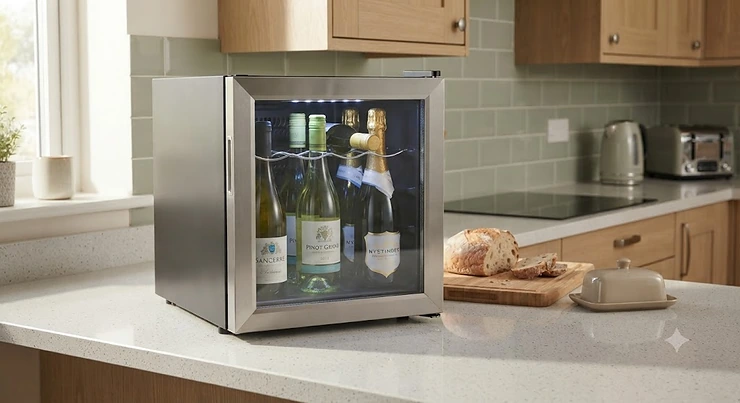
There’s a very specific kind of kitchen chaos that leads someone to Google countertop wine cooler at eleven o’clock on a Tuesday night: you’ve just discovered that your fridge door shelf, the one meant for milk and ketchup, is now hoarding four bottles of Rioja at exactly the wrong temperature, elbowing out the actual food. A countertop wine cooler is a compact, plug-in refrigeration unit — usually holding 6 to 20 bottles — that sits directly on your kitchen counter and keeps wine at its proper serving temperature, separate from your everyday fridge. No installation, no carpentry, no calling in a favour from your DIY-inclined neighbour.
This guide is built for a British kitchen, with British storage habits in mind — which is to say, limited worktop space, an ancient fridge that’s already fighting for its life, and a Saturday-night bottle of Malbec that deserves better than being crammed next to the yoghurts. We’ve researched seven genuinely available models sold on amazon.co.uk, from ultra-compact thermoelectric units through to premium dual-zone compressor models, and we’ve weighed up their real specs against real, verifiable review sentiment.
What follows isn’t a repackaged spec sheet. It’s commentary on what the numbers actually mean once the unit is humming away on your counter: which models run quiet enough for an open-plan kitchen, which ones sulk in a hot conservatory, and which are simply the best table top wine fridge for a small flat with precisely one metre of spare worktop. We’ll also cover the transformation content Amazon listings never bother with — setup tips, common first-month mistakes, and a decision framework for matching the right cooler to your actual drinking habits, not just your aspirational ones.
Quick Comparison: Countertop Wine Coolers at a Glance
Before we get into the detailed breakdowns, here’s the shortlist. Each of these earns its place for a different reason — capacity, portability, price, or sheer counter-space efficiency.
| Model | Capacity | Cooling Type | Best For |
|---|---|---|---|
| Barcool VINO8 | 8 bottles | Thermoelectric | Best for tight worktop space |
| Baridi DH217 | 6 bottles | Thermoelectric | Best portable wine cooler |
| Klarstein Vinamora HEA3 | 12 bottles | Thermoelectric | Best all-rounder on a budget |
| Klarstein Shiraz Slim Uno | 12 bottles | Thermoelectric | Best for narrow counters |
| Baridi DH6 | 18 bottles | Compressor | Best value compressor model |
| Baridi DH89 | 18 bottles (dual zone) | Compressor | Best for reds and whites together |
| Subcold Viva20 | 20 bottles | Compressor | Best premium/largest capacity |
Looking at the spread, there’s a clear line between the thermoelectric units at the top of the table and the compressor units towards the bottom — and that distinction matters more than bottle count alone. Thermoelectric coolers like the Barcool VINO8 and Baridi DH217 run near-silently and cost less upfront, but they can only really chill wine 10-20°C below room temperature, which limits them in a warm kitchen. Compressor models such as the Baridi DH6 and Subcold Viva20 cost more but can hold a genuinely cold, stable 5°C regardless of how hot your summer gets — which is what you actually want for whites and fizz.
💬 Just one click — help others make better buying decisions too!😊
Top 7 Countertop Wine Coolers: Expert Analysis
1. Barcool VINO8 — best for tight worktop space
The standout here is the footprint: at just 258mm wide, the Barcool VINO8 slots into gaps that most 8-bottle coolers simply can’t reach, making it a genuine contender for the best countertop wine chiller if your kitchen counter space is measured in inches rather than feet. Under the hood it’s a thermoelectric unit — no compressor, no moving parts to wear out, just a Peltier plate quietly shifting heat away from a 23-litre cavity. That means a single-zone range of 5-18°C, a sound level of just 41dB (about as loud as a quiet conversation), and 72kWh of annual energy consumption, which works out to a few pounds a year on a typical UK tariff. Based on the spec comparison with rival 8-bottle units, this is one of the more energy-frugal options in its class, though thermoelectric cooling means performance dips if your kitchen regularly tops 25°C.
Who should care: anyone in a flat, studio, or small kitchen who wants dedicated wine storage without sacrificing a cupboard. It’s not built for serious collectors chasing a rock-steady 12°C for ageing reds — it’s built for people who want their Pinot Grigio at the right temperature on a Friday night. Reviewers consistently report that the tempered glass door and LED lighting make it look considerably more expensive than its price tag suggests, and appearance comes up as a strong positive theme in aggregated customer feedback, with the majority of comments on this point being favourable. A recurring gripe in the same review pool is that taller bottles — particularly Alsace or German styles — don’t always fit horizontally, so measure your typical bottle before assuming every shape will slot in.
Pros:
- ✅ Compact 258mm width fits narrow gaps
- ✅ Whisper-quiet 41dB thermoelectric operation
- ✅ Low annual running cost around 72 kWh
Cons:
- ❌ Struggles to hold temperature in hot rooms
- ❌ Tall or wide bottles may not fit horizontally
Typically found in the £130-£170 range at the time of research, the Barcool VINO8 represents solid value for casual drinkers who prioritise a small footprint over raw chilling power — check current price before buying, as retailer promotions shift regularly.
2. Baridi DH217 — best portable wine cooler
If portability is genuinely your priority — moving the unit between a kitchen counter, a conservatory, and a spare room depending on the season — the Baridi DH217 is built around that flexibility. It’s a 6-bottle thermoelectric tabletop unit with a digital display and touch-screen controls, and because it skips the compressor entirely, it’s noticeably lighter to lift and carry than any compressor-based rival on this list. That single design choice is what makes it the best plug-and-play portable wine cooler here: unbox it, place it anywhere with a socket, and it’s chilling within minutes, no bracket or bolt required.
The trade-off, honestly, is capacity and chilling depth — six bottles disappears fast if you host regularly, and like all thermoelectric units it cools relative to room temperature rather than to an absolute cold point. What most buyers overlook about this style of cooler is that “portable” cuts both ways: it’s brilliant for a caravan, a home office, or a granny annexe, but it’s not the unit to buy if you want a fixed, always-on wine station that quietly does its job for a decade without being nudged around. Aggregated feedback on similarly specced Baridi tabletop units tends to praise the glass door’s clarity and the simplicity of the touch controls, while noting that the internal light can feel a touch dim for showing off a full rack in a dark room.
Pros:
- ✅ Genuinely light enough to relocate easily
- ✅ True plug-and-play setup, no fixing required
- ✅ Touch-screen digital temperature display
Cons:
- ❌ Only 6-bottle capacity for larger households
- ❌ Cooling power limited by ambient room heat
At the budget end of the market — commonly under £120 at the time of research — this is the pick for anyone who wants portable chilling on their own terms rather than a fixed kitchen fixture.
3. Klarstein Vinamora HEA3 — best all-rounder on a budget
The Klarstein Vinamora HEA3 earns its spot through sheer practicality: 12-bottle capacity, five individually removable steel shelves, and a 35-litre cavity that’s genuinely usable rather than theoretical. Here’s what to weigh up — this is a thermoelectric cooler rated at the old EU energy class B, which on the current UK A-G rescaled system would likely land several bands lower, so don’t assume “class B” still means what it once did; judge it on the actual kWh figure rather than the letter.
On paper this means steady, quiet cooling (Klarstein’s thermoelectric range typically runs in the low-40dB bracket) with an LCD display and touch panel that’s simple enough not to need the manual after day one. The double-insulated glass door and side carry handle are small but telling design choices — this is a unit designed to be moved occasionally, not bolted in place. Reviewers of Klarstein’s compact wine coolers frequently flag the value-for-money angle as the headline positive, with the black metal housing looking considerably more premium than the price point implies; a recurring criticism across the range is that first-use setup requires patience, since the compressor-free system needs roughly 24 hours to settle at the target temperature after being switched on.
Pros:
- ✅ 12-bottle capacity in a compact footprint
- ✅ Five fully removable, reconfigurable shelves
- ✅ Simple LCD touch-control interface
Cons:
- ❌ Needs about 24 hours to stabilise on first use
- ❌ Old-scale energy rating no longer directly comparable
Expect to pay somewhere in the £150-£200 range, which — set against 12-bottle compressor rivals costing £100 or more extra — makes this a genuinely sensible mid-budget pick.
4. Klarstein Shiraz Slim Uno — best for narrow counters
Where the Vinamora goes wide, the Klarstein Shiraz Slim Uno goes narrow: at just 25.2cm across, it’s engineered specifically for that awkward sliver of worktop space next to the kettle that nothing else quite fits. It still holds 12 bottles in a 32-litre cavity, which is a genuinely efficient use of a slim chassis, and it runs on an 85W thermoelectric system across a 5-18°C single zone. Based on the spec comparison with wider 12-bottle units, you’re not losing capacity for the slimmer build — you’re gaining vertical space efficiency instead, which suits galley kitchens and rented flats where you can’t reconfigure the layout.
The touch control panel handles temperature adjustment without fuss, and the freestanding design means no cut-out or cabinet modification is needed — it simply stands on the countertop and plugs in. One genuine first-hand account surfaced in Klarstein’s own customer feedback describes the unit settling in “perfectly” on a countertop straight out of the box, once given time for the refrigerant gases to stabilise before switching on — a useful reminder that thermoelectric units generally need a settling period regardless of brand. The spec sheet won’t tell you this, but user reports suggest the slim design does mean slightly reduced airflow at the back, so the manufacturer’s minimum clearance guidance is worth actually following rather than skipping.
Pros:
- ✅ Just 25.2cm wide, ideal for narrow gaps
- ✅ 12-bottle capacity despite the slim chassis
- ✅ Straightforward touch-control temperature panel
Cons:
- ❌ Requires strict rear clearance for ventilation
- ❌ Single zone only, no separate red/white settings
Priced typically in the £160-£210 bracket, this is the clearest answer if your search really started with “countertop wine cooler that will actually fit here.”
5. Baridi DH6 — best value compressor model
This is where the list shifts from thermoelectric to compressor cooling, and the difference is immediate: the Baridi DH6 holds a genuine 5-18°C range regardless of how warm your kitchen gets, thanks to proper compressor refrigeration rather than a Peltier plate. It stores 18 bottles across removable waved metal shelves, runs at a measured 42dB — quiet enough for an open-plan living space — and its annual energy consumption sits around 120kWh, translating to a modest few tens of pounds a year on current UK electricity rates. Based on the spec comparison with thermoelectric rivals on this list, the DH6 is the first model here that a serious white-wine or Champagne drinker should take seriously, since compressor cooling holds a stable cold point that thermoelectric units simply can’t match in summer.
Reviewers consistently note the mirror-tempered glass door as a strong visual feature, reflecting UV light away from the bottles while still allowing a clear view of the collection — and the automatic defrost feature means it’s genuinely low-maintenance rather than needing periodic manual defrosting like older compressor designs. A common theme in feedback on this model range is that the compressor produces an occasional low hum when cycling on, which is normal for compressor technology but worth knowing if you’re placing it somewhere silence is non-negotiable, like a bedroom.
Pros:
- ✅ True compressor cooling holds 5°C reliably
- ✅ 18-bottle capacity with removable shelving
- ✅ Automatic defrost, low ongoing maintenance
Cons:
- ❌ Audible compressor hum during cooling cycles
- ❌ Heavier and less portable than thermoelectric rivals
At around £230-£290 depending on retailer, it’s a meaningful step up in price from the thermoelectric options above — but for anyone who actually wants their wine cooler for kitchen counter use to hit a genuine 5°C, that jump is arguably the whole point.

6. Baridi DH89 — best for reds and whites together
The Baridi DH89 solves a specific, common household problem: one person drinks red, another drinks white, and neither wants their bottle sitting at the wrong temperature. Its dual-zone design splits an 18-bottle capacity into an upper zone (6 bottles) and lower zone (12 bottles), each independently adjustable across 5-18°C — so a Sauvignon Blanc can sit at 9°C up top while a Rioja settles at 16°C below, with the compressor and shared insulation doing the work invisibly. What most buyers overlook about dual-zone coolers generally is that the two zones share one compressor system, so don’t expect completely independent thermal isolation the way you’d get from two separate appliances — but for typical serving-temperature differences, it’s more than sufficient.
The beech wood shelving is a genuine step up in tactile quality from the metal-shelf models earlier in this list, and the automatic defrost compressor keeps maintenance minimal. Annual energy consumption runs around 145kWh — higher than the single-zone DH6, which makes sense given it’s essentially running two thermal zones — and noise sits at a slightly higher but still reasonable 46dB. Aggregated review sentiment for Baridi’s dual-zone range tends to highlight the independent zone control as the standout practical feature, while some buyers note the overall unit runs taller than expected, so measuring available headroom under wall cabinets is worth doing before ordering.
Pros:
- ✅ Independently adjustable upper and lower zones
- ✅ Genuine beech wood shelving, not metal
- ✅ Handles both reds and whites at once
Cons:
- ❌ Taller unit needs checked cabinet clearance
- ❌ Higher energy use than single-zone equivalents
Sitting around £350-£400 at the time of research, this is squarely a mid-to-premium pick for two-wine households who’ve outgrown a single-zone unit.
7. Subcold Viva20 — best premium/largest capacity
Closing out the list, the Subcold Viva20 is the largest and most feature-complete unit here: a 20-bottle capacity across a 53-litre cavity, genuine compressor cooling spanning a wide 3-18°C range, and a lockable glass door with two supplied keys — a small but genuinely useful feature if you’ve got curious teenagers or a shared house. Four removable chrome wire shelves mean the layout can flex between all-wine storage and a mixed rack for beer, cans, or Prosecco when the occasion calls for it. Here’s what to weigh up: at 430mm wide, it’s noticeably larger than every other model on this list, so it needs a proper dedicated stretch of worktop space rather than a leftover gap.
Reviewers of Subcold’s compressor range consistently point to the 39dB noise rating as unusually quiet for a unit of this capacity, and the built-in lock is repeatedly flagged as a genuinely practical extra rather than a gimmick. The trade-off for that capacity and feature set is footprint and price — this isn’t a discreet countertop appliance, it’s closer to a small feature fridge that happens to sit on a counter rather than the floor. Based on the spec comparison with the rest of this list, if you’re drinking through more than a bottle or two a week and want headroom for growth, the Viva20 is the model built to absorb that without needing an upgrade in a year’s time.
Pros:
- ✅ Largest capacity on this list at 20 bottles
- ✅ Lockable door with two keys included
- ✅ Wide 3-18°C compressor cooling range
Cons:
- ❌ Significant worktop footprint at 430mm wide
- ❌ Pricier than every other model here
Typically listed in the low-to-mid £200s to £300 range, though this fluctuates by retailer, so always check current price before ordering — this is the pick for anyone treating their countertop wine cooler as a genuine long-term investment rather than a stopgap.
Top 7 Countertop Wine Coolers: Full Spec Comparison
| Model | Capacity | Cooling | Noise Level | Best For |
|---|---|---|---|---|
| Barcool VINO8 | 8 bottles | Thermoelectric | 41dB | Tight worktop space |
| Baridi DH217 | 6 bottles | Thermoelectric | Not stated | Portability |
| Klarstein Vinamora HEA3 | 12 bottles | Thermoelectric | ~40dB (typical) | Budget all-rounder |
| Klarstein Shiraz Slim Uno | 12 bottles | Thermoelectric | Not stated | Narrow counters |
| Baridi DH6 | 18 bottles | Compressor | 42dB | Value compressor pick |
| Baridi DH89 | 18 bottles (dual zone) | Compressor | 46dB | Reds and whites together |
| Subcold Viva20 | 20 bottles | Compressor | 39dB | Largest capacity |
Set side by side, the pattern is obvious: capacity and noise don’t move in lockstep with price the way you’d assume. The Subcold Viva20 manages the quietest rating of the entire compressor group despite the largest capacity, while the Baridi DH89 trades a little extra noise for genuine dual-zone flexibility. If quiet is your single non-negotiable criterion — say, the unit’s going in a bedroom or open-plan living space — noise level should outrank bottle count when you’re comparing these side by side.
💬 Just one click — help others make better buying decisions too!😊
Practical Usage Guide: Setting Up and Living With a Countertop Wine Cooler
Getting a new countertop wine cooler right in the first month makes a genuine difference to how long it lasts and how well it performs. Start with placement: every model on this list needs clearance — typically 5cm at the rear and 3cm at the sides — for proper airflow, and skipping this is the single most common reason a unit underperforms its stated temperature range. Resist the urge to tuck it into a corner cabinet with the door half-closed against the wall.
Next, don’t switch it on the moment it arrives. If the unit has travelled on its side or been recently delivered, let it stand upright for a few hours before plugging in — this allows any refrigerant or coolant to settle, and several manufacturers explicitly flag this in their setup guidance. Once switched on, expect 12-24 hours before the display temperature matches the actual internal temperature; loading bottles too early, before the unit has stabilised, is a common first-week mistake that leads people to wrongly assume the cooler is faulty.
For ongoing maintenance, wipe the door seal and interior shelving every few weeks with a mild, non-abrasive cleaner, and vacuum any dust from the rear ventilation grille every couple of months — dust buildup is the main long-term cause of reduced cooling efficiency in compressor units. If you’re using a thermoelectric model, avoid placing it near an oven, radiator, or in direct sunlight, since ambient heat directly undermines its cooling capacity in a way compressor units are far more resistant to.
Real-World Scenarios: Which Countertop Wine Cooler Fits Your Life
Picture three households, each searching for broadly the same thing but needing something different. First, the flat-sharing graduate with a single shelf of worktop space and a habit of buying one bottle at a time for a Friday takeaway: the Barcool VINO8 or Baridi DH217 suit this pattern precisely, since neither needs a fixed installation spot and both handle occasional, light use without complaint.
Second, the family kitchen where one partner drinks red and the other exclusively whites, and where a proper worktop stretch exists near the breakfast bar: this is where the Baridi DH89‘s dual-zone design genuinely earns its higher price, letting both preferences sit correctly chilled without either person having to compromise or decant early.
Third, the household that hosts regularly — book club, Sunday roasts with extended family, the odd impromptu gathering — and needs headroom rather than just adequate capacity: the Subcold Viva20‘s 20-bottle spread and lockable door make it the sensible long-term choice, since running out of chilled options mid-evening is a far more common frustration than owning slightly too much capacity.
Problem → Solution: Fixing Common Countertop Wine Cooler Headaches
Problem: the unit isn’t reaching the set temperature. This is almost always a clearance or ambient-heat issue rather than a fault — check rear ventilation space first, and move thermoelectric units away from direct sunlight or heat sources before assuming a return is necessary.
Problem: condensation building up inside the door. This typically points to a door seal that isn’t sitting flush, often because the unit isn’t level. Adjustable feet, present on most models here, should be used to level the cooler on the actual worktop surface rather than assumed level.
Problem: bottles won’t fit the way the marketing photos suggested. Bordeaux-shaped 750ml bottles are the standard most shelving is designed around; Burgundy, Champagne, and German Alsace-style bottles are typically wider or taller and may need vertical storage in the base section rather than horizontal shelving.
Problem: the display shows an error or the unit stops cooling. Manufacturers including Dellonda (Baridi’s parent brand) note this can indicate either an ambient temperature issue or a control panel fault, and generally recommend contacting support directly rather than attempting a DIY fix, since these are sealed refrigeration systems.
✨ Still weighing up which capacity actually suits your household? Scroll back up and compare the seven picks side by side — the right one is usually more about worktop space and drinking habits than raw bottle count.
How to Choose a Countertop Wine Cooler
Countertop wine coolers vary enough in cooling type, capacity, and zone configuration that a quick checklist genuinely helps narrow things down before you commit to a purchase.
- Measure your worktop space first, not last. Note the width, depth, and available headroom under wall cabinets — several models on this list, including dual-zone units, are taller than their bottle count suggests.
- Decide between thermoelectric and compressor cooling. Thermoelectric suits light, occasional use and quiet spaces; compressor cooling suits anyone who wants a genuine cold point regardless of room temperature.
- Count your actual weekly bottles, not your aspirational collection. Buying for the wine rack you wish you had leads to overspending on capacity you won’t use.
- Check the temperature range against your wine preferences. A single-zone 5-18°C range suits one wine style at a time; dual-zone units suit households split between reds and whites.
- Factor in noise level if placement is near living or sleeping space. A few decibels’ difference matters more than it looks on a spec sheet once the unit is running constantly.
- Confirm ventilation clearance requirements before buying. Tight cupboard alcoves without rear airflow will undermine even a well-reviewed unit’s performance.
- Set a realistic budget band and stick to price ranges, not exact figures. Prices shift constantly, so treat any published number as a starting point rather than gospel.
Countertop Wine Cooler vs Traditional Fridge Storage
Storing wine in a standard kitchen fridge feels like the free option, but it rarely serves the wine well. A typical UK fridge runs at 3-5°C throughout — ideal for milk, disastrous for red wine, which loses much of its aromatic complexity when served that cold, and merely adequate for whites, which usually prefer 7-12°C depending on style. According to guidance widely echoed across UK wine retailers, serving wine at the correct temperature genuinely changes how its acidity, tannins, and aromatics come through — a distinction a single-setting fridge simply can’t offer.
| Factor | Standard Fridge | Countertop Wine Cooler |
|---|---|---|
| Temperature range | Fixed ~3-5°C | Adjustable, typically 5-18°C |
| Vibration | Compressor cycles constantly | Vibration-dampened shelving |
| UV/light exposure | Frequent door opening | UV-protected glass door |
| Dedicated space | Competes with food | Dedicated wine-only zone |
The gap that matters most here is temperature flexibility and vibration. A countertop wine cooler holds a chosen temperature steadily and shields bottles from the constant door-opening and jostling that comes with a shared family fridge, both of which genuinely affect how wine tastes over time rather than being marketing flourishes. That said, a fridge remains perfectly fine for a bottle you’re drinking within the hour — it’s long-term storage and serving precision where a dedicated unit earns its keep.
Common Mistakes When Buying a Countertop Wine Chiller
The single most common mistake is buying on bottle count alone without checking the cooling type — a thermoelectric countertop wine chiller in a warm, south-facing kitchen will simply never hit 5°C, no matter how good the reviews looked. A close second is ignoring ventilation clearance requirements; cramming a unit into a snug alcove without the manufacturer’s stated rear and side gaps quietly sabotages its efficiency from day one.
Buyers also frequently overlook noise ratings, assuming “quiet” is universal across the category, when compressor units in particular can vary by several decibels between models — worth checking closely if the cooler’s going in a bedroom or open-plan living space. Another recurring error is assuming every 750ml bottle fits identically; Burgundy and Champagne bottles are notably wider than standard Bordeaux shapes and can force awkward, wasteful shelf spacing. Finally, don’t assume the cheapest option is the best value — a bargain thermoelectric unit that can’t actually reach a stable serving temperature for whites ends up being replaced within a year, which costs more in the long run than paying slightly more for compressor cooling upfront.
Features That Actually Matter (And Those That Don’t)
Genuinely worth prioritising: compressor versus thermoelectric cooling (it dictates real-world performance more than any other spec), stated noise level in decibels, ventilation clearance requirements, and dual-zone capability if your household drinks both reds and whites regularly. These four factors predict day-to-day satisfaction far more reliably than anything else on a spec sheet.
Less important than the marketing suggests: exact bottle capacity beyond your actual weekly consumption, LED lighting colour options, and touch-screen aesthetics over simple dial controls — these affect how a unit looks in photos far more than how well it keeps your wine. UV-protected glass is a genuinely useful feature worth having, but it’s not a dealbreaker if a countertop wine cooler otherwise ticks every box, since most kitchens don’t expose bottles to prolonged direct sunlight regardless.
Long-Term Cost & Maintenance: What a Countertop Wine Cooler Really Costs to Run
The purchase price is only part of the total cost of ownership. Annual energy consumption across this list ranges from roughly 72kWh for the smallest thermoelectric unit up to 145kWh for the dual-zone compressor model — at typical UK domestic electricity rates, that translates to a running cost gap of perhaps £15-£40 a year between the cheapest and priciest options here, which is worth weighing against the £150-£250 difference in upfront price.
| Model | Est. Annual Energy | Cooling Type |
|---|---|---|
| Barcool VINO8 | ~72 kWh | Thermoelectric |
| Baridi DH6 | ~120 kWh | Compressor |
| Baridi DH89 | ~145 kWh | Compressor (dual zone) |
Maintenance costs are minimal across the board — none of these units require servicing under normal use, and automatic defrost features on the compressor models mean there’s no manual upkeep beyond occasional cleaning. The main long-term cost consideration is genuinely energy use rather than repairs, and current UK energy labelling guidance is a useful reference point if you want to compare stated consumption figures accurately against the rescaled A-G ratings introduced in 2021.
Safety, Regulations & Plug-and-Play Compliance for UK Kitchens
Every model on this list is designed as a genuine plug-and-play appliance — no hardwiring, no professional installation, just a standard UK three-pin plug into a nearby socket. That said, a few practical safety points are worth following: avoid running any wine cooler from an extension lead shared with high-draw appliances, ensure the socket used is easily accessible in case of an emergency shutoff, and never block the rear ventilation grille, since restricted airflow is a genuine fire-risk factor for any compressor-based appliance, not just wine coolers specifically.
UK and Northern Ireland appliances sold since 2021 should carry updated A-G energy labelling rather than the older A+++ system, and Which?’s guidance on the new energy label is a helpful way to interpret ratings that may otherwise look confusingly low compared with older appliances rated under the previous scale. Always check that any unit you buy carries UKCA or CE marking as appropriate, confirming it meets current UK electrical safety standards — legitimate retailers will list this in the product documentation.
FAQ
❓ What's the difference between a wine cooler and a wine fridge?
❓ How many bottles do I actually need capacity for?
❓ Is a thermoelectric or compressor wine cooler better?
❓ Can a countertop wine cooler go anywhere in the kitchen?
❓ Do countertop wine coolers use much electricity?
Conclusion
A countertop wine cooler isn’t a luxury indulgence so much as a small, sensible fix for a genuinely common household problem: wine that deserves better than a squeeze on the fridge door. Across the seven models here, the right pick really comes down to three honest questions — how much worktop space you actually have, whether you need a stable cold point for whites or just gentle chilling for reds, and how many bottles genuinely pass through your kitchen in an average month.
For tight spaces and light use, the Barcool VINO8 and Baridi DH217 cover the essentials without demanding much in return. For households wanting genuine temperature reliability, the Baridi DH6 and Baridi DH89 step up to proper compressor cooling, with the DH89’s dual zones solving the classic reds-and-whites household divide. And for anyone treating this as a long-term kitchen fixture rather than a stopgap, the Subcold Viva20 offers the capacity and cooling range to match.
Whichever you choose, the fundamentals from this guide hold: check ventilation clearance, understand cooling type before capacity, and treat published prices as a guide rather than gospel — always check current pricing before buying.
✨ Ready to give your wine collection the home it deserves? 🍷 Take a closer look at whichever pick matched your kitchen and drinking habits best — click through to check current availability and pricing before it changes.
Recommended for You
- Wine Fridge Brands 2026: 7 Top Picks Ranked & Compared
- Liebherr Wine Fridge Review 2026: 7 Best Models Compared
- Professional Wine Fridge: 7 Best Picks for Serious Cellars (2026)
Disclaimer: This article contains affiliate links. As an Amazon Associate, I earn from qualifying purchases. If you purchase products through these links, we may earn a small commission at no additional cost to you.
✨ Found this helpful? Share it with your friends! 💬🤗
