
In This Article
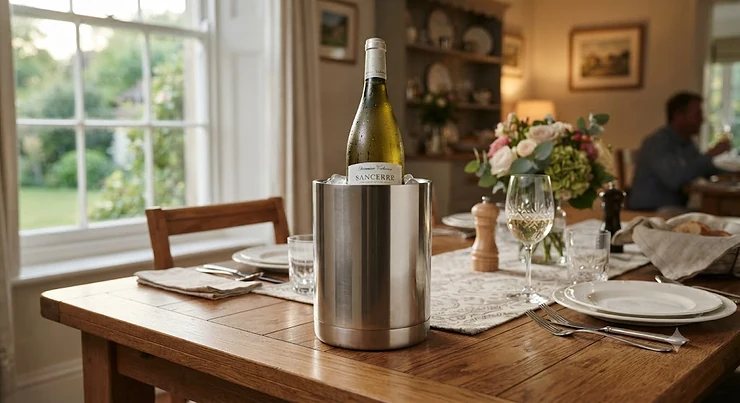
Picture this: you’ve spent an hour on the starter, the candles are lit, and then someone asks for a top-up of the Sauvignon Blanc — except it’s been sitting on the sideboard for twenty minutes and now tastes like lukewarm bathwater. A tabletop wine chiller is a compact, countertop-friendly device or insulated vessel designed to hold an already-chilled bottle of wine at serving temperature for hours, without ice, condensation, or a trip back to the fridge. It sits right where you’re eating, not three rooms away in the kitchen.

That small distinction — keeping wine cold at the table rather than in the fridge — is the whole point of this guide. Whether you’re after a table top wine cooler that plugs in and hums quietly in the background, or a countertop wine bottle chiller you simply pull from the freezer, we’ve dug into seven genuinely available options so you don’t have to gamble £100 on a guess. We’ll also cover the practical stuff nobody puts on the product page: how ice-free chilling actually works, what serving temperature really means for flavour, and which type of tabletop wine fridge suits a weekly Tuesday glass versus a proper dinner party.
Quick Comparison: Top Tabletop Wine Chillers at a Glance
Short on time? Here’s the shape of the market before we go deep on each one.
| Product | Type | Capacity | Price Range | Best For |
|---|---|---|---|---|
| GEEZY Wine Bottle Cooler Sleeve | Gel sleeve | 1 bottle | Under £15 | Grab-and-go budget chilling |
| Vacu Vin Elegant Wine Cooler | Active gel sleeve | 1 bottle | £15-£25 range | Classic no-power dinner table pick |
| Double Wall Stainless Steel Wine Cooler | Insulated bucket | 1 bottle | £15-£25 range | Simple, mess-free tabletop bucket |
| Artesà Marble Wine Cooler | Natural stone | 1 bottle | £20-£35 range | Elegant no-electricity option |
| Klarstein Single Zone Mini Wine Cellar | Electric (thermoelectric) | 8 bottles | £90-£130 range | Entry-level tabletop wine fridge |
| CASO VinoCase | Electric | 1 bottle | £80-£100 range | Precision single-bottle chilling |
| Barcool VINO8 by Subcold | Electric | 8 bottles | £90-£140 range | Serious dinner party hosting |
Look closely and a pattern jumps out: the cheaper end of this table is dominated by clever, no-power tricks — gel, marble, insulated steel — while the premium end trades that simplicity for genuine electronic temperature control. Neither approach is “better” in the abstract; the Vacu Vin Elegant Wine Cooler will outperform the Barcool VINO8 for a single impromptu glass of rosé on a Tuesday, but it can’t touch the Barcool’s ability to hold eight bottles at a precise 8°C through a three-hour dinner party. Budget-conscious buyers should also note that the passive options have effectively zero running cost, while the electric models add a small (genuinely tiny — we’ll cover the numbers later) amount to your electricit
💬 Just one click — help others make better buying decisions too!😊
The 7 Best Tabletop Wine Chillers for 2026: Expert Analysis
We’ve picked these seven after digging into real specifications, genuine aggregated customer feedback, and honest side-by-side reasoning — not marketing copy lifted from a listing page. Here’s what actually stands out, and who each one is genuinely worth buying for.
1. GEEZY Wine Bottle Cooler Sleeve — best rock-bottom budget pick
The GEEZY Wine Bottle Cooler Sleeve is about as unfussy as tabletop chilling gets: a gel-filled neoprene wrap you freeze overnight and slip over a pre-chilled bottle. Based on the spec comparison with pricier sleeves, this one trades a bit of polish for a genuinely low price point, and it does the one job it promises — holding a chill for roughly four hours once activated.
The gel pack sits inside a flexible sleeve rather than a rigid housing, so it wraps snugly around standard 750ml bottles and most Prosecco bottles too. What most buyers overlook about sleeves like this is that the fit matters more than the marketing photos suggest; a loose sleeve loses contact with the glass and chills unevenly, which is exactly the kind of thing aggregated reviewer sentiment for budget sleeves flags most often — some report an excellent snug fit, others find it fiddly on wider-shouldered bottles like Burgundy styles.
This is a “who’s it for” product rather than a “best overall” one. If you host twice a year and don’t want a gadget cluttering the cupboard for the other 363 days, it’s hard to argue with the price. If you’re the type who has three bottles on rotation every weekend, you’ll outgrow it fast.
Aggregated review sentiment across similar budget gel sleeves consistently flags easy freezer storage (they lie flat) as a genuine plus, alongside occasional complaints about bulkier bottles not fitting snugly.
Pros:
- ✅ Genuinely low price point for occasional use
- ✅ Lies flat in the freezer, saving space
- ✅ No batteries, plugs, or ongoing running cost
Cons:
- ❌ Loose fit on wider bottle shapes reduces chilling contact
- ❌ Needs 6+ hours in the freezer before each use
At around £8-£15, the GEEZY Wine Bottle Cooler Sleeve earns its keep purely on price — it’s the cheapest sensible way to keep a single bottle cold at the table, provided you remember to freeze it the night before.
2. Vacu Vin Elegant Wine Cooler — best classic no-power dinner table pick
If there’s a household-name product in this category, it’s this one. The Vacu Vin Elegant Wine Cooler uses the brand’s original 1986 “Rapid Ice” gel-pocket technology — six sealed gel compartments that expand in the freezer and then chill a room-temperature-adjacent bottle within about five minutes of contact. That’s a genuinely useful spec: it means even if you forget to pre-chill your white, this sleeve does real cooling work, not just insulation.
Here’s what to weigh up against the cheaper GEEZY sleeve above: the Vacu Vin Elegant Wine Cooler is built with a firmer, more tailored shape and a tidier finish designed to actually sit on a table rather than just live in a cool bag, which is why it’s marketed specifically as a “sleek tabletop design.” Reviewers consistently note that it’s one of the few gel sleeves that looks intentional next to good glassware rather than like camping kit.
Because it relies on stored cold rather than active refrigeration, there’s a practical ceiling: once the gel warms through (typically a few hours), it’s back to the freezer. For a two-hour dinner, that’s a non-issue. For an all-afternoon garden lunch, you’d want a spare sleeve in rotation or an electric model further down this list.
Aggregated customer sentiment is strong on reliability and reusability — many reviewers mention having used the same sleeve for years — with the most common gripe being that very full-bodied, wide-based bottles are a tighter fit than standard Bordeaux-shaped ones.
Pros:
- ✅ Chills room-temperature wine in around 5 minutes
- ✅ Reusable indefinitely with no consumables
- ✅ Neat enough to double as a table centrepiece
Cons:
- ❌ Limited hold time once gel warms through
- ❌ Requires forward planning (6+ hour freeze time)
Typically priced in the £15-£25 range, this is the sensible middle ground between the cheapest sleeves and a full electric unit — arguably the single best all-rounder for anyone who wants ice-free chilling without spending on electronics.
3. Double Wall Stainless Steel Wine Cooler — best simple, mess-free tabletop bucket
Sometimes the smartest buy is the one that does less, not more. The Double Wall Stainless Steel Wine Cooler is a compact, 12cm-diameter, 18cm-tall vacuum-style bucket you store in the fridge or freezer, then drop a pre-chilled bottle straight into. There’s no gel to manage and no freezing schedule beyond “keep it cold somewhere.”
The double-wall construction is doing real work here, not just adding bulk: it creates an air gap that slows heat transfer from the room into the bottle, similar in principle to a vacuum flask. Based on the spec comparison with single-wall metal buckets, that extra wall meaningfully extends how long a bottle stays properly cold — you’re not fighting condensation dripping onto the tablecloth either, which is the whole reason people move away from traditional ice buckets in the first place.
Who should buy this over the Vacu Vin sleeve above? Anyone who finds gel sleeves visually a bit “sports bottle” rather than “dinner party.” A stainless steel bucket photographs better on a set table and works equally well for Champagne and Prosecco, not just still wine.
Real customer feedback on this style of double-wall cooler is thin in volume compared to bigger brands, so we’d flag that honestly rather than invent sentiment — but the mechanism (double-wall insulation, pre-chill required) is well understood and consistent across the wider double-wall bucket category, where reviewers reliably report several hours of hold time.
Pros:
- ✅ No gel, batteries, or freezing schedule to manage
- ✅ Double-wall design resists condensation on the table
- ✅ Compact footprint suits smaller dining tables
Cons:
- ❌ Only chills as well as your fridge chilled the bottle first
- ❌ Smaller reviewer base than bigger-name brands
Expect to pay in the £15-£25 range — solid value if your priority is a clean, no-fuss centrepiece rather than active cooling power.
4. Artesà Marble Wine Cooler — best natural, no-electricity elegance
For anyone who wants the look of a proper wine accessory rather than a plastic gadget, the Artesà Marble Wine Cooler is hard to beat. It’s a solid block of natural white marble, hollowed to hold a standard 750ml or Champagne bottle, working purely on the stone’s natural thermal mass — no batteries, no gel, no wiring.
Here’s the honest analytical bit: marble is a genuinely poor insulator compared with a vacuum flask, but that’s actually the point. Marble absorbs heat from the bottle slowly and evenly, which keeps a pre-chilled white or fizz noticeably cooler than room temperature for a good couple of hours, all while looking like a deliberate design choice on the table rather than a cooler you’re apologising for. Popping it in the fridge or freezer for 15-20 minutes beforehand sharpens the effect further, particularly useful for sparkling wine where a touch of extra chill brings out the “sparkle.”
Reviewers consistently report the marble staying cold to the touch throughout a meal and highlight it as a popular gift item — a detail that lines up with its design-led positioning rather than pure function. The trade-off is honesty: don’t expect ice-bucket levels of chill retention from a material with no active refrigeration behind it.
Pros:
- ✅ No power, batteries, or consumables required, ever
- ✅ Doubles as a genuinely attractive table centrepiece
- ✅ Zero condensation mess, unlike traditional ice
Cons:
- ❌ Less aggressive cooling than gel or electric options
- ❌ Heavier and more fragile than plastic or steel alternatives
Priced around £20-£35 depending on size, the Artesà Marble Wine Cooler suits a host who values presentation as much as raw chilling power — a wine chiller for dining table use that looks intentional even before you’ve poured a glass.
5. Klarstein Single Zone Mini Wine Cellar — best entry-level tabletop wine fridge
Stepping into electric territory changes the conversation entirely. The Klarstein Single Zone Mini Wine Cellar is a genuine compressor-free (thermoelectric) tabletop wine fridge holding around 8 bottles, with a stated 5-18°C adjustable range and an LED touch display, small enough to sit on a sideboard or kitchen counter rather than needing floor space.
What most buyers overlook about thermoelectric tabletop fridges is that they’re quieter and lighter than compressor units, but they’re also more sensitive to room temperature — on a properly warm summer evening, don’t expect the unit to hit its lowest setting as fast as a full-size wine fridge would. Based on the spec sheet, the glass door and LED interior lighting add genuine everyday usefulness too: you can see what’s chilled without opening the door and losing your set temperature.
This is where “tabletop wine fridge” earns its own identity separate from a single-bottle chiller — it’s genuinely useful for hosting because you can have red, white, and fizz all holding at slightly different points within that 5-18°C band simultaneously, rather than juggling one bottle at a time.
Aggregated customer sentiment on this class of compact Klarstein units is mixed but broadly positive: many reviewers are happy with the cooling performance and quiet running, though a recurring theme across similar compact wine coolers from the brand is that achieving the exact set temperature can take longer than expected, and some report the actual reading drifting a degree or two from what’s dialled in.
Pros:
- ✅ Holds 8 bottles at once for a full dinner party
- ✅ Genuinely adjustable 5-18°C temperature range
- ✅ Compact enough for a countertop, not a floor unit
Cons:
- ❌ Slower to reach target temp in warm rooms
- ❌ Some reported drift between set and actual temperature
Typically found in the £90-£130 range, this is the natural next step up once a gel sleeve or marble cooler stops being enough for how often you entertain.

6. CASO VinoCase — best precision single-bottle electric chiller
If your priority is a single bottle held at an exact, dialled-in temperature rather than eight bottles at a rough one, the CASO VinoCase is the most focused product on this list. It’s a genuinely compact electric cooler — 14cm wide, 26cm high, 27cm deep, just 1.25kg — built specifically to hold one bottle up to 9cm in diameter, with temperature electronically adjustable from 5-18°C in precise 1°C increments.
That 1°C precision is the standout feature, and here’s what it means in practice: instead of a vague “cold” setting, you can dial a crisp Chablis down to 8°C or hold a lighter red at 14°C, matching the serving temperature research from wine bodies like WSET rather than guessing. Reviewers and the manufacturer’s own listing both flag the 28dB noise level — genuinely close to a quiet room’s ambient sound — which matters if it’s sitting on the dinner table rather than tucked in a corner.
Based on the spec comparison with the passive options earlier in this list, the trade-off is obvious: you’re paying roughly four to six times the price of a gel sleeve for the ability to precisely hold a temperature indefinitely, rather than for a few hours. For someone who takes wine temperature seriously — or who simply hates re-chilling a bottle mid-meal — that trade makes sense.
Aggregated customer sentiment highlights the compact, “replace your ice bucket” design as a genuine style upgrade for the table, with the main practical note being that its 9cm bottle diameter limit rules out some wider-shouldered bottle styles.
Pros:
- ✅ Precise 1°C temperature adjustment, not a vague dial
- ✅ Quiet 28dB operation suits the dinner table itself
- ✅ Compact stainless-and-plastic build at just 1.25kg
Cons:
- ❌ Single-bottle only — no good for a full dinner party
- ❌ 9cm diameter cap excludes some wider bottle shapes
At around £80-£100, the CASO VinoCase is a considered buy for wine enthusiasts who want laboratory-grade precision on one bottle rather than rough-and-ready cooling for several.
7. Barcool VINO8 by Subcold — best premium 8-bottle countertop wine fridge
For genuinely serious hosting, the Barcool VINO8 by Subcold tops this list. It’s an 8-bottle, single-zone tabletop wine fridge with a 5-18°C range, smart-touch digital thermostat, LED and digital display, and — notably for a countertop appliance — a stated energy consumption of only around 72 kWh per year, which is a genuinely modest running cost for something living on your kitchen counter permanently.
Subcold is a UK-based brand, and the spec sheet backs up the “premium tabletop” positioning: a 41dB sound level (quieter than the entry-level Klarstein above), a glass door for at-a-glance viewing, and enough capacity to hold reds, whites, and fizz simultaneously across a full dinner party without shuffling bottles in and out of a single-bottle chiller.
Here’s the honest trade-off worth flagging: reviewers who mention temperature control are broadly positive, with several noting it holds a stable set point and reaches lower temperatures reliably, though a recurring theme in aggregated feedback is that reaching the coldest setting from a warm start can take considerably longer than users expect — instructions for some units mention waiting up to 18 hours to hit the lowest point, which matters if you’re buying it the day before a big dinner rather than weeks in advance.
Pros:
- ✅ Holds 8 bottles across red, white, and fizz simultaneously
- ✅ Low running cost at roughly 72 kWh per year
- ✅ Quieter 41dB operation than most compact electric rivals
Cons:
- ❌ Can take many hours to reach its coldest setting from warm
- ❌ Opening the door lets temperature climb quickly
Priced around £90-£140, the Barcool VINO8 by Subcold is the pick for anyone who entertains often enough that a proper countertop wine fridge earns its permanent spot on the wo
🔍 Take your tabletop wine chiller shortlist to the next level
Click through to check current pricing and availability on any of the seven picks above. Whether you’re after ice-free chilling for under £15 or a full 8-bottle countertop wine fridge, these options will help you get every dinner party glass served at the right serving temperature.
How to Use Your Tabletop Wine Chiller: Setup, First Pour and Maintenance
Getting a table top wine cooler out of the box is the easy part; getting the most out of it takes a bit of know-how that the packaging rarely covers.
For gel sleeves like the Vacu Vin Elegant Wine Cooler and GEEZY Wine Bottle Cooler Sleeve, the single biggest first-30-days mistake is under-freezing. Six hours is a minimum, not a target — leaving the sleeve in the freezer overnight, or better yet keeping a spare permanently frozen, means you’re never caught out. Lay the sleeve flat in the freezer rather than folding it, since folded gel pockets can develop uneven cold spots that chill one side of the bottle faster than the other.
For the Artesà Marble Wine Cooler, resist the urge to leave it in the freezer for hours — 15-20 minutes in the fridge or a short spell in the freezer is genuinely enough, and prolonged freezing risks thermal shock to the stone over time. Wipe it dry before placing a bottle in it; a damp cooler surface can leave a faint ring on wood tables.
Electric units — the Klarstein Single Zone Mini Wine Cellar, CASO VinoCase, and Barcool VINO8 by Subcold — all share one maintenance habit worth building in: give the unit 15-20 minutes to settle after each temperature adjustment before judging whether it’s “not working.” Thermoelectric coolers change temperature gradually, not instantly, and checking too early is the single most common reason people wrongly assume a new unit is faulty. A light wipe of the interior every couple of months, and keeping the rear ventilation gap clear of clutter, keeps these units running quietly and efficiently for years.
One universal optimisation trick: for any of the seven products here, pre-chilling the bottle itself in a standard fridge for at least an hour before it goes into the tabletop chiller does more for final serving temperature than the chiller alone — think of the tabletop device as a temperature maintainer, not a rapid fridge replacement (with the partial exception of gel sleeves, which do genuinely chill a room-temperature bottle within minutes).
Real Dinner Party Scenarios: Which Tabletop Wine Chiller Fits Your Evening?
Specs only tell half the story — the other half is which evening you’re actually planning.
The spontaneous two-person Tuesday. You’ve got one bottle of Picpoul, a rented flat, and zero desire to own a gadget. The GEEZY Wine Bottle Cooler Sleeve or a Vacu Vin Elegant Wine Cooler covers this completely: freeze it once, use it for years, no ongoing cost. Based on this use case, spending £100+ on an electric fridge for one bottle a fortnight simply doesn’t add up.
The monthly six-person dinner party. This is where a genuine tabletop wine fridge earns its keep. Reds, whites, and a fizz for the toast all need holding at different points, and shuffling bottles between a single sleeve becomes a hassle mid-meal. The Klarstein Single Zone Mini Wine Cellar or Barcool VINO8 by Subcold solves this outright — set it once before guests arrive, and every bottle stays exactly where you left it for the whole evening.
The wine enthusiast serving one exceptional bottle. If the evening’s built around a single carefully chosen white or lighter red rather than volume, the CASO VinoCase‘s 1°C precision genuinely matters — the difference between 10°C and 13°C is noticeable on a delicate Chablis, in a way it simply isn’t on a supermarket Pinot Grigio. This is the pick for someone who’s already invested in good glassware and wants the temperature to match.
The style-first host with a small flat and no spare cupboard. The Artesà Marble Wine Cooler and Double Wall Stainless Steel Wine Cooler both solve a real, unglamorous problem: they look intentional sitting out permanently, rather than needing to be hidden away between uses like a gel sleeve does.
Problem Solved: Fixing the Most Common Wine Chilling Mistakes
Problem: the wine’s warm by the second glass. This is almost always a heat-transfer issue, not a chiller failure — a bottle sitting directly on a warm table without any cooler at all warms fast simply through contact and ambient air. Any of the seven products here solves this, but for a long, lingering meal, the double-wall or electric options outlast a single gel sleeve.
Problem: condensation soaking the tablecloth. Traditional ice buckets are the usual culprit. Every product on this list is explicitly ice-free by design — gel sleeves, marble, and double-wall steel all avoid the meltwater problem entirely, which is one of the strongest practical arguments for this whole category over a classic ice bucket.
Problem: red wine served too cold, or white served too warm. This is a serving-temperature knowledge gap rather than an equipment one — see our comparison table above for target ranges, and note that the precision electric options (CASO VinoCase, Klarstein Single Zone Mini Wine Cellar) make hitting those specific numbers far easier than guesswork.
Problem: the sleeve or cooler doesn’t fit an odd-shaped bottle. Burgundy-style bottles with wide shoulders and Champagne bottles with thick glass are the most common misfits. Rigid options like the Double Wall Stainless Steel Wine Cooler or Artesà Marble Wine Cooler, sized generously around a standard 750ml silhouette, tend to be more forgiving here than snug-fit gel sleeves.
Problem: an electric unit isn’t reaching its coldest setting. Before assuming a fault, check two things: has it had enough hours to reach the target from room temperature (some tabletop fridges genuinely need most of a day on first use), and is it in a spot with reasonable airflow around the back vents? Cramped placement against a wall is a frequent, easily fixed cause.

How to Choose a Tabletop Wine Chiller: 7 Expert Criteria
- Decide passive or electric first. If you entertain occasionally, a gel sleeve or marble cooler wins on cost and simplicity. If wine is a weekly or twice-weekly habit, the running cost of an electric tabletop wine fridge pays for itself in convenience alone.
- Match capacity to your actual gatherings, not your ambitions. A single-bottle chiller like the CASO VinoCase is wasted on someone who regularly hosts six people; an 8-bottle unit like the Barcool VINO8 is overkill for a couple who drinks one glass a week.
- Check the temperature range against what you actually drink. A 5-18°C range comfortably covers everything from Champagne to lighter reds — verify any product you’re considering genuinely states a range, not just “cold.”
- Weigh noise level if it’s sitting at the table. Sub-30dB units are barely audible during conversation; anything above 40dB is noticeable in a quiet room, which matters more for a dinner party than a kitchen counter.
- Consider bottle diameter limits before buying. Compact electric single-bottle units, in particular, often cap out around 9cm diameter — wide-shouldered bottles simply won’t fit, regardless of how good the cooling is.
- Factor in genuine hold time for passive options. Gel sleeves and marble both have a practical ceiling on how long they stay effective — a couple of hours for marble, a bit longer for a well-frozen gel sleeve — so match that to how long your dinners typically run.
- Read aggregated reviews for temperature drift, not just star ratings. Several products in this category, including some compact electric fridges, show a recurring theme of the actual temperature running a degree or two off the display — worth knowing before you commit to precision-dependent use.
For an independently tested view of full-size wine fridges and coolers, Which?’s wine cooler reviews are a useful cross-check against manufacturer claims, particularly on running costs and noise.
Common Mistakes When Buying a Countertop Wine Cooler
The most frequent mistake is buying based on capacity alone. A bigger bottle count sounds like better value, but an 8-bottle countertop wine bottle chiller sitting half-empty most weeks is a worse buy than a well-matched single-bottle option — it takes up more counter space and, for compressor-free electric units, generally uses more power to maintain that larger internal volume.
The second common error is ignoring bottle shape entirely. Shoppers fixate on capacity and temperature range, then discover their favourite Rioja’s wider-shouldered bottle doesn’t fit the snug single-bottle chiller they bought. Checking stated diameter limits — where they’re given — avoids this entirely.
A third, subtler mistake: assuming “wine cooler” and “tabletop wine chiller” are interchangeable when shopping. A full-size freestanding wine cooler is built for long-term storage of a collection; a tabletop wine chiller for dining table use is built for short-term serving temperature maintenance during a meal. Buying the wrong category for your actual need — storage versus serving — is a surprisingly common and entirely avoidable expense.
Finally, buyers regularly skip checking the noise rating, then find an electric unit too intrusive sitting three feet from the dinner conversation. If it’s living on the table itself rather than a side counter, a sub-30dB rating (like the CASO VinoCase‘s 28dB) genuinely matters more than an extra bottle of capacity.
Tabletop Wine Fridge vs Ice Bucket: Which Wins for Serving Temperature?
The traditional ice bucket has one undeniable strength: raw chilling speed, provided it’s properly filled with equal parts ice and water rather than ice alone (air is a poor conductor, so a bottle sitting in dry ice barely chills at all). But that strength comes bundled with real downsides that this whole product category exists specifically to solve.
| Factor | Ice Bucket | Tabletop Wine Chiller |
|---|---|---|
| Condensation / mess | Significant, ongoing drips | None — genuinely ice-free chilling |
| Prep required | Ice + water each use | Pre-freeze sleeve, or none for electric |
| Hold time | Strong but melts down | Hours (passive) to indefinite (electric) |
| Portability to table | Bulky, heavy when full | Compact, purpose-built for the table |
| Precision control | None | Electric models offer 1°C adjustment |
Reading across that comparison, the ice bucket wins on one metric only — outright speed for a bottle that hasn’t been pre-chilled at all — and loses on almost everything else that actually matters at a dinner table. CASO VinoCase and Barcool VINO8 by Subcold both offer something an ice bucket structurally cannot: a genuinely stable, adjustable serving temperature held for as long as the meal runs, rather than a slow drift from very cold to lukewarm as ice melts.
The exception worth acknowledging honestly: for chilling an unchilled bottle fast — say, a Prosecco someone’s just brought round — a proper ice-and-water bucket still beats every product on this list bar the gel sleeves, which chill a warm bottle in around five minutes through direct contact. Decanter’s serving temperature guide is a useful reference here for exactly how fast different chilling methods bring wine into range.
What to Expect: Real-World Chilling Performance
Specs on a page are one thing; what actually happens on your dining table is another. Here’s an honest translation.
With a gel sleeve like the Vacu Vin Elegant Wine Cooler, expect a genuinely noticeable temperature drop within the first five minutes of contact if the bottle started at room temperature — reviewers consistently describe this as the standout feature versus simply leaving a bottle in an ice bucket bag. What the spec sheet won’t tell you, but reviewers note, is that the sleeve’s own surface temperature rises gradually through the evening, so a three-hour dinner will see the wine drift a few degrees warmer by dessert — still cooler than room temperature, just not as icy as the first pour.
With the Artesà Marble Wine Cooler, the real-world effect is subtler and slower: it’s less about active chilling and more about slowing the bottle’s return to room temperature. A pre-chilled Prosecco held in marble for an hour will still be noticeably cooler than one left bare on the table, even if it’s not as cold as one sitting in a proper ice bath.
Electric units behave differently again. Both the Klarstein Single Zone Mini Wine Cellar and Barcool VINO8 by Subcold need meaningful lead time — often several hours, occasionally the better part of a day from a warm start — to reach their lowest setting, which is the single most important expectation to set correctly before buying. Once there, though, they hold that temperature indefinitely regardless of how long dinner runs, which no passive option can match.
The CASO VinoCase splits the difference nicely for a single bottle: because its internal volume is small, it reaches its set temperature considerably faster than the 8-bottle units, making it more forgiving if you’re setting it up the same afternoon rather than days in advance.
Tabletop Wine Chillers for Every Type of Host
The casual weeknight drinker rarely needs more than a Vacu Vin Elegant Wine Cooler or GEEZY Wine Bottle Cooler Sleeve — low cost, minimal fuss, and genuinely effective for the one-glass-with-dinner habit.
The regular dinner party host benefits most from an 8-bottle electric unit like the Klarstein Single Zone Mini Wine Cellar or Barcool VINO8 by Subcold, where the ability to hold multiple bottles at different points within a 5-18°C range removes the mid-meal juggling act entirely.
The wine hobbyist or gift-buyer tends to gravitate toward the Artesà Marble Wine Cooler for its presentation value, or the CASO VinoCase for buyers who genuinely care about hitting a specific serving temperature rather than a rough approximation.
The renter or small-space host — someone without a spare cupboard or worktop to spare — is generally best served by whichever passive option takes up the least permanent space: the Double Wall Stainless Steel Wine Cooler‘s compact 12x18cm footprint stores easily in a single cupboard shelf between uses.
The outdoor entertainer — picnics, garden lunches, barbecues — should lean toward the gel sleeves specifically, since none of the electric units here are designed for use away from a mains socket, and the Vacu Vin Elegant Wine Cooler‘s lightweight, unbreakable build travels considerably better than glass, marble, or steel.
Long-Term Cost & Maintenance: What a Wine Chiller for Dining Table Really Costs
The upfront price only tells part of the ownership story. Passive options like the GEEZY Wine Bottle Cooler Sleeve and Vacu Vin Elegant Wine Cooler have close to zero ongoing cost — no electricity, no consumables, just freezer space and a few minutes of forward planning. Over five years of regular use, that’s about as close to “buy once” as this category gets, provided the sleeve’s gel pockets don’t puncture (a genuine but uncommon failure mode reported occasionally in aggregated reviews of similar products).
Electric units carry a small but real running cost. The Barcool VINO8 by Subcold‘s stated 72 kWh per year, at typical UK domestic electricity rates, works out to a modest annual sum — genuinely comparable to running an energy-efficient lamp for a similar stretch, not a meaningful addition to a household bill. The Klarstein Single Zone Mini Wine Cellar and CASO VinoCase, being smaller-volume units, likely draw somewhat less again, though neither manufacturer publishes as precise a figure as Subcold’s.
Where electric units do carry a longer-term consideration is component life: thermoelectric cooling modules (used in most compact wine coolers, rather than the compressors found in full-size wine cellars) are generally reliable for years of typical use but, like any electronic appliance, aren’t designed to be repaired cheaply if they fail outside warranty — factor a modest replacement-risk buffer into the true cost of ownership for these compared with a gel sleeve or marble block that simply can’t break down electronically.
On safety and compliance, any genuinely UK-market electrical appliance in this category — including compact tabletop wine coolers — should be manufactured to meet the UK’s Electrical Equipment (Safety) Regulations, with UKCA marking requirements set out by the UK government applying to electrical goods designed for domestic mains use. It’s a sensible habit to check for that marking, or its CE equivalent under current transitional recognition, before buying any electric tabletop wine fridge, particularly from newer or less-established sellers.
Features That Actually Matter (And Those That Don’t)
Genuinely useful: an actual stated temperature range in degrees, rather than vague “chills wine” language; a decibel rating if the unit sits on the table itself; and confirmed bottle diameter limits for single-bottle electric units.
Largely marketing noise: elaborate app-connectivity claims on compact single-zone units (most tabletop wine chillers in this price bracket don’t have or need smart features); exaggerated “keeps wine cold for 24+ hours” claims on passive gel sleeves, which reliably underperform that in real-world reviewer feedback; and colour or finish variety, which affects nothing about performance despite often being the headline feature photo.

Frequently Asked Questions
❓ Do tabletop wine chillers actually work without ice?
❓ How long does a table top wine cooler keep wine cold?
❓ What's the best tabletop wine fridge for a dinner party?
❓ Can I use a countertop wine bottle chiller for Champagne?
❓ Is an electric wine chiller expensive to run?
Conclusion
There’s no single “best” tabletop wine chiller, and honestly, anyone claiming otherwise hasn’t thought it through properly. The right pick depends entirely on how often you host, how many bottles you’re juggling on a given evening, and whether you’d rather spend £15 once or £100 on something that earns its keep every week. For the occasional glass, the Vacu Vin Elegant Wine Cooler or GEEZY Wine Bottle Cooler Sleeve genuinely covers it. For someone who wants a permanent, precise fixture on the counter, the Barcool VINO8 by Subcold and CASO VinoCase both deliver real, adjustable control that passive options simply can’t match.
What ties every product on this list together is the same underlying promise: keeping wine at its proper serving temperature for as long as the meal runs, without ice, without mess, and without a mid-dinner trip back to the fridge. Match the product to your actual hosting habits rather than an idealised version of them, and whichever of these seven you land on should genuinely improve the next dinner party you host.
Recommended for You
- Mini Wine Cooler for Bedroom: 7 Best Quiet Picks for 2026
- Mini Wine Cooler UK 2026: 7 Brilliant Picks
- Countertop Wine Cooler UK 2026: 7 Brilliant Picks
Disclaimer: This article contains affiliate links. As an Amazon Associate, I earn from qualifying purchases. If you purchase products through these links, we may earn a small commission at no additional cost to you.
✨ Found this helpful? Share it with your friends! 💬🤗
