
In This Article
✨ Don’t Miss These Exclusive Deals!
🔍 Take your wine storage to the next level with these carefully selected models. Click any highlighted product to check current pricing and availability on Amazon.co.uk — and find the one that fits your home and budget perfectly.
Top 7 Wine Fridges on Amazon.co.uk: Expert Analysis
1. Subcold Viva16 LED — Best Table-Top for Small Spaces
If you live in a flat — and the majority of UK city dwellers do — counter space is roughly as precious as the wine you’re storing. The Subcold Viva16 LED is one of the most sensible compact wine fridges on Amazon.co.uk, holding 16 standard 75cl bottles in a frame that’ll slip onto a kitchen counter or sideboard without drama.
Energy-wise, it’s impressively restrained. Based on Subcold’s published consumption data across the Viva range, a 16-bottle model of this type draws approximately 100 kWh per year — working out to around £25 annually at current Ofgem rates. That’s genuinely less than the average UK household spends on standby power from devices left on overnight. The compressor technology (rather than thermoelectric) keeps temperatures stable even when the ambient room temperature fluctuates, which matters more than you’d expect in British homes that can swing between a chilly 16°C in October and a sticky 26°C during an unexpected July heatwave.
The single zone covers 3–18°C, which handles whites, rosés, sparkling wines, and lighter reds with ease. A UV-tempered glass door and built-in lock add a touch of professionalism. UK buyers on Amazon consistently praise the build quality and near-silent running — several note it’s quieter than their main kitchen fridge.
Pros:
✅ Very low wine fridge energy consumption (~100 kWh/year)
✅ Genuinely compact — works in flats and terraced houses
✅ Compressor cooling handles variable room temperatures well
Cons:
❌ 16-bottle limit may feel restrictive as your collection grows
❌ Single zone only — not ideal if you regularly mix reds and whites
Price range: under £150 | Available on Amazon.co.uk, Prime-eligible | 230V UK compatible ⭐
2. Subcold Viva24 LED — Best Under-Counter for Everyday Use
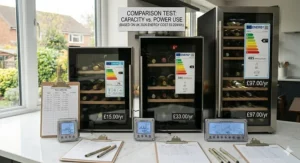
Step up slightly in the Subcold family and you reach the Subcold Viva24 LED, which Subcold lists at a confirmed 135 kWh per year — putting annual running costs at approximately £33 at current electricity prices. That’s a modest premium over the 16-bottle model for a meaningful leap in capacity, and it’s the model I’d point most UK buyers towards as the sensible everyday option.
At 82 litres and designed to slot under a standard UK kitchen worktop, it fits the lived reality of British home layouts far better than larger freestanding towers. The temperature range of 3–18°C is well-suited to everything from a chilled Sauvignon Blanc to a lightly served Pinot Noir. Noise output of 45 dB is comparable to a quiet conversation — you’ll hear it if the room is silent, but it won’t intrude during dinner.
What most buyers overlook about this model is the dual-glazed frameless glass door. It’s not just an aesthetic flourish; it meaningfully improves insulation, which reduces how hard the compressor works and keeps that kWh figure honest. UK reviewers praise the robust construction and the smart-touch digital thermostat, which allows precise degree-by-degree adjustment rather than the vague dial settings you find on cheaper models.
Pros:
✅ Verified 135 kWh/year — one of the lowest in its capacity class
✅ Under-counter design suits compact UK kitchens
✅ Smart-touch thermostat for precise temperature control
Cons:
❌ 45 dB noise rating — slightly louder than the Viva16
❌ No dual zone
Price range: £150–£250 | Available on Amazon.co.uk, Prime-eligible | 230V UK plug ⭐
3. Cookology CWC301BK — Best Budget Wine Fridge to Run
The Cookology CWC301BK is a 30cm wide, 20-bottle freestanding unit that punches well above its price bracket for sheer running cost efficiency. At roughly 90 kWh per year, it has one of the lowest wine fridge energy consumption figures on Amazon.co.uk in the under-£150 price range — meaning annual running costs of just around £22, or less than a round of drinks at a London wine bar.
Cookology is a British brand with genuine UK market awareness, and this shows in the thoughtful details: the reversible door hinge is a small but significant feature for anyone trying to squeeze a wine fridge into a tight kitchen corner, and the digital temperature control beats the analogue dials on competitors at this price. The single zone covers a practical range, and the black finish suits contemporary British interiors.
The honest caveat? At 20 bottles, it’s a wine fridge for the occasional enthusiast rather than the serious collector. If your average weekend sees you reaching for more than five or six bottles, you’ll outgrow this quickly. But for a first wine fridge — or a dedicated white wine cooler to complement a larger unit — it represents outstanding value with minimal impact on your electricity bill.
Pros:
✅ Among the cheapest wine fridges to run in its capacity range (~£22/year)
✅ Reversible door — useful for awkward kitchen layouts in UK terraced houses
✅ Solid build quality from a UK-focused brand
Cons:
❌ 20 bottles is a genuine limitation for regular entertainers
❌ No lock — worth noting if you have curious children about
Price range: under £130 | Available on Amazon.co.uk | 230V UK compatible ⭐
4. Hisense RW12D4NWG0 — Best Value Mid-Range
Hisense has quietly become one of the more credible appliance brands on Amazon.co.uk, and the Hisense RW12D4NWG0 is a solid demonstration of why. This 93-litre, 30-bottle freestanding unit sits in the mid-range sweet spot: enough capacity for a serious casual drinker, not so large that the wine fridge electricity cost becomes a conversation your energy supplier starts.
Estimated at approximately 120 kWh per year, annual running costs come to around £29 — competitive for a 30-bottle unit. The wide temperature range of 2–12°C is notably cooler than many single-zone competitors, making it particularly well-suited to champagne, sparkling wines, and crisp whites that benefit from serving at the lower end. Digital touch controls and a clean design make it feel premium at a mid-range price.
UK buyers note that it runs quietly and cools reliably. Where it earns its Hisense reputation is in the consistency of temperature maintenance — an area where budget thermoelectric models often wobble embarrassingly. The spec sheet won’t tell you this, but in practice, consistent temperature is more valuable than a flashy door finish; wine stored at fluctuating temperatures ages unpredictably, which rather defeats the purpose of owning a wine fridge.
Pros:
✅ ~£29/year running cost — good efficiency for 30-bottle capacity
✅ Temperature range extends to 2°C — ideal for champagne and sparkling wines
✅ Reliable compressor cooling with stable temperature maintenance
Cons:
❌ Single zone limits versatility for mixed collections
❌ Not the most spacious shelving layout
Price range: £150–£220 | Available on Amazon.co.uk, Prime-eligible | 230V UK compatible ⭐
5. Klarstein Vinsider Victoria 36 — Best Dual-Zone for Mixed Collections
Here’s where the running cost conversation becomes a genuine trade-off. The Klarstein Vinsider Victoria 36 is a dual-zone wine fridge with a 36-bottle capacity and a temperature range of 5–22°C across its two independently controlled zones. That dual-zone functionality — the feature that lets you store your Bordeaux at 16°C and your Chablis at 8°C simultaneously without a second unit — pushes energy consumption to approximately 150 kWh per year, or around £37 annually.
Is that extra cost justified? For regular entertainers who routinely serve both reds and whites at the right temperature, absolutely. The frustration of pulling out a too-warm white because you only have one zone is real, and the Klarstein’s elegant cream or black finish means it earns its place in a dining room or kitchen rather than hiding in a utility cupboard. Touch controls and LED lighting add a premium feel that the price range (mid-range for a dual-zone unit) doesn’t quite suggest.
Where Klarstein units sometimes draw mixed UK reviews is on noise consistency — some buyers report a more audible fan cycle than competing compressor models. Worth knowing before placing it beside your home office. For a living room setting or open-plan kitchen, it’s perfectly fine.
Pros:
✅ Dual zone — store reds and whites at correct temperatures simultaneously
✅ 5–22°C range covers essentially every wine style
✅ UV protection glass and LED lighting for proper storage conditions
Cons:
❌ ~150 kWh/year is higher than single-zone equivalents — reflects dual-zone cost
❌ Some UK reviews note inconsistent fan noise
Price range: £200–£320 | Available on Amazon.co.uk via Klarstein UK | 230V UK plug ⭐
6. Haier HWS49GA (Wine Bank 50 Series 5) — Best for Serious Collectors
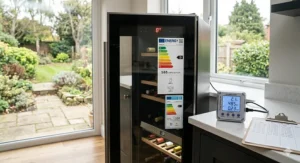
The Haier HWS49GA — branded as the Wine Bank 50 Series 5 — is where wine storage stops being casual and starts becoming a considered hobby. With capacity for 49 bottles across a single zone (5–20°C), anti-vibration beechwood shelves, anti-UV glass, and connectivity via the Haier hOn app (which even includes a “Scan Your Wine” feature for cataloguing your collection), this is one of the most feature-complete wine fridges available on Amazon.co.uk.
The app connectivity is more useful than it sounds. Being able to check and adjust the temperature remotely — or log your cellar from the sofa — suits the increasingly smart British home. Energy consumption runs at approximately 160 kWh per year: around £39 annually. For a 49-bottle capacity, that’s actually competitive. The anti-vibration system is genuinely worth highlighting: wine stored in a vibrating environment experiences accelerated chemical reactions that alter flavour, so this isn’t marketing fluff — it’s a meaningful preservation feature for anyone spending serious money on their collection.
One consideration for UK buyers: the hOn app connects via your home Wi-Fi (230V, UK plug compatible), and the Haier UK warranty provides domestic coverage. Post-Brexit, it’s worth confirming UK warranty terms at purchase — Amazon.co.uk listings typically show Haier UK as the seller, which covers this.
Pros:
✅ 49-bottle capacity with anti-vibration beechwood shelves — proper long-term storage
✅ Smart hOn app with remote temperature monitoring and wine scanning
✅ 230V UK plug, UK-warranted through Amazon.co.uk
Cons:
❌ F energy rating — less efficient than newer models in its category
❌ Smart features require reliable Wi-Fi to function fully
Price range: £350–£450 | Available on Amazon.co.uk | Prime-eligible ⭐
7. SIA HSWC150BL/G — Best Large Capacity Under-Counter
If the question is how to store 58 bottles without turning your spare room into a makeshift cellar, the SIA HSWC150BL/G is the answer that makes the most sense on Amazon.co.uk. At 150 litres and designed to sit under a standard UK worktop (or freestanding), it’s a properly large-capacity unit that still manages annual running costs of approximately £45 — creditable for a 58-bottle unit running 24/7.
SIA is a British brand with a strong UK following, and the HSWC150BL/G shows it: the 2-year parts and labour guarantee is notably better than many continental brands, and UK customer service is reported as responsive and effective. The wooden shelves add a traditional cellar aesthetic that suits British sensibilities rather better than stark steel racks, and the single-zone digital display keeps operation straightforward.
Where this earns its place as a large-capacity recommendation is in value over time. Running at around £45/year, over a five-year period that’s roughly £225 in running costs — compare that against even modest alternatives, and the SIA holds its ground. The glass door with LED lighting makes it a presentable addition to a dining room or kitchen, not something you’ll want to hide away.
Pros:
✅ 58 bottles — the most generous capacity in this review
✅ 2-year parts and labour guarantee from a UK-focused brand
✅ Under-counter design suits British homes with limited floor space
Cons:
❌ ~185 kWh/year reflects the large capacity — highest running cost in this list
❌ Single zone only — not suited to mixed red/white storage at different temperatures
Price range: £250–£380 | Available on Amazon.co.uk | 230V UK compatible ⭐
How to Calculate Your Wine Fridge Electricity Cost (The Simple Way)
This is the bit that most buying guides skip over, and it’s genuinely useful. The formula for working out annual wine fridge electricity cost couldn’t be simpler:
Annual kWh × electricity price per kWh = annual running cost
In the UK, the Ofgem price cap sets the unit rate at around 24–25p per kWh for most households on a standard variable tariff (as of 2026 — always check current Ofgem figures as this changes quarterly). If you’re on a fixed-rate deal, your unit rate may differ.
Finding the kWh figure for your wine fridge is equally simple: it’s stated on the energy label, in the product manual, or — increasingly — on the Amazon.co.uk product page itself. Not all listings show it prominently, but searching the model number alongside “kWh per year” or “annual energy consumption” usually surfaces it within minutes.
A worked example: The Subcold Viva24 LED consumes 135 kWh/year. At 24.5p per kWh: 135 × £0.245 = £33.08 per year, or roughly £2.76 per month. Over ten years (a perfectly reasonable lifespan for a quality wine fridge), that’s around £330 in running costs — enough context to justify spending an extra £80 or £100 upfront on a more efficient model.
One thing the spec sheet won’t tell you: ambient temperature in your home has a significant effect on actual consumption. A wine fridge parked beside your oven or in a south-facing conservatory will work harder than one in a cool, shaded spot — and that extra effort shows up on your electricity bill. More on that in the next section.
How to Slash Your Wine Fridge Running Costs Without Touching the Thermostat
The most effective way to reduce your wine fridge electricity cost has nothing to do with the fridge itself. It’s about where you put it and how you use it. Here are the changes that actually make a measurable difference:
1. Placement is everything. A wine fridge positioned next to an oven, a radiator, or in direct sunlight is fighting a constant battle against external heat. Every degree of ambient warmth above the fridge’s target temperature forces the compressor to run longer. In a typical British terrace — where kitchen layouts tend to be compact and appliances clustered — this is a real consideration. Ideally, position your wine fridge in the coolest, most stable-temperature spot available: a north-facing kitchen corner, a utility room, or a dining room away from windows.
2. Set the temperature sensibly. The colder you set your wine fridge, the harder it works. Red wines genuinely don’t need to be stored at 8°C — a serving temperature of 14–18°C is appropriate for most reds, and storage at 12–14°C is perfectly adequate for ageing. Every degree you reduce the set temperature increases energy consumption slightly, so don’t over-chill out of habit.
3. Don’t leave the door open. This sounds obvious until you’re mid-dinner party, reaching in and out of the fridge several times whilst distracted by conversation. Each opening lets warm air in, and the compressor then has to compensate. A lockable model (like the Subcold Viva24) actually helps here — the act of using the key creates a small but useful pause.
4. Keep it reasonably full. A completely empty wine fridge is less efficient than a well-stocked one. Bottles act as thermal mass, holding the cool temperature when the door is opened and reducing how hard the compressor has to work to recover. This doesn’t mean cramming it to capacity — good airflow around bottles matters — but a fridge running half-empty is spending more per stored bottle than a fuller unit.
5. Ventilation around the unit. Built-in and under-counter wine fridges need clearance on the sides and above for heat to dissipate. Blocking the ventilation vents (usually at the front on under-counter models) forces the compressor to run hotter and longer. Check the manual for the minimum clearance your model requires — it’s usually just a few centimetres, but it matters.

Real-World Scenarios: Which Wine Fridge Suits Your Situation?
The most useful question isn’t “which wine fridge uses the least electricity?” — it’s “which wine fridge makes the most sense for how I actually live?” Here are three recognisably British scenarios:
The urban flat dweller in Manchester or Leeds. Counter space is limited, the kitchen is galley-style, and the wine collection rotates between whatever’s open and maybe twelve bottles in reserve. The Subcold Viva16 LED or Cookology CWC301BK fits this life. Both run under £25 per year, sit on a worktop or under a counter with ease, and don’t require a dedicated alcove. Running cost is minimal; inconvenience from an oversized unit would be significant.
The semi-detached family home in the Home Counties. You entertain occasionally, have a proper kitchen with room under the counter, and like having a mix of reds and whites ready to serve. The Klarstein Vinsider Victoria 36 earns its dual-zone premium here. Yes, it’s around £37 per year to run rather than £25 — that’s less than £1 per week extra for the convenience of never pulling out a too-warm Sauvignon Blanc at a dinner party. With 36 bottles across two zones, it handles the job properly.
The serious collector in a larger house in Surrey, the Cotswolds, or rural Scotland. You buy wine to keep, not just to consume immediately. You care about anti-vibration storage and long-term cellaring conditions. The Haier HWS49GA or SIA HSWC150BL/G is where you’re looking. The Haier’s smart app and anti-vibration beechwood shelves make it genuinely well-suited to a 10-year-plus storage strategy; the SIA’s 58-bottle capacity and 2-year UK guarantee make it the practical large-capacity workhorse.
Energy Ratings Explained: What F, G and A Actually Mean on Your Bill
Since March 2021, UK appliances have used a rescaled A–G energy label (you may remember the old A+/A++/A+++ system — that’s been retired). Under the new scale, A is the most efficient and G is the least. Here’s where wine fridges currently sit, and what it means in honest, practical terms:
| Energy Rating | Typical Annual kWh (wine fridge) | Approx. Annual Cost (24.5p/kWh) | Notes |
|---|---|---|---|
| D | 80–100 kWh | £20–£25 | Best available for wine fridges in 2026 |
| E | 100–130 kWh | £25–£32 | Good efficiency — most quality compressor models |
| F | 130–170 kWh | £32–£42 | Mid-range — common in budget to mid-market |
| G | 170–250+ kWh | £42–£61+ | Older or larger models; thermoelectric units often here |
The uncomfortable truth: under the new A–G scale, virtually all wine fridges currently sold in the UK — including premium brands — land in the E, F, or G category. According to energy efficiency experts, the very newest 2025–26 models from specialist brands are beginning to achieve D ratings, but A, B, or C-rated wine fridges are essentially non-existent on the consumer market. Don’t be put off by an F rating on a wine fridge — in this appliance category, F is often the new norm rather than a sign of poor engineering.
The meaningful comparison to make is between models within the same capacity class. A 30-bottle wine fridge rated F at 130 kWh/year is considerably more efficient than a 30-bottle model rated G at 200 kWh/year. Always check the kWh figure, not just the letter rating.
Thermoelectric vs Compressor: The Running Cost Reality
This is a question that crops up constantly in UK wine fridge research, and the answer is more nuanced than most buying guides admit.
Thermoelectric wine fridges use a Peltier device rather than a compressor to cool. They’re silent, vibration-free, and simple — with no moving parts to wear out. Sounds ideal. The catch is that they’re significantly less energy-efficient in ambient temperatures above about 20°C, and they struggle to achieve temperatures much below ambient minus 8°C. In a British home during summer (which increasingly means rooms reaching 25–28°C during heatwaves), a thermoelectric wine fridge works considerably harder than its kWh label might suggest. Actual running costs can exceed the stated figure substantially.
Compressor wine fridges — all seven models in this review use compressor cooling — maintain temperature reliably regardless of ambient room temperature, because the refrigeration cycle actively pumps heat out of the cabinet. They’re slightly noisier (though modern units are impressively quiet), and in rare cases vibration can be a minor consideration for very long-term ageing. For everyday use in a British home, the efficiency and temperature reliability of compressor cooling wins comprehensively.
For wine fridges specifically, the British climate creates a particular problem for thermoelectric models: our homes aren’t uniformly warm. A thermoelectric unit that performs adequately in a 20°C kitchen may struggle to reach the target temperature in a 25°C kitchen during a summer heatwave, then overcool slightly in a 14°C utility room in January. Compressor models handle this variation without complaint.
Common Mistakes That Push Up Your Wine Fridge Running Costs
It’s worth being honest about the errors that turn a reasonably efficient wine fridge into a genuine energy drain:
Buying a thermoelectric model for a warm room. As above — in British homes that vary seasonally, thermoelectric units frequently consume more than their stated kWh figure. If your wine fridge will live in a kitchen, dining room, or conservatory that reaches above 20°C in summer, choose a compressor model.
Ignoring ventilation requirements. Under-counter fridges need front-vented clearance to dissipate heat. Block those vents by pushing the unit flush against cabinetry on three sides, and the compressor runs hotter, works harder, and uses more electricity. A small amount of planning at installation prevents this entirely.
Setting the temperature unnecessarily low. There’s a common misconception that wine fridges should be set as cold as possible. Most wines store beautifully at 12–14°C. Running at 8°C (common in fridges set to “max cold”) pushes consumption up meaningfully and doesn’t improve wine quality — it may actually slow development in wines that benefit from gentle ageing.
Placing the fridge next to heat sources. Even in compact UK kitchens, the positioning of your wine fridge relative to the oven, hob, or a west-facing window makes a measurable difference to how often the compressor cycles.
Buying a larger unit than you need. Bigger fridges use more electricity. A 58-bottle unit running at 30% capacity doesn’t save you £45/year — it costs you that. Match the capacity to your genuine collection size, not your aspirational one.
Long-Term Cost & Maintenance: The True Cost of Ownership
When comparing wine fridge electricity cost, the purchase price is only part of the picture. Here’s a straightforward ten-year total cost of ownership calculation for three different buyer types, based on current Amazon.co.uk price ranges and estimated running costs at 24.5p/kWh:
| Buyer Type | Best Model | Est. Purchase Price | 10-Year Running Cost | 10-Year Total |
|---|---|---|---|---|
| Casual (16 bottles) | Subcold Viva16 | ~£130 | ~£250 | ~£380 |
| Mid-range (36 bottles, dual zone) | Klarstein Vinsider 36 | ~£260 | ~£370 | ~£630 |
| Serious collector (49 bottles) | Haier HWS49GA | ~£400 | ~£390 | ~£790 |
The takeaway here is subtler than it first appears. The Haier costs significantly more upfront, but its running cost over ten years is only marginally higher than the Klarstein — because the single-zone compressor is more efficient than the dual-zone equivalent. The casual buyer’s Subcold has the lowest total cost of ownership by a clear margin, but only if 16 bottles genuinely suits your collection.
On maintenance: good compressor wine fridges require minimal upkeep. Keep the condenser coils (usually accessible at the back or base) free from dust — a quick wipe every six months is sufficient. Clean the interior every few months to prevent odours, and check door seals annually; a deteriorated seal lets warm air seep in and sends the compressor into overtime. These are five-minute tasks, not projects.
Frequently Asked Questions
❓ How much does a wine fridge cost to run per year in the UK?
❓ What is the most energy-efficient wine fridge to buy in the UK?
❓ Does a wine fridge use more electricity than a normal fridge?
❓ Is it cheaper to run a wine fridge in winter in the UK?
❓ Do I need a special electrical connection for a wine fridge in the UK?
Conclusion: What the Numbers Actually Tell You
The headline figure — wine fridge electricity cost in the UK ranges from about £20 to £65 per year depending on size and efficiency — is useful context but not the whole story. The real insight, once you dig into the numbers, is that the difference between a sensibly chosen wine fridge and a poorly matched one isn’t dramatic in annual cost, but it compounds over a decade into a meaningful sum.
Choose a compressor model over thermoelectric for UK conditions. Match capacity to your actual collection rather than your theoretical one. Position the unit away from heat sources — genuinely the single biggest free efficiency gain available. And check the kWh figure before you buy, not just the energy letter rating.
The seven models in this guide all represent legitimate options currently available on Amazon.co.uk, with genuine UK compatibility, and honest efficiency profiles. The Subcold Viva24 LED remains our pick for most UK buyers — low running costs, sensible capacity, compressor reliability, and a price that doesn’t require a second mortgage. But if your collection genuinely warrants 49 or 58 bottles, the Haier HWS49GA and SIA HSWC150BL/G both deliver serious storage for what amounts to a few pounds per month in electricity.
A well-chosen wine fridge costs about as much to run annually as a couple of bottles from a decent independent wine merchant. That’s not bad value for keeping everything else in your collection at exactly the right temperature.
✨ Don’t Miss These Exclusive Deals!
🔍 Check current pricing and availability for all seven models above on Amazon.co.uk. Whether you’re after the cheapest wine fridge to run or a serious 50-bottle cabinet, these picks cover every budget and home size. Click any highlighted product to explore your options and add to basket today!
Recommended for You
- Wine Fridge vs Normal Fridge: 7 Best UK Picks (2026)
- Wine Fridge Buying Guide: 7 Best UK Picks for 2026
- Best Wine Fridge UK 2026: 7 Top Picks for Every Budget
Disclaimer: This article contains affiliate links. As an Amazon Associate, I earn from qualifying purchases. If you purchase products through these links, we may earn a small commission at no additional cost to you.
✨ Found this helpful? Share it with your mates! 💬🤗
