
In This Article
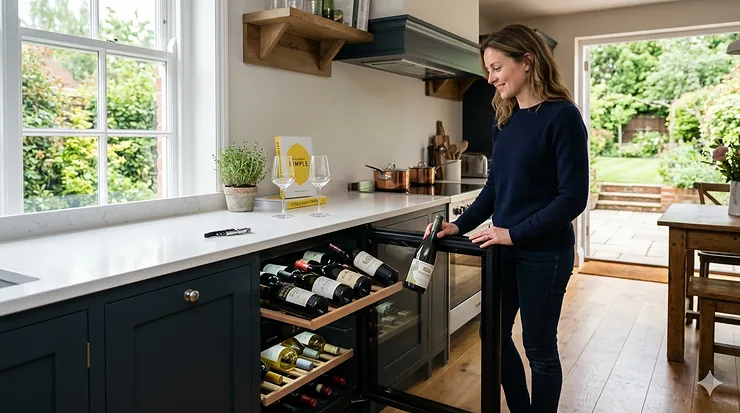
There are worse problems to have than owning too much wine. But storing it badly? That’s a genuine tragedy. A treasured bottle of Burgundy quietly oxidising next to the bread bin, vibrated into oblivion by the family fridge’s compressor, is enough to make a sommelier weep. Whether you’ve recently got into collecting or you’ve been scouring Waitrose’s shelves for decades, a decent wine fridge is arguably the single most impactful purchase you can make for the quality of what ends up in your glass.
This wine fridge buying guide cuts through the noise. We’ve researched what’s actually available on Amazon.co.uk right now — not hypothetical imports, not discontinued models, not American units running on 120V that’ll blow a fuse the moment they reach British soil. Real products, tested by real people, available with Prime delivery and UK plug sockets as standard.
What is a wine fridge buying guide, exactly? It’s a structured resource that helps you identify the right cooling solution for your specific wine storage needs — covering capacity, cooling technology, temperature zones, noise levels, UV protection, and value for money. Whether you’re looking for a discreet under-counter unit for a London flat kitchen or a freestanding showpiece for a dining room in the Home Counties, this guide will steer you right.
British homes present particular challenges for wine storage. Central heating keeps rooms warm and dry in winter, while summer heat waves (increasingly common, as the Met Office has documented) push kitchen temperatures above 25°C. Neither is kind to a Pinot Noir. A dedicated wine fridge solves all of this — quietly, efficiently, and with considerably more style than a cardboard box under the stairs.
Let’s get into it.
Quick Comparison: Top 7 Wine Fridges on Amazon.co.uk
| Product | Capacity | Zones | Cooling Type | Best For | Price Range |
|---|---|---|---|---|---|
| Barcool VINO12 | 12 bottles | Single | Thermoelectric | Flat-dwellers, beginners | Around £80–£130 |
| Cookology CWC300SS | 20 bottles | Single | Compressor | Slim kitchen gaps | £100–£160 |
| Hisense RW12D4NWG0 | 30 bottles | Single | Compressor | Everyday collections | £150–£220 |
| Subcold Viva24 LED | 24 bottles | Single | Compressor | Style-conscious buyers | £120–£200 |
| Hisense RW17W4NWG0 | 46 bottles | Dual | Compressor | Mixed red & white storage | £200–£320 |
| Haier Wine Bank 50 HWS49GA55 | 49 bottles | Single | Compressor | Serious enthusiasts | £300–£450 |
| Cookology CWC608SS | 40 bottles | Dual | Compressor | Built-in kitchen fit | £280–£420 |
The table above illustrates something immediately useful: dual-zone models cost noticeably more, but if you regularly drink both reds and whites (and most of us do), the price gap closes quickly when you consider the alternative — opening a warm Chardonnay or a chilled-to-submission Merlot. Budget buyers under £150 are largely in thermoelectric territory or compact compressor units, which suit a 12–20 bottle collection admirably but struggle to scale. If your collection already runs to 30+ bottles, the mid-range is where the real value lives.
✨ Don’t Miss These Exclusive Deals!
🔍 Take your wine storage to the next level with these hand-picked products. Click any highlighted product name to check current pricing and availability on Amazon.co.uk. These picks represent the best the UK market has to offer right now!
💬 Just one click — help others make better buying decisions too! 😊
Top 7 Wine Fridges on Amazon.co.uk — Expert Analysis
1. Barcool VINO12 — Table-Top Slim Wine Cooler Fridge
The VINO12 is the wine fridge you buy when you live in a first-floor flat in Bristol and the kitchen is, generously speaking, galley-shaped. At just 15cm wide, it tucks neatly onto a worktop or shelf and holds 12 standard bottles in its UV-tempered glass door cabinet.
The thermoelectric cooling system operates in a temperature range of 5–18°C, which covers chilled whites and lightly cooled reds admirably. Here’s what the spec doesn’t shout about loudly enough: thermoelectric models produce virtually no vibration — and that matters enormously for wines you intend to keep for more than a few weeks. Vibration agitates the sediment, disrupts the slow chemical reactions that age wine properly, and generally makes a mess of anything with a bit of complexity. The VINO12’s quiet operation (a genuine whisper compared to a standard kitchen fridge) is its real selling point, not just a marketing bullet point.
The LED display and digital touch panel make temperature adjustment clean and modern. The UV-tempered glass door is a detail that most buyers at this price point overlook entirely — direct light is wine’s enemy, and the VINO12 takes that seriously.
That said, this is unambiguously a short-term storage and serving unit. It won’t maintain the 12–14°C humidity-stable conditions you’d want for ageing fine wine over years. It’s also thermoelectric, meaning performance degrades noticeably in warm rooms — if your kitchen regularly hits 25°C in July, expect the fridge to struggle to hit its minimum temperature.
UK customer reviews consistently praise the compact footprint and whisper-quiet operation, though a handful note the shelves are on the snug side for wider-shouldered Burgundy bottles.
✅ Virtually silent thermoelectric operation
✅ UV-tempered glass door at an excellent price
✅ Genuinely compact — no plumbing, no drama
❌ Thermoelectric cooling loses efficiency above ~25°C ambient
❌ Capacity is 12 standard Bordeaux bottles — Burgundy shapes may fit fewer
Best for: First-time wine fridge buyers, flat-dwellers, anyone who wants to serve wine at the right temperature without making a production of it. Price range around £80–£130 — frankly, excellent value for what it does.
2. Cookology CWC300SS — 30cm Slim Freestanding Wine Cooler
Cookology is a British brand that deserves more attention than it typically gets. The CWC300SS is a 30cm wide, 60-litre under-counter unit in stainless steel that holds 20 standard bottles across five sliding shelves. Think of it as the wine fridge equivalent of a well-tailored jacket — slim, professional, and just the right size for most occasions.
The compressor-based cooling maintains temperatures reliably from 5–18°C regardless of ambient room temperature. This is the critical advantage over thermoelectric models: a compressor-cooled unit doesn’t care whether it’s January or a rare British heatwave, it will hold its temperature. The five sliding shelves are beech-finished and angled correctly to keep corks moist — a small detail that preserves natural corks, which cover the vast majority of quality wine bottles.
The reversible door is a practical stroke of genius for smaller kitchens where opening direction matters. The digital temperature control panel is crisp and readable. At 30cm wide, this model slides neatly into the gap left by most standard kitchen cabinet configurations.
UK buyers consistently highlight the build quality as punching above its price. A few reviewers note that the fan can produce a faint hum when the compressor kicks in — not intrusive in a kitchen environment, but worth knowing if you’re planning to position it in a bedroom or living room.
✅ Reliable compressor cooling — unaffected by ambient temperature
✅ 30cm slim profile fits most UK kitchen gaps perfectly
✅ Reversible door — a practical detail British kitchens genuinely need
❌ Fan hum audible in very quiet rooms
❌ 20-bottle limit means it outgrows moderate collections
Best for: Homeowners with a specific 30cm kitchen gap to fill, those building a starter collection of 15–20 bottles, buyers upgrading from thermoelectric. In the £100–£160 range, it represents the best compressor wine fridge value at this size.
3. Hisense RW12D4NWG0 — 30-Bottle Freestanding Undercounter Wine Fridge
Hisense has quietly become one of the most trusted names in UK kitchen appliances, and the RW12D4NWG0 is a perfect illustration of why. This 93-litre, 30-bottle freestanding unit occupies under-counter height and width while delivering features that would have cost three times as much a decade ago.
The digital touch control panel sets temperature precisely across a 2–12°C range — narrower than some rivals, but perfectly calibrated for white wines, Champagne, and lighter reds served slightly cool. The freestanding design means ventilation is built in for front-exhaust, making it genuinely under-counter compatible without modification. The glass door features low-E coating that provides meaningful UV protection for your bottles.
In practice, the Hisense holds temperature with impressive consistency. UK reviewers frequently mention performance during the summer months as a highlight — it maintained its set temperature during a reported ambient temperature of 28°C in a south-facing kitchen, which is precisely the kind of performance that separates a real wine fridge from an overpriced box.
The 30-bottle capacity covers most enthusiast collections without becoming unwieldy. The LED interior lighting uses warm-tone LEDs rather than the harsh white of cheaper models, which is a small but genuinely pleasant touch when you’re rummaging for a bottle on a Friday evening.
✅ Consistent compressor cooling even during summer heat
✅ Front-exhaust ventilation — true under-counter installation
✅ 30 bottles at an accessible price point
❌ 2–12°C range suits whites; determined red-only collectors may prefer wider range
❌ Slightly taller than some 82cm under-counter configurations
Best for: Everyday white wine and Champagne enthusiasts, buyers who entertain regularly and need reliable serving-temperature storage. In the £150–£220 range, it’s competitive with anything at this capacity.
4. Subcold Viva24 LED — Under-Counter Wine Fridge
Subcold is one of the UK’s own appliance brands, and the Viva24 LED wears that heritage confidently. This 24-bottle single-zone under-counter unit combines a 3–18°C temperature range with LED interior lighting, a lock and key, and a glass door that has no business looking this elegant at this price point.
The 3°C lower limit is worth pausing on. Most competitors start at 5°C; the Subcold hits 3°C, which means it can properly chill Champagne and Cava to their ideal serving temperatures (4–8°C) without the white wine sitting at an awkward compromise temperature. This is a detail that most buyers only notice after they’ve lived with a rival model for six months.
The lock-and-key system feels like a premium touch in a mid-range product. Unnecessary for most households, but rather useful if you share a kitchen with teenagers or enthusiastic house guests. The LED lighting gives the bottles a warm amber glow that’s genuinely attractive when the door is opened.
At 24 bottles across its shelves, the Viva24 suits collections that have grown past the beginner stage but haven’t yet crossed into serious collector territory. The compressor cooling handles ambient temperatures well, and the 3–18°C range means it can serve as a dual-purpose unit — whites at the bottom, reds slightly warmer higher up, exploiting the natural temperature gradient inside the cabinet.
UK customer feedback is overwhelmingly positive, with particular praise for build quality and aesthetics. A minority note that the shelves are fixed-height, which limits flexibility for odd-shaped bottles.
✅ 3°C lower limit — better Champagne service than most rivals
✅ Lock and key included — practical for busy households
✅ One of the more aesthetically refined mid-range options
❌ Fixed shelves limit flexibility for larger formats
❌ No dual-zone — single temperature across all bottles
Best for: Design-conscious buyers, Champagne enthusiasts, those who want a mid-range fridge that looks expensive. Priced in the £120–£200 range with solid UK Prime availability.
5. Hisense RW17W4NWG0 — 46-Bottle Dual Zone Freestanding Wine Fridge
Now we’re talking. The RW17W4NWG0 is Hisense’s dual-zone flagship at the accessible end of the premium market, and it solves the most common wine storage dilemma in British households: you want your Sauvignon Blanc at 8°C and your Rioja at 16°C simultaneously, and you’d rather not own two fridges.
The 145-litre cabinet holds 46 bottles across independent upper and lower zones, each controlled separately via the LED touch display on the door. The temperature range spans 5–20°C across both zones combined, giving you the full spectrum from crisp Champagne to room-temperature red. The digital display is intuitive — refreshingly so in a category where confusing interfaces are practically a tradition.
What strikes UK reviewers consistently is the even temperature distribution throughout the cabinet. Cheaper dual-zone units often have a significant temperature variance between the top and bottom of each zone; the RW17W4NWG0 uses a fan-assisted circulation system that keeps temperatures genuinely consistent. That matters for long-term storage — a bottle sat at 18°C rather than the intended 15°C accumulates heat stress over months.
At freestanding under-counter dimensions, it fits the standard 82cm UK kitchen height without modification. Front ventilation means built-in installation is also viable. Given that dual-zone units at this capacity frequently tip into the £400+ range, the £200–£320 price band represents genuine value.
UK customer feedback highlights quiet operation and the large, legible LED display. A small number report the door seal requiring attention after a year, which is worth checking periodically.
✅ True dual-zone — independent temperature control for reds and whites
✅ Fan-assisted circulation for even temperature distribution
✅ 46 bottles at a price point significantly below premium rivals
❌ Door seal may need checking over time
❌ Limited to front ventilation positioning
Best for: Mixed red-and-white collectors, anyone upgrading from a single-zone unit, households that entertain and need serving-temperature flexibility. The sweet spot of this guide.
6. Haier Wine Bank 50 Series 5 (HWS49GA55) — 49-Bottle Freestanding Wine Cooler
The Haier Wine Bank range is where wine fridge engineering starts to feel like it’s been taken seriously rather than merely considered. The HWS49GA55 holds 49 bottles in a sleek black freestanding cabinet (49.7 × 58.5 × 82 cm), equipped with anti-UV glass door, a low-vibration compressor design, and connectivity via Haier’s hOn app — yes, you can monitor and adjust your wine fridge temperature from your phone. Whether you consider that a genuine innovation or a solution looking for a problem is entirely your prerogative.
The anti-UV glass door deserves genuine respect here. Light degrades wine through a process that produces sulphur compounds responsible for the unpleasant “lightstruck” flavour — a particular issue for wines stored in glass-fronted units near windows. Haier’s anti-UV coating blocks the relevant wavelengths properly, not just cosmetically.
The low-vibration motor is another feature that matters more for storage than for casual serving. If you’re planning to keep bottles for 12 months or more, a vibration-free environment allows the slow, undisturbed maturation that makes aged wine what it is. Most budget and mid-range compressor units produce sufficient vibration to be a mild concern over long periods; the HWS49GA55 addresses this directly.
At F energy class, it’s not the most efficient wine fridge on the market, but running costs in the UK are modest — roughly £25–£35 per year at average UK electricity rates.
✅ Anti-UV glass door — genuine light protection, not a marketing claim
✅ Low-vibration compressor — serious long-term storage capability
✅ hOn app connectivity for remote temperature monitoring
❌ F energy class — not the most efficient option
❌ Wooden shelves reported as feeling lightweight in some UK reviews
Best for: Serious enthusiasts building a collection for aging, buyers who want smart home integration, anyone storing wines for 12+ months. Priced in the £300–£450 range — a substantial but justified investment for the serious collector.
7. Cookology CWC608SS — 60cm Dual-Zone Built-Under Wine Fridge
The CWC608SS is Cookology’s premium dual-zone flagship, and it’s built to fill a standard 60cm kitchen cabinet gap with the authority of a unit that knows exactly what it’s doing. At 40 bottles across 120 litres, with separate temperature zones and anti-UV glass, this is a wine fridge designed to be integrated into a kitchen rather than apologetically placed in a corner.
The dual-temperature zones operate independently, covering the same 5–18°C range that covers the full spectrum of service temperatures for still wines. The anti-UV glass door, stainless steel finish, and reversible hinge make it kitchen-ready in a way that cheaper units simply aren’t. This is a wine fridge that will look deliberate and considered in a fitted kitchen renovation — not an afterthought.
The 60cm width is key. Most under-counter kitchen units are specified at 60cm, meaning this model integrates seamlessly without gaps, custom panelling, or the faintly embarrassing look of a narrower fridge floating in a too-wide cabinet opening. For anyone doing a kitchen renovation in 2026, specifying this early in the process pays dividends.
UK reviews highlight the build quality as confidently premium and the temperature accuracy as reliable across both zones. A few buyers note it runs slightly warm in the upper zone during summer — worth noting if your kitchen regularly exceeds 28°C ambient.
✅ 60cm width — integrates perfectly into standard UK kitchen cabinetry
✅ Dual-zone with anti-UV glass — comprehensive wine protection
✅ Stainless steel finish sits naturally in modern fitted kitchens
❌ Upper zone can run slightly warm in very hot ambient conditions
❌ At 39kg, installation is a two-person job
Best for: Kitchen renovation projects, buyers fitting out a new home, anyone who wants a wine fridge to look as though it was always there. Price range £280–£420 with free Prime delivery to most UK mainland addresses.
How to Choose a Wine Fridge in the UK — 6 Things That Actually Matter
Buying a wine fridge sounds simpler than it is. The market is full of products with impressive-sounding specifications that, in practice, tell you very little about whether the unit will actually suit your needs. Here’s what matters — and what doesn’t.
1. Compressor vs Thermoelectric Cooling
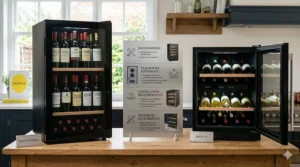
This is the most consequential decision in this wine fridge buying guide. Compressor models cool using the same refrigerant-cycle technology as your kitchen fridge — powerful, reliable, and unaffected by ambient temperature. Thermoelectric models use the Peltier effect, which is quieter and vibration-free but loses efficiency when the surrounding temperature rises above roughly 22–25°C.
In a British climate, compressor cooling is the safer choice for anyone planning to keep wine for more than a few weeks. British summers may be modest by Mediterranean standards, but a south-facing kitchen in July will regularly hit 25–28°C — exactly the threshold where thermoelectric units start to struggle. That said, thermoelectric models are genuinely excellent for tabletop serving fridges where the goal is “ready to pour in 30 minutes” rather than “stored safely for 18 months.”
2. Single Zone vs Dual Zone
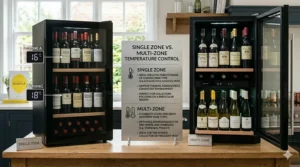
A single-zone fridge maintains one temperature throughout. A dual-zone fridge maintains two independent temperatures — typically one zone for whites at 8–12°C and one for reds at 14–18°C. If you drink roughly equal quantities of red and white wine, dual-zone is transformative. If you primarily drink one or the other, single-zone is simpler and more energy-efficient.
A practical middle-ground approach: exploit the natural temperature gradient inside a single-zone fridge by setting it to 12°C, placing whites on the lower shelves (cooler) and reds on the upper shelves (fractionally warmer). Not perfect, but functional for casual use.
3. Capacity — Be Honest With Yourself
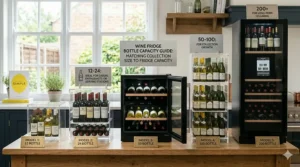
Wine fridge capacity is measured in standard Bordeaux-shape bottles (75cl, ~82mm diameter). If you drink Burgundy, Champagne, or wider-shouldered bottles regularly, reduce the stated capacity by 15–20%. A “30-bottle” fridge may hold 24–26 bottles of your actual collection.
More importantly: whatever capacity you’re considering, buy the next size up. Collections grow. This is not a character flaw — it is simply the nature of wine.
4. UV Protection
Direct and indirect UV light breaks down the tartaric acid compounds in wine, producing sulphur-based off-flavours in a process oenologists call the “lightstruck” effect, described in detail by Wine & Spirit Education Trust resources. Any wine fridge kept near a window, skylight, or well-lit open-plan kitchen benefits meaningfully from a UV-protected glass door. Haier and Cookology’s premium models take this seriously; budget models less so.
5. Noise Level
Wine fridges are rated in decibels. The UK standard for “quiet” kitchen appliances is broadly accepted as below 40 dB — roughly the level of a whispered conversation. Thermoelectric units are typically 25–35 dB; compressor units range from 38–45 dB depending on quality. If you’re locating the fridge in a living room or open-plan kitchen-diner, pay close attention to the noise specification and weight it accordingly.
6. Physical Dimensions and Ventilation
This sounds obvious, but it trips up a surprising number of UK buyers. Under-counter wine fridges require either rear ventilation (freestanding only, needing clearance behind and above) or front ventilation (can be built-in under a counter with zero rear clearance). Check which type you’re buying before it arrives and you’ve already cleared the kitchen cabinet space. Models with front ventilation cost slightly more but offer dramatically more installation flexibility — critical in the smaller kitchens of British terraced houses and flats.
Thermoelectric vs Compressor Wine Fridge — A Deeper Look
This is one of the most searched topics in the wine fridge buying guide space, and for good reason. The choice is less about one technology being objectively better and more about which one suits your specific home environment.
Thermoelectric advantages: Virtually silent operation (25–35 dB). No compressor vibration — genuinely beneficial for long-term wine aging. Environmentally friendlier refrigerants. Simpler internal mechanics mean fewer things to go wrong. Lower purchase price at equivalent capacities.
Thermoelectric limitations: Cooling capacity is proportional to the difference between ambient temperature and target temperature. Specify a 7°C target; if your room is at 22°C, you’re asking the Peltier system to maintain a 15-degree differential. Manageable. If the room hits 28°C in August, you’re asking for 21 degrees — and the unit will struggle, potentially stabilising at 12–14°C rather than the target 7°C. For serving purposes, this is inconvenient. For storage purposes, it’s a genuine quality risk.
Compressor advantages: Maintains target temperature regardless of ambient room temperature. Suitable for ambient temperatures up to 38–40°C, meaning performance never degrades in British summer conditions. Better humidity stability over long periods. Scales effectively to larger capacities.
Compressor limitations: Produces more vibration than thermoelectric — mitigated by quality anti-vibration mounting in premium models. Generates slightly more noise (typically 38–42 dB). Higher purchase price at equivalent specifications.
The verdict for UK homes: For collections above 20 bottles or wines stored for more than two months, a compressor wine fridge is the right choice for the British climate. For small serving fridges in temperature-controlled rooms, thermoelectric remains a charming and effective option.
Real-World Scenarios — Which Wine Fridge for Which British Household?
The London Flat-Dweller
Profile: One-bedroom flat in zone 2, kitchen measured in optimism rather than square metres, stores 10–15 bottles at any one time, primarily drinks white wine and Champagne for entertaining.
Best match: Barcool VINO12 or Cookology CWC300SS. The VINO12 fits on a worktop and disappears into a compact kitchen; the CWC300SS slots into a 30cm cabinet gap if one exists. Neither will overwhelm the kitchen budget.
The Suburban Family, Mixed Collection
Profile: Semi-detached in Birmingham or Leeds, kitchen with under-counter space available, drinks both red and white wine, accumulates bottles faster than they’re consumed.
Best match: Hisense RW17W4NWG0 (dual-zone, 46 bottles). Handles a growing mixed collection, fits standard UK under-counter height, and won’t require a second unit when the whites and reds start competing for shelf space.
The Serious Enthusiast Building a Collection
Profile: Detached house with utility room or garage (temperature-controlled), buys wine specifically to age, cares deeply about vibration, UV protection, and long-term storage conditions.
Best match: Haier Wine Bank 50 (HWS49GA55). The anti-UV glass, low-vibration compressor, and hOn app monitoring make it the most storage-focused option in this guide. It’s built for bottles that will still be there in five years.
The Kitchen Renovation Project
Profile: Fully refitting the kitchen, wants the wine fridge to look integrated rather than retrofitted, standard 60cm cabinet planning.
Best match: Cookology CWC608SS. Designed specifically to fill a 60cm kitchen unit gap, stainless steel finish, dual-zone. Specify it early in the renovation — it’s significantly easier to plan around than to accommodate after the cabinets are fitted.
Wine Fridge Temperature Settings — What to Actually Set It To
The temperature debate in wine circles can become comically granular. Here’s the practical reality for UK buyers:
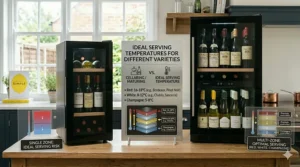
🌡️ Sparkling wines (Champagne, Prosecco, Cava): 6–8°C. The lowest zone of a dual-zone fridge, or the bottom shelf of a single-zone set to 8°C.
🌡️ White and rosé wines (everyday drinking): 8–12°C. Crisp Sauvignon Blanc, Pinot Grigio, and lighter rosés sit happily towards the lower end; richer whites like aged Chardonnay or Viognier benefit from 11–12°C.
🌡️ Red wines (serving temperature): 14–18°C. Lighter reds — Beaujolais, lighter Pinot Noir — prefer 13–15°C; full-bodied reds like Cabernet Sauvignon, Shiraz, and Rioja Reserva are best at 16–18°C.
🌡️ Long-term storage (all wines): 12–14°C. If you’re buying a wine fridge specifically to age wine rather than just serve it, set the temperature to a steady 12–13°C and leave it there. The consistency matters more than the exact number.
One point that gets overlooked in most buying guides: humidity levels inside a wine fridge matter for cork preservation. Natural cork requires ambient humidity of roughly 60–70% to remain elastic and seal properly. Most quality wine fridges maintain this range passively; models with active humidity control are a premium feature found on higher-end units. For the vast majority of UK buyers drinking wine within 2–3 years of purchase, this is a minor consideration. For anyone laying down Bordeaux or Burgundy for a decade, it’s worth investigating.
Common Mistakes When Buying a Wine Fridge in the UK
Buying a thermoelectric unit for a warm kitchen. The most frequent regret among UK wine fridge buyers. If your kitchen faces south, has limited ventilation, or regularly exceeds 22°C in summer, a thermoelectric unit will underperform on its warmest days — which are precisely when cold wine matters most.
Ignoring ventilation requirements. Every wine fridge listing specifies ventilation type, and approximately half of all buyers ignore it until the unit arrives. Front-exhaust models can go under a counter; rear-exhaust models cannot. Check this before you order.
Underestimating how quickly collections grow. A 12-bottle fridge is perfect until the moment it isn’t. Wine accumulates. If you’re even slightly serious about collecting, size up.
Prioritising aesthetics over temperature range. Some beautifully designed wine fridges on Amazon.co.uk have temperature floors of 8°C — fine for most whites, but limiting for Champagne service. Check the minimum temperature specification before being seduced by a stainless steel door.
Placing the fridge in an unheated garage. This surprises many UK buyers: wine fridges are designed to cool below ambient temperature. Place one in a British garage in January where the ambient temperature is 4°C, and a thermoelectric unit may actually struggle to cool at all — or, worse, run continuously trying to. Most manufacturers specify a minimum ambient operating temperature of 10°C. Garages and outbuildings in colder months can fall below this.
Forgetting about bottle formats. Champagne bottles, magnum formats, and some German Riesling bottles are wider and taller than the standard Bordeaux bottle. If your collection includes these regularly, check the shelf dimensions and internal height before purchasing.
FAQ — Wine Fridge Buying Guide UK
❓ What temperature should I set my wine fridge to in the UK?
❓ Are thermoelectric or compressor wine fridges better for UK homes?
❓ Can I use a wine fridge in an unheated garage or outbuilding in the UK?
❓ What is UV protection glass on a wine fridge, and do I need it?
❓ Do wine fridges available on Amazon.co.uk come with UK plugs and 230V compatibility?
Conclusion — Finding Your Perfect Wine Fridge in the UK
A wine fridge is one of those purchases that, once made, produces an almost immediate “why didn’t I do this sooner” reaction. The difference between a wine opened at the right temperature and one pulled from a warm kitchen shelf or an ice bucket compromise is not subtle — it is the difference between the wine as the winemaker intended it and the wine as a vague approximation of itself.
This wine fridge buying guide has covered the full range of what’s genuinely available on Amazon.co.uk right now — from the whisper-quiet Barcool VINO12 for compact spaces, through the versatile mid-range of the Hisense RW17W4NWG0, to the collection-focused precision of the Haier Wine Bank 50 HWS49GA55 and the kitchen-integrated elegance of the Cookology CWC608SS. Every product on this list is available with UK plug, 230V compatibility, and Amazon Prime delivery to mainland UK addresses.
If you’re still unsure after reading this guide: buy a compressor, buy slightly bigger than you think you need, check the ventilation requirements before it arrives, and remember that the goal is simply to enjoy your wine more. It’s not complicated. It’s just wine. Very cold, very well-stored, very excellent wine.
✨ Don’t Miss These Exclusive Deals!
🔍 Ready to upgrade your wine storage? Click any of the highlighted product names in this guide to check current pricing and availability on Amazon.co.uk. All products are Prime-eligible with fast UK delivery — your first perfectly chilled bottle is closer than you think.
Recommended for You
- Wine Fridge Electricity Cost UK: 7 Cheapest Models to Run in 2026
- Wine Fridge vs Normal Fridge: 7 Best UK Picks (2026)
- Best Wine Fridge UK 2026: 7 Top Picks for Every Budget
Disclaimer: This article contains affiliate links. As an Amazon Associate, I earn from qualifying purchases. If you purchase products through these links, we may earn a small commission at no additional cost to you.
✨ Found this helpful? Share it with your mates! 💬🤗
