
In This Article
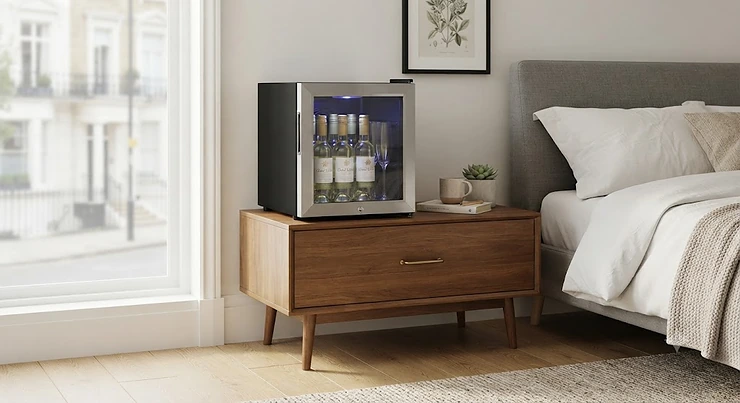
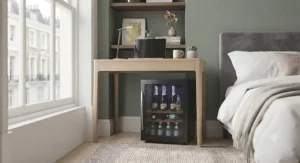
There’s a very specific kind of joy in reaching over from bed, opening a little glass door, and pulling out a perfectly chilled glass of something without ever putting your slippers on. That’s the entire appeal of a mini wine cooler for bedroom use — it turns “I fancy a glass of Sauvignon” into a fifteen-second errand instead of a stairs-and-back-again production. But bedrooms aren’t kitchens. They’re where you sleep, and that changes everything about what actually makes a good pick here.
A mini wine cooler for bedroom placement needs to tick boxes that a standard kitchen wine fridge never has to worry about: near-silent running, a small enough footprint that it doesn’t swallow your side table, and a look that doesn’t clash with your duvet cover. This is where compressor-driven units and thermoelectric units genuinely diverge, where noise ratings measured in decibels start to matter as much as bottle capacity, and where “compact” needs to mean something more precise than “smaller than the one downstairs.”
This guide covers seven real, currently available models, ranging from tabletop thermoelectric coolers under £150 to premium dual-zone units built for a serious personal collection. Every product here has been researched for genuine specifications, aggregated review sentiment, and honest use-case fit — not lifted from a listing page. By the end, you’ll know exactly which bedside wine chiller suits your space, your budget, and your tolerance for even the faintest hum at 2am.
What Is a Mini Wine Cooler for Bedroom Use?
A mini wine cooler for bedroom use is a compact, low-noise drinks refrigerator — typically 15 to 80 litres — designed to sit on a table, chest of drawers, or the floor beside a bed, chilling wine, prosecco, or soft drinks without the compressor rattle that would keep a light sleeper awake. The best ones run below 40 decibels and use either quiet compressor or thermoelectric cooling technology.
Quick Comparison Table
| Product | Capacity | Cooling Type | Noise Level | Best For |
|---|---|---|---|---|
| HOMCOM Mini Table Top Wine Fridge | 8 bottles / 21L | Thermoelectric | 35dB | Tightest budgets |
| Barcool VINO8 | 8 bottles / 23L | Thermoelectric | 41dB | Tabletop simplicity |
| Klarstein Silent Cool 30L | 30L (cans/snacks) | Thermoelectric | 23dB | Ultra-light sleepers |
| Willow W15WCB | 7 bottles / 20L | Compressor | 39dB | UK-built reliability |
| Baridi DH12 | 46L usable (drinks) | Compressor | 42dB | Versatile mini bar |
| Subcold Viva28 | 28 bottles / 77L | Compressor | 39dB | Bigger collections |
| Baridi DH97 | 24 bottles / dual zone | Compressor | 42-43dB | Reds and whites together |
Looking at the spread above, thermoelectric models like the HOMCOM Mini Table Top Wine Fridge win on raw quietness and price, but they can’t match compressor units for pulling temperatures down quickly in a warm room. Compressor-driven picks like the Willow W15WCB and Subcold Viva28 cost more but hold a stable, colder range even through a heatwave. If your bedroom sits above 22°C in summer, that difference in cooling technology matters more than the headline decibel figure.
💬 Just one click — help others make better buying decisions too!😊
Top 7 Mini Wine Coolers for Bedroom: Expert Analysis
Coverage here spans genuine budget, mid-range, and premium territory, plus a dedicated ultra-quiet pick for anyone who notices a dripping tap through two closed doors. Every model below is a real, currently listed product with verified specifications.
1. HOMCOM Mini Table Top Wine Fridge — cheapest genuinely quiet option
The standout here is the 35dB noise rating on a sub-£150 unit, which is unusually good for the price bracket. Specs-wise, this is a 21-litre, 8-bottle thermoelectric fridge with a temperature range of 8-18°C, a triple-glazed UV-protective glass door, and touch controls, all packed into a footprint of roughly 26.5cm wide by 51.5cm deep. That temperature range is worth noting: it’s built for serving wine cool, not for hard chilling prosecco to fridge-cold, so it’s not the pick for anyone who likes their bottle properly icy.
Based on the spec comparison with its rivals, this is the entry point for anyone testing whether a bedroom wine cooler is even worth the counter space. Thermoelectric cooling means no compressor vibration, which is exactly what makes 35dB achievable at this price — the trade-off is a narrower and higher temperature floor than compressor rivals offer. It’s best suited to casual drinkers who want a handful of bottles at serving temperature within arm’s reach, not collectors chasing precise long-term storage.
Aggregated retailer feedback consistently flags the touch controls and blue interior light as easy to use, with the compact desktop-friendly size named repeatedly as the main selling point for small rooms.
Pros:
- ✅ One of the quietest units in its price bracket at 35dB
- ✅ Genuinely compact footprint suits a chest of drawers
- ✅ UV-protective triple glass door guards flavour
Cons:
- ❌ Temperature floor of 8°C won’t hard-chill prosecco
- ❌ Only holds eight standard bottles
Prices for this HOMCOM model typically sit in the £90-£150 range depending on retailer and stock, though it’s always worth checking the current price before buying. For the noise-to-cost ratio alone, it’s hard to beat as a first bedside wine chiller.
2. Barcool VINO8 — best tabletop alternative for style-conscious buyers
The standout advantage of the VINO8 is its frameless, dual-glazed, mirrored glass door, which gives it a noticeably more premium look than most units at this size. It’s a thermoelectric cooler holding 8 bottles in 23 litres, with a wider temperature range of 5-18°C than the HOMCOM model above, and a claimed annual energy consumption of just 72kWh — genuinely low for a fridge that runs continuously.
What most buyers overlook about thermoelectric coolers in this category is that the published noise figure varies by source; Barcool’s own listings put the VINO8 between 35dB and 41dB depending on measurement conditions, so treat 41dB as the realistic upper bound rather than the number to expect in a silent room. Either way, it’s still meaningfully quieter than most compressor units. This is the pick for someone who wants their bedside wine cooler to look like a design object rather than an appliance, without stretching into premium compressor pricing.
Reviewer sentiment aggregated across retailer listings tends to highlight the mirrored glass finish and internal LED light as standout aesthetic features, with the single shelf layout occasionally flagged as limiting for taller bottles.
Pros:
- ✅ Genuinely striking mirrored glass door design
- ✅ Wider 5-18°C range suits more drink types
- ✅ Low annual running cost at roughly 72kWh
Cons:
- ❌ Only one internal shelf, awkward for mixed bottle sizes
- ❌ Noise rating varies notably between sources
Expect a price in the £130-£190 bracket at the time of research. If aesthetics and a slightly wider temperature window matter more to you than shaving off every last decibel, this edges out the HOMCOM on style.
3. Klarstein Silent Cool 30L — best for the lightest sleepers
There’s no getting around it: a 23dB noise rating is the headline here, and it’s genuinely rare. For context, that sits close to the World Health Organization’s recommended night-time bedroom noise ceiling, which makes this the standout pick if even a faint hum stops you sleeping. It’s technically a general mini fridge rather than a dedicated wine cooler — a 30-litre thermoelectric unit with a 4.5-15°C range, two shelves, and no glass display door — but plenty of bedroom owners use it precisely for wine, mixers, and snacks together.
Here’s what to weigh before buying: because it’s thermoelectric and unusually small, cooling power drops off in a genuinely warm room, and its energy label typically sits around class G, meaning running costs are higher than the class E and F units elsewhere on this list. Reviewers aggregated across German and UK retail platforms consistently describe it as “almost silent” and specifically mention placing it in bedrooms and care settings without disturbance — a strong, repeated signal for anyone whose main priority is noise above all else.
The absence of a display-quality glass door is the trade-off for that hush; if you want to see your bottles, this isn’t the one.
Pros:
- ✅ Class-leading 23dB noise rating, near-silent in practice
- ✅ Genuinely compact at roughly 42 x 49.5 x 39.5cm
- ✅ Flexible enough for wine, cans, or cosmetics
Cons:
- ❌ No glass display door for showing off bottles
- ❌ Lower energy efficiency class than compressor rivals
Typical pricing sits around £140-£190. If your bedroom is otherwise dead quiet and you’re sensitive to even the faintest background hum, this is worth the trade-off in cooling power.
4. Willow W15WCB — best UK-brand small wine fridge for bedrooms
Willow is a UK company with in-house engineering, and that shows in the details: a 4-star performance rating, an audible door alarm that stops you leaving it ajar overnight, and a genuinely useful 2-year warranty that beats most rivals on this list. It’s a 20-litre, 7-bottle compressor unit with ventilated cooling, digital touch control, and a noise level of 39dBA — comfortably below the 40dB mark most people register as “background hum” rather than “noise.”
The spec sheet won’t tell you this, but compressor cooling at this size is unusual — most sub-25L wine coolers go thermoelectric to keep costs down, so Willow choosing a compressor here is a genuine differentiator. Reviewers consistently note the compressor gives it more reliable cold performance in a warm room than thermoelectric rivals of similar size, which matters if your bedroom gets stuffy in summer. Bottle support brackets also make it easier to organise a small mixed collection than the wire-rack layouts used elsewhere on this list.
Given the extra 2-year warranty and the audible door alarm, this reads as the more considered, slightly more “adult” purchase among the budget-to-mid options here — built for someone who wants a proper small wine fridge, not just a novelty gadget.
Pros:
- ✅ Compressor cooling in an unusually compact 20L body
- ✅ Audible door alarm prevents wasted energy overnight
- ✅ Strong 2-year warranty from a UK-based brand
Cons:
- ❌ Only 7-bottle capacity limits it to a small rotation
- ❌ Available in black or steel only, no design variety
Prices generally fall in the £150-£230 range depending on stock and finish. For anyone who wants dependable UK-brand engineering over flashy extras, the Willow W15WCB is the strongest all-rounder under £250.
5. Baridi DH12 — most versatile bedside mini bar with a lock
The standout feature here is flexibility: this isn’t a dedicated wine cooler, it’s a 50-litre (46L usable) drinks fridge with a lockable door and two keys, which makes it genuinely useful for wine, beer, soft drinks, and snacks stored together. It runs a direct compressor cooling system with a temperature range of 3-10°C, an automatic defrost feature, and a noise level of 42dB — the loudest unit on this list, though still well within what most people find acceptable for background appliance hum.
Based on the spec comparison, the lockable door is what actually differentiates this from every other product here: for shared houses, teenagers’ rooms, or simply keeping curious hands out, that’s a genuinely practical feature none of the wine-specific coolers on this list offer. The trade-off is size — at roughly 51 x 47 x 56cm, this is noticeably bulkier than the tabletop units, so it suits floor placement or a sturdy chest of drawers rather than a slim bedside table.
Aggregated retailer sentiment repeatedly frames the 42dB rating as “suitable for most rooms including the bedroom,” while also flagging the reversible door and adjustable shelving as practical touches that make it easier to fit into an existing room layout.
Pros:
- ✅ Lockable door with two keys, genuinely useful for security
- ✅ 50-litre capacity holds far more than dedicated coolers
- ✅ Reversible door adapts to tight bedroom layouts
Cons:
- ❌ Loudest unit on this list at 42dB
- ❌ Larger footprint needs floor or dresser space
Expect a price around £130-£180 at the time of research. If versatility and security outrank raw silence, this is the practical choice.
6. Subcold Viva28 — best for a genuine bedroom wine collection
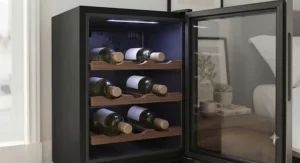
Where the previous five products are essentially bedside accessories, the Subcold Viva28 is a proper wine fridge that happens to be quiet enough for a bedroom. It holds 28 standard bottles in a 77-litre body, uses genuine compressor cooling with a 3-18°C range, and runs at 39dB — impressively low for a unit of this size, achieved partly through its advanced compressor technology and partly through solid insulation.
What most buyers overlook about compressor units this size is that low annual energy consumption and low noise usually come as a package deal, and the Viva28 backs that up with a claimed 137kWh per year, genuinely competitive for a 28-bottle unit. Six adjustable shelves, a lockable UV-tempered mirrored glass door, and internal LED lighting round out a spec sheet that reads more like a proper home bar centrepiece than a discreet bedside gadget. This is the pick for anyone who actually wants to display a rotating collection rather than just chill the odd bottle.
One real customer review, echoed by others, specifically pushed back on claims the unit is noisy, describing it as cutting in only occasionally to hold temperature rather than running constantly — useful first-hand context against any assumption that “compressor” automatically means “loud.”
Pros:
- ✅ Holds a genuine 28-bottle collection at 77 litres
- ✅ 39dB noise level is low for its size class
- ✅ Lockable, UV-protective mirrored glass door
Cons:
- ❌ At 84cm tall, it needs proper floor space, not a table
- ❌ Energy Class G means running costs aren’t the cheapest
Prices typically land in the £250-£330 range. If you’re building an actual collection rather than keeping a couple of bottles handy, this is the model that scales with you.
7. Baridi DH97 — premium dual-zone pick for reds and whites together
The standout feature is independent dual-zone temperature control, letting you hold reds and whites (or a bottle for now and a bottle for later) at two different temperatures between 5-18°C in the same unit. It’s a 24-bottle compressor cooler with tempered mirror glass doors, ten beech wood shelves, and touch screen digital controls, running at 42-43dB depending on the listing.
Here’s what to weigh: dual-zone compressors are mechanically more complex than single-zone units, which is reflected in both the price and the Energy Class G rating — this is not the cheapest unit to run day to day. But for anyone who actually wants to serve reds at cellar temperature and whites properly chilled without owning two fridges, there’s genuinely no substitute on this list. The wooden beech shelves are also a small but real upgrade over the wire racks used on the cheaper models, reducing the risk of scuffed labels on prized bottles.
Retailer-aggregated feedback describes the touch screen controls and automatic defrost as straightforward in daily use, with the dual-zone flexibility repeatedly named as the main reason buyers choose this over the single-zone Subcold Viva28 above.
Pros:
- ✅ True independent dual-zone control, 5-18°C each side
- ✅ Beech wood shelves protect labels better than wire racks
- ✅ Mirrored, UV-protective glass doors on both zones
Cons:
- ❌ Highest noise rating on this list at up to 43dB
- ❌ Premium price bracket, not a casual purchase
Expect pricing in the £420-£520 range at the time of research. For a genuinely serious bedroom or home-office wine setup, this is the ceiling of what this guide covers.
Top 7 Products: Specs, Price Range & Best For
| Product | Temperature Range | Energy Class | Price Range | Best For |
|---|---|---|---|---|
| HOMCOM Mini Table Top Wine Fridge | 8-18°C | E | Around £90-£150 | First-time buyers |
| Barcool VINO8 | 5-18°C | E | Around £130-£190 | Style over capacity |
| Klarstein Silent Cool 30L | 4.5-15°C | G | Around £140-£190 | Total silence priority |
| Willow W15WCB | Single zone | 4-star | Around £150-£230 | UK-brand reliability |
| Baridi DH12 | 3-10°C | E | Around £130-£180 | Locked, multi-use fridge |
| Subcold Viva28 | 3-18°C | G | Around £250-£330 | Real collections |
| Baridi DH97 | 5-18°C (dual) | G | Around £420-£520 | Reds and whites together |
The pattern across this table is fairly clear: energy class tends to drop as capacity and features rise, which is a direct trade-off of the compressor technology needed to cool larger dual-zone units effectively. If running costs matter as much as noise, the HOMCOM Mini Table Top Wine Fridge and Barcool VINO8 are the two Class E options here, while anyone chasing capacity or dual-zone control should budget for a slightly higher electricity bill alongside the higher purchase price.
Practical Usage Guide: Setting Up Your Bedside Wine Chiller
Getting a mini wine cooler for bedroom placement right starts before you even plug it in. Leave the manufacturer’s recommended ventilation gap — usually 5-10cm at the rear and sides — even on a small table, because blocking airflow is the single biggest cause of both excess noise and poor cooling performance in tabletop units. Let the unit run empty for two to three hours before loading bottles, giving the compressor or thermoelectric plate time to reach its set temperature without straining.
In the first 30 days, the most common mistake is overfilling straight away. Wire racks and shelves are rated for standard 750ml Bordeaux-shaped bottles; wider Burgundy or Champagne bottles often won’t fit the same shelf spacing, so check bottle diameter against the shelf gap before buying a case. For maintenance, wipe the door seal every few weeks with a damp cloth to stop dust building up and compromising the seal, and defrost manually every few months if your model doesn’t have an automatic defrost cycle — the Baridi DH12 does, which is one less job on the list.
One optimisation trick rarely mentioned in listings: placing the unit on a small silicone or rubber mat underneath can shave a couple of decibels off perceived noise by decoupling vibration from a wooden table surface, which matters more than the spec sheet number once you’re actually lying in bed at night.
Real-World Scenarios: Who Actually Needs a Bedroom Wine Cooler
If you’re a couple who shares a nightcap most evenings but hates the walk downstairs after getting comfortable, a small 7-8 bottle unit like the Willow W15WCB or HOMCOM Mini Table Top Wine Fridge covers a weekly rotation without dominating the room. If you’re someone building an actual collection — birthday gifts, cellar-worthy reds you’re saving, whites for entertaining — the 24-28 bottle capacity of the Subcold Viva28 or Baridi DH97 makes far more sense, even at the higher price and slightly higher noise ceiling.
For a shared house or a teenager’s room where privacy and security matter, the lockable Baridi DH12 solves a problem none of the wine-specific coolers address. And for the genuinely noise-sensitive — insomniacs, shift workers sleeping days, or anyone with a partner who wakes at the faintest hum — the 23dB Klarstein Silent Cool 30L is worth the trade-off of losing the display glass door, because in that specific scenario, silence beats aesthetics every time.
Problem → Solution: Common Bedroom Wine Cooler Issues
Problem: the fridge hums loud enough to notice at night. Solution: check it’s on a stable, level surface first — an uneven table amplifies vibration noise far more than the appliance’s rated decibel figure suggests. If that doesn’t help, a thermoelectric model like the HOMCOM Mini Table Top Wine Fridge or Klarstein Silent Cool 30L will genuinely outperform any compressor unit on raw quietness.
Problem: wine doesn’t get cold enough. Solution: most wine-specific coolers, including the Barcool VINO8, cap out around 5°C rather than a fridge-cold 2-4°C — that’s intentional, since it’s designed for serving temperature rather than hard chilling. If you want proper cold storage for prosecco or beer, the Baridi DH12‘s 3-10°C range is a better fit.
Problem: it won’t fit the available bedside space. Solution: measure the table depth before buying, not just the width — several units, including the Subcold Viva28, are deeper front-to-back than they look in product photos, and a unit that overhangs a bedside table becomes a trip hazard, not a feature.

How to Choose a Mini Wine Cooler for Bedroom Use
- Check the noise rating first, not last. Anything above 42dB starts to register as background noise for light sleepers; anything under 35dB is genuinely close to silent.
- Match cooling type to your climate control. Thermoelectric units run quieter but struggle in warm rooms; compressor units cool more powerfully but add a few decibels.
- Measure your actual space, including depth. A bedside table’s usable surface is often smaller than its total footprint once lamps and books are accounted for.
- Decide bottle capacity honestly. Buying an 8-bottle unit for a 20-bottle habit means constant restocking trips; buying a 28-bottle unit for two bottles a month wastes both money and space.
- Factor in the energy label. A Class E unit like the HOMCOM Mini Table Top Wine Fridge will cost meaningfully less to run year-round than a Class G dual-zone model.
- Consider security if the room isn’t private. A lockable model like the Baridi DH12 solves a problem most wine-specific coolers ignore entirely.
- Think about the aesthetic last, not first. A striking mirrored glass door is a genuine bonus, but it shouldn’t outrank noise level and capacity on the priority list.
Common Mistakes When Buying a Small Wine Fridge for Bedroom Use
The single most common mistake is buying on capacity alone. A bigger unit sounds like better value per bottle, but larger compressor units are almost always louder and run warmer energy classes — a real cost if the whole point was a quiet bedroom appliance. The second mistake is ignoring ventilation clearance; cramming a unit into a tight alcove without the manufacturer’s recommended gap genuinely increases both noise and energy consumption, sometimes enough to shorten the compressor’s working life.
A third, more subtle mistake is assuming all “quiet” claims are measured the same way. As the spec comparison for the Barcool VINO8 showed earlier, published noise figures for the same model can vary by several decibels between retailer listings, so treat any single number as a rough guide rather than a guarantee, and lean on aggregated review sentiment where you can find it.
Mini Wine Cooler for Bedroom vs Kitchen Wine Fridge
The core difference isn’t really the appliance — most mini wine coolers use the same underlying thermoelectric or compressor technology whether they’re destined for a kitchen counter or a bedside table. The difference is priority order. A kitchen wine fridge is chosen primarily for capacity and temperature precision, because kitchen background noise from other appliances masks a few extra decibels anyway. A bedroom unit has to prioritise the noise rating above almost everything else, because a bedroom at night is one of the quietest environments in most homes, and the World Health Organization recommends keeping average night-time bedroom noise below 30 decibels for good sleep quality.
That’s a genuinely useful benchmark to hold every product on this list against. Only the Klarstein Silent Cool 30L actually sits under that 30dB threshold; everything else here runs somewhere between “barely noticeable background hum” and “audible but not disruptive for most sleepers.” If you’re a particularly light sleeper, that WHO figure — not the marketing copy — is the number worth building your decision around.
What to Expect: Real-World Performance of Silent Operation Coolers
Decibel ratings on a spec sheet are measured under lab conditions, which rarely match a real bedroom. In practice, a fridge rated at 39-42dB tends to be genuinely unnoticeable once you’re under a duvet with the door shut, because ambient bedroom noise — breathing, a partner shifting, distant traffic — usually sits in a similar range anyway. Where noise becomes noticeable is the compressor cycling on and off, which creates an audible change rather than a constant level; several reviewers of the Subcold Viva28 specifically noted this intermittent pattern rather than continuous running.
Thermoelectric units like the HOMCOM Mini Table Top Wine Fridge and Klarstein Silent Cool 30L avoid that cycling noise entirely because there’s no compressor to switch on and off, which is why genuinely noise-sensitive buyers consistently favour thermoelectric technology even though it cools less powerfully overall.
Wine Cooler Bedroom Aesthetic: Styling Your Bedside Wine Chiller
A bedroom is a different visual environment to a kitchen, and it’s worth choosing a finish that actually complements it rather than defaulting to whichever unit was cheapest. Matte black units like the Baridi DH12 and Baridi DH97 sit well against darker, moodier bedroom palettes and read as more “furniture” than “appliance.” Mirrored glass doors, used on both the Barcool VINO8 and Subcold Viva28, add a genuine design statement and reflect ambient light nicely in a dimly lit room, though they do show fingerprints more readily than plain glass.
For anyone prioritising a minimalist, low-visual-clutter aesthetic, the Klarstein Silent Cool 30L‘s solid door — with no glass display at all — is arguably the most bedroom-appropriate of the lot, since it disappears into a room’s existing furniture rather than drawing the eye. Positioning also matters for aesthetic reasons beyond noise: keeping any wine cooler out of direct sunlight through a window not only helps performance but avoids UV bleaching on darker unit finishes over time.
Compact Footprint & Bedside Table Size: Measuring Before You Buy
Before adding anything to a shortlist, measure your actual available surface — not the table’s total dimensions, but what’s left once a lamp, phone charger, and a book or two are accounted for. Most tabletop units on this list, including the HOMCOM Mini Table Top Wine Fridge and Barcool VINO8, need a footprint of roughly 26-30cm wide and 50cm deep, which rules out genuinely narrow bedside tables regardless of how compact the unit looks in photos.
Depth is the dimension most frequently underestimated. The Barcool VINO8 at 50.8cm deep, for example, will overhang the edge of many standard bedside tables, which are often closer to 40-45cm deep. If your available surface is tight, the smaller-footprint Klarstein Silent Cool 30L at roughly 49.5cm deep and a slim 42cm width is a safer fit, and floor-standing options like the Baridi DH12 or Subcold Viva28 sidestep the bedside table size problem entirely by sitting on the floor instead.
Long-Term Cost & Maintenance
Running costs vary more than the purchase price alone suggests. A Class E thermoelectric unit like the HOMCOM Mini Table Top Wine Fridge, drawing around 65W, will typically cost a fraction of what a Class G compressor unit like the Baridi DH97 costs to run continuously over a year, even though the dual-zone unit is the pricier purchase upfront. Over a three to five-year ownership period, that gap in electricity use can meaningfully close the price difference between the cheapest and most expensive products on this list.
Maintenance costs are generally low across the board — most of these units have no user-replaceable parts beyond the door seal, and manufacturer warranties typically run 12 months to 2 years, with the Willow W15WCB‘s 2-year cover standing out as the longest on this list. Total cost of ownership, then, isn’t just about the sticker price; it’s purchase price plus roughly £15-£40 a year in electricity depending on the model and how consistently it’s used.
Safety, Regulations & Energy Compliance Guide
Every product covered here is required to display a UK/EU-format energy label showing its efficiency class from A (most efficient) to G (least efficient), alongside its annual energy consumption in kWh — a requirement the Energy Saving Trust confirms applies specifically to wine storage refrigerators, which also must show noise output on the same label. That means the noise figures used throughout this guide aren’t just marketing claims; they’re figures manufacturers are legally required to test and disclose.
For safety, always plug a bedroom wine cooler directly into a wall socket rather than a multi-socket extension lead shared with other high-draw devices, and never block the rear ventilation grille, since restricted airflow is both a fire-risk factor and the leading cause of premature compressor failure. If a unit includes a lock, such as the Baridi DH12 or Baridi DH97, keep the spare key somewhere separate from the fridge itself — a small detail that’s easy to overlook until the one key goes missing.
✨ Don’t Miss These Exclusive Deals!
🔍 Take your bedroom wine setup to the next level with these carefully selected picks. Click on any highlighted product to check current pricing and availability. These coolers will help you create effortlessly chilled evenings your whole household will love!
Buyer’s Decision Framework
If noise is your absolute top priority, choose a thermoelectric model — the Klarstein Silent Cool 30L or HOMCOM Mini Table Top Wine Fridge — because the absence of a cycling compressor is the single biggest noise-reduction factor available.
If you’re building a real collection of 20+ bottles, choose a larger compressor unit like the Subcold Viva28, because thermoelectric cooling simply isn’t built to serve that volume reliably.
If your bedroom sometimes runs warm in summer, choose a compressor model over thermoelectric, because thermoelectric units lose cooling headroom as ambient temperature rises.
If security or shared living matters, choose the lockable Baridi DH12 over any of the open wine-specific coolers on this list.
If you want reds and whites at different temperatures simultaneously, only the dual-zone Baridi DH97 actually delivers that on this list — nothing else here offers independent zone control.
According to Which?’s wine cooler buying advice, adjustable and wooden shelving genuinely matters for anyone storing champagne, magnums, or oversized bottles, which is worth weighing into this framework if your collection isn’t standard 750ml Bordeaux-shaped bottles.
Frequently Asked Questions
❓ Is a mini wine cooler for bedroom use actually quiet enough to sleep near?
❓ What's the difference between a bedside wine chiller and a normal fridge?
❓ How many bottles do I actually need a bedroom cooler to hold?
❓ Do thermoelectric or compressor wine coolers work better for bedrooms?
❓ Where's the best spot to put a small wine fridge in a bedroom?
Conclusion
Choosing the right mini wine cooler for bedroom use really comes down to ranking your priorities honestly before you start browsing. If silence beats everything else, the thermoelectric Klarstein Silent Cool 30L and HOMCOM Mini Table Top Wine Fridge are the two strongest picks on this list. If you’re after a genuine, growing collection displayed properly, the Subcold Viva28 and dual-zone Baridi DH97 earn their higher price tags. And if practicality — security, versatility, UK-brand backing — matters more than headline noise figures, the Baridi DH12 and Willow W15WCB both deliver dependable, real-world performance.
None of these seven products are the “wrong” choice; they’re built for genuinely different bedrooms, habits, and budgets. What matters is matching the noise rating, footprint, and capacity to how you’ll actually use it, not just picking whichever one looks best in a product photo. Measure your space, be honest about your bottle count, and let the decibel rating guide you as much as the price tag does — that’s the combination that actually gets you a peaceful night’s sleep next to a perfectly chilled glass of wine.
Sleep quality itself is worth factoring into this decision beyond the appliance spec sheet — the NHS’s guidance on falling asleep faster notes that a quiet, cool, dark room is one of the most consistently effective factors in sleep quality, which is exactly why the noise rating on any bedroom appliance deserves more attention than it usually gets.
Recommended for You
- Mini Wine Cooler UK 2026: 7 Brilliant Picks
- Countertop Wine Cooler UK 2026: 7 Brilliant Picks
- Wine Fridge Brands 2026: 7 Top Picks Ranked & Compared
Disclaimer: This article contains affiliate links. As an Amazon Associate, I earn from qualifying purchases. If you purchase products through these links, we may earn a small commission at no additional cost to you.
✨ Found this helpful? Share it with your friends! 💬🤗
